

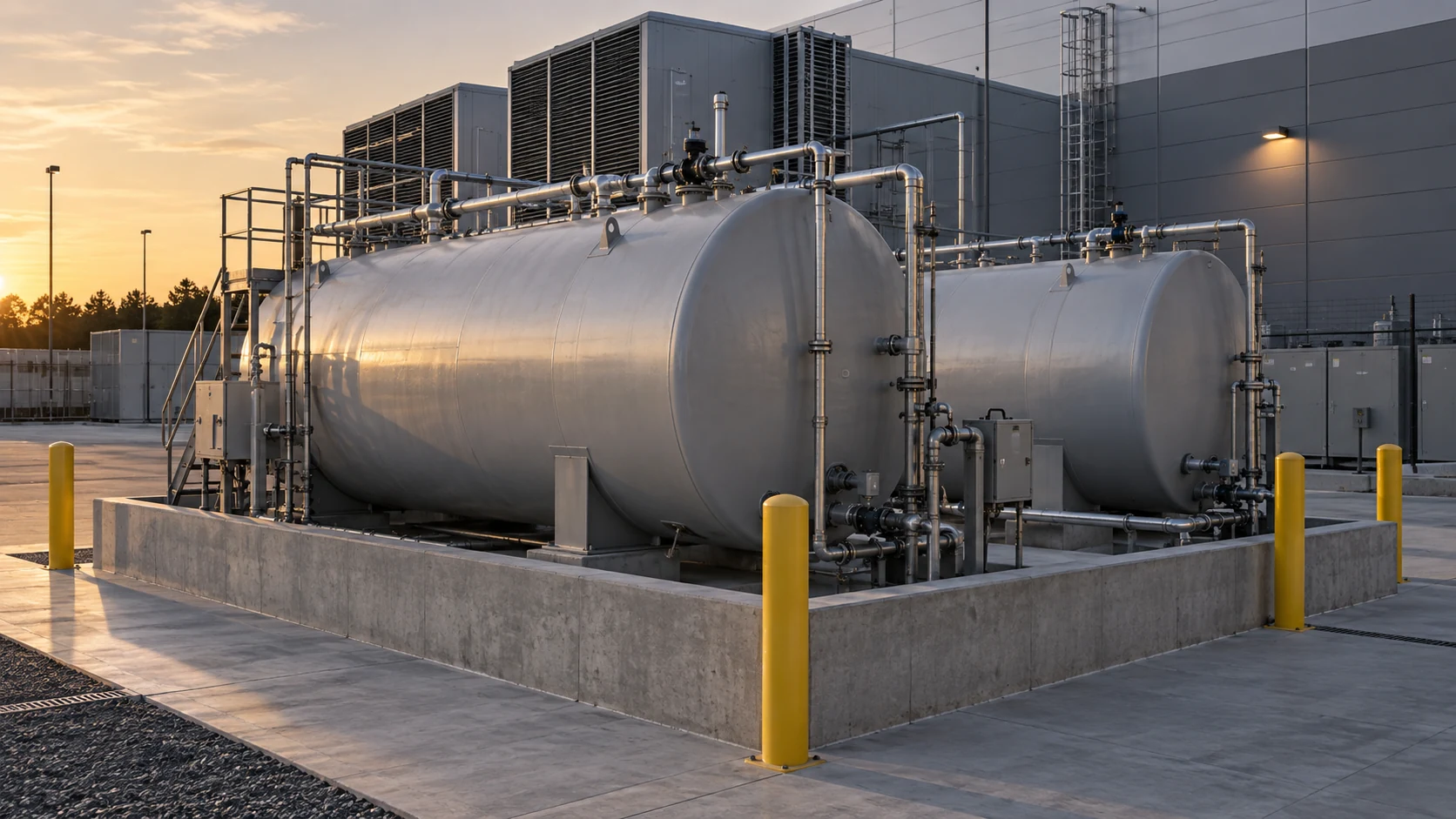
Start a data center's fuel and chemical compliance review with an equipment walkdown. Reconcile the generator tanks, transformer oil, battery rooms, maintenance supplies, and cooling chemicals against the drawings and purchasing records. Then make two separate calculations: oil storage capacity for SPCC applicability and hazardous chemical quantities for EPCRA inventory reporting. An air permit, tank installation approval, or completed annual inventory does not answer all three questions. This guide covers the federal baseline as of September 15, 2026, with state and local requirements checked separately.
Before you start
- Calculate SPCC using applicable oil storage capacity, including qualifying oil-filled equipment.
- Calculate EPCRA thresholds from hazardous chemicals present, using the relevant SDS and mixture rules.
- Aggregate sulfuric acid in lead-acid batteries when evaluating its reporting threshold.
- Give fuel deliveries, battery replacements, and chemical changes a compliance review owner.
Use the right inventory for each obligation
| Review | What the calculation concerns | Record to collect |
|---|---|---|
| SPCC applicability | Oil storage capacity and the potential for a harmful discharge to navigable waters or adjoining shorelines. | Container capacities, equipment oil volumes, facility boundary, drainage, and the basis for exclusions. |
| EPCRA Sections 311 and 312 | Covered hazardous chemicals present at or above reporting thresholds. | Current SDSs, chemical composition, maximum quantities, storage locations, and reporting decisions. |
| Generator air permit | The operating and recordkeeping conditions in the facility's applicable air requirements. | Engine and fuel-use records matched to the actual permit conditions. |
Keep one asset identifier across these records, while preserving each calculation's basis. A tank capacity sheet cannot establish the maximum chemical inventory during the year without operating information. A fuel invoice may support deliveries and consumption but omit the transformer yard entirely. Ask the facilities lead and environmental owner to sign off on the same physical inventory before either assessment is finalized.
Count diesel and transformer oil before deciding SPCC applicability
EPA's SPCC applicability screen asks whether a non-transportation-related facility handles oil, could reasonably be expected to discharge harmful quantities to navigable waters or adjoining shorelines, and exceeds an applicable capacity threshold. The thresholds are more than 1,320 gallons aboveground or more than 42,000 gallons in completely buried storage. Specified exclusions apply, including containers smaller than 55 gallons and qualifying buried tanks subject to all technical requirements of the federal underground-storage-tank rules or an approved state program.U.S. Environmental Protection Agency
Do not stop at the main diesel tank. EPA confirms that the 55-gallon minimum also applies to oil-filled operating and electrical equipment, including transformers. Obtain the manufacturer's oil capacity for each relevant unit. Review generator day tanks, lubricant storage, and maintenance drums as well as bulk fuel. Document whether equipment inside or beside the campus belongs within the assessed facility; a utility ownership label alone should not replace a documented boundary analysis.U.S. Environmental Protection Agency
For a simple screening example, assume two 1,000-gallon aboveground diesel tanks and two transformers containing 150 gallons each, all within the assessed facility and without a relevant exclusion. The counted capacity is 2,300 gallons. That exceeds the aboveground threshold even if the tanks are routinely half full. The discharge-potential and other applicability questions still need an answer. Save the equipment sheets and site drainage drawing with that conclusion.
Translate the SPCC assessment into operating controls
For covered facilities, the SPCC Plan must address the relevant prevention measures, inspections, personnel instruction, and discharge response. Section 112.7 also requires a management-approved plan and identifies facility diagrams and oil-handling information. Its provisions distinguish general containment requirements from special treatment available to qualifying oil-filled operational equipment. Have the plan preparer classify each asset before assigning its control requirements.Electronic Code of Federal Regulations
A covered new data center must have its SPCC Plan prepared and implemented before operations begin. EPA's six-month allowance for new oil-production facilities does not apply to an ordinary data center. Put plan completion and implementation on the commissioning schedule, with the operating team involved before fuel deliveries and startup activities are arranged.U.S. Environmental Protection Agency
EPA explains that applicable bulk storage installations need containment for the largest single container plus sufficient precipitation freeboard. Shared containment may serve multiple containers when it satisfies the requirements. This is a design calculation, not a reason to apply a single percentage to every tank, transformer, or loading area. Review the drainage route and the relevant containment provisions for each installation.U.S. Environmental Protection Agency
Test the procedure against an ordinary delivery. Identify who checks available tank space, confirms the connection, watches the transfer, and responds to a leak. Walk the route from a failed hose to the nearest drain. Record whether valves, barriers, or response equipment are accessible during nights and bad weather. These operational questions help the preparer confirm that the written plan matches the people and equipment actually available.
Evaluate Tier II reporting from chemicals and maximum quantities
Under 40 CFR 370.10, the federal reporting test generally starts with hazardous chemicals for which the OSHA Hazard Communication Standard requires an SDS. The threshold is 10,000 pounds for ordinary hazardous chemicals. For extremely hazardous substances, it is 500 pounds or the substance's threshold planning quantity, whichever is lower. The test concerns quantities present at any one time. The higher retail gasoline and diesel thresholds are narrowly conditioned exceptions for qualifying retail gas stations, not general allowances for data center generator fuel.Electronic Code of Federal Regulations
Create a row for each purchased chemical or mixture before deciding how it should be reported. Include diesel, battery electrolyte, water-treatment products, cleaning chemicals, and other materials identified by the walkdown. Use the actual product SDS to establish composition and hazards. Ask the supplier to resolve missing information. A familiar trade name or a prior site's inventory is a starting point for investigation, not a substitute for the current product record.U.S. Environmental Protection Agency
Reconstruct peak inventory using delivery dates, tank readings, stock records, and temporary supplies. Annual gallons consumed can exceed the amount ever present at once. Conversely, a large delivery shortly before year end can set the maximum even when average use is low. Where a conversion to pounds is needed, retain the density source and units. Record the assumptions so another reviewer can reproduce the result.
Calculate battery chemicals without assuming every battery follows one rule
EPA's non-consumer lead-acid battery guidance requires aggregation of sulfuric acid across batteries to evaluate the 500-pound reporting threshold. It permits reporting the batteries as mixtures identifying the sulfuric acid, or reporting the sulfuric acid itself, with consistent Section 311 and 312 reporting. EPA separately says facilities are not required to aggregate non-EHS lead across those batteries, although they may choose to do so. Do not replace those specific instructions with a blanket rule for all battery constituents.U.S. Environmental Protection Agency
For an illustrative calculation, suppose verified supplier data establishes 6 pounds of sulfuric acid per battery and 100 batteries are present within the facility. The total is 600 pounds, exceeding the sulfuric-acid threshold. Use the actual model and count in a real assessment. When a UPS replacement changes chemistry, collect the new SDS and reassess reporting. Keep that review linked to the equipment change order so the inventory does not retain obsolete lead-acid assumptions.
Build the reporting calendar around the facility's state
Section 312 inventories cover the preceding calendar year and are due by March 1. Section 311 is a separate SDS or chemical-list submission obligation with its own initial and update triggers. Assign those triggers to the person approving new chemicals, rather than discovering them only during annual reporting. EPA's inventory overview identifies the state or tribal commission, local or tribal planning committee, and local fire department as recipients.U.S. Environmental Protection Agency
The June 2026 final rule's Section 370.33 preserves three months for an initial submission, including a newly reportable chemical, and for a revised SDS after discovering significant new information about a chemical previously reported by SDS. An LEPC request for an SDS has a separate 30-day deadline. Its hazard-category changes have a January 1, 2028 compliance date, with the 2027 annual inventory due March 1, 2028. Keep the effective rule and those later compliance milestones distinct.Federal Register, U.S. Environmental Protection Agency
Check the state program's current filing instructions, fees, additional requirements, and handling of local recipients. EPA's state directory illustrates materially different submission arrangements: some states distribute a single submission, while others require additional local delivery. Capture the actual portal, facility identifier, authorized submitter, and receipts in the site's calendar. Recheck these details when acquiring a campus or replacing the employee who controls the filing account.U.S. Environmental Protection Agency
Keep an evidence pack that survives an operator change
- Asset register: tank and transformer identifiers, capacities, products, locations, and responsible operators.
- Applicability record: facility boundary, drainage assessment, exclusions, threshold calculations, and reviewer.
- Chemical register: SDS revision, constituent basis, unit conversions, maximum quantities, and reporting approach.
- Operating record: current plan, relevant inspections, delivery procedure, training, and unresolved corrective actions.
- Submission record: reporting year, recipients, filed inventory, confirmation receipts, and state-specific instructions.
This evidence pack is a recommended management practice. EPA states that Sections 311 and 312 themselves have no federal record-retention requirement, while state requirements may differ. Do not label an internal retention period a universal Tier II rule. Separate it from enforceable SPCC inspection records or other requirements, and set a company retention policy that preserves the basis for past reporting decisions.U.S. Environmental Protection Agency
Questions that come up.
Does every data center with diesel generators need an SPCC Plan?
Determine the counted oil capacity, facility characteristics, discharge potential, and exclusions. The presence of a generator alone does not establish applicability.U.S. Environmental Protection Agency
Should transformer oil be included in the SPCC calculation?
Relevant oil-filled equipment with capacity of 55 gallons or more is included when assessing facility oil capacity. Confirm the equipment capacity and assessed facility boundary.U.S. Environmental Protection Agency
Can an annual Tier II report replace the SPCC Plan?
No. Tier II communicates hazardous chemical inventory to emergency-planning authorities. SPCC addresses oil-discharge prevention and controls for covered facilities. Maintain the different calculations and required records.Electronic Code of Federal RegulationsU.S. Environmental Protection Agency
Sources and references.
Primary sources checked for this guide on . The location, equipment, and operating plan determine which requirements apply to a project.
- U.S. Environmental Protection AgencyDoes the SPCC Rule Apply to Your Facility? ↗
- U.S. Environmental Protection AgencyOil-filled equipment capacity less than 55 gallons ↗
- Electronic Code of Federal Regulations40 CFR 112.7: General requirements for SPCC Plans ↗
- U.S. Environmental Protection AgencySPCC Compliance Dates ↗
- U.S. Environmental Protection AgencySecondary containment for each container under SPCC ↗
- Electronic Code of Federal Regulations40 CFR 370.10: Applicability and reporting thresholds ↗
- U.S. Environmental Protection AgencyEPCRA Hazardous Chemical Inventory Reporting: General Reporting Guidance ↗
- U.S. Environmental Protection AgencyHow does a facility report batteries for Tier II? ↗
- U.S. Environmental Protection AgencyHazardous Chemical Inventory Reporting ↗
- Federal Register, U.S. Environmental Protection AgencyEPCRA Hazardous Chemical Inventory Reporting Requirements: June 22, 2026 Final Rule ↗
- U.S. Environmental Protection AgencyState Tier II Reporting Requirements and Procedures ↗
- U.S. Environmental Protection AgencyFederal recordkeeping requirements under EPCRA Sections 311 and 312 ↗
Put the requirements to work
Bring the project.
Map the path to approval.
Connect the applicable requirements to the design, the evidence, and the people responsible for each decision.
Talk to an expert