

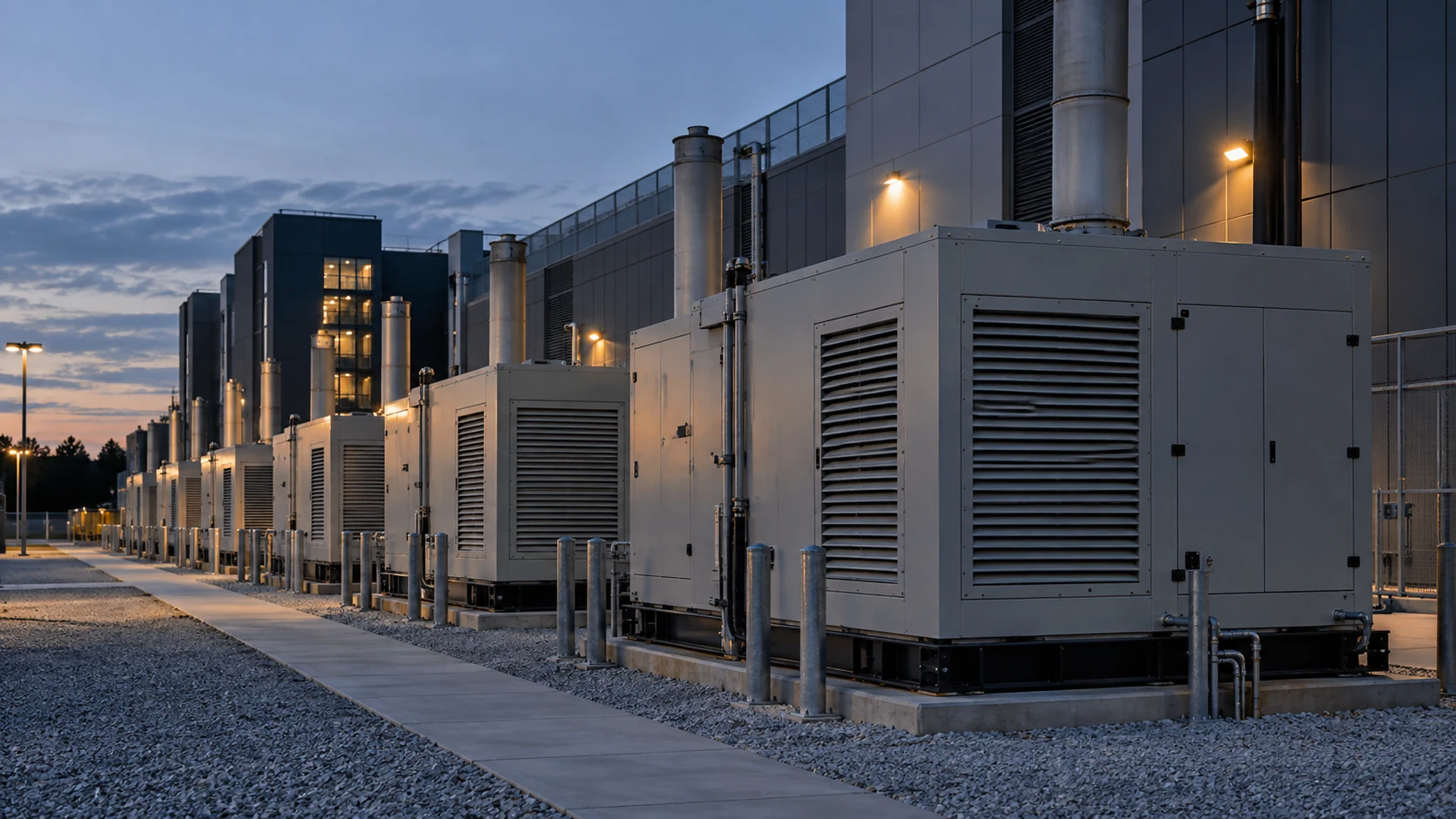
Before ordering a generator fleet, settle what the engines will do. Emergency backup, commissioning, routine testing, grid support, and temporary power before utility service are different operating scenarios. Put each on the design brief. The permitting team needs to assess the equipment against that operating plan, and the operations team needs a record it can use when somebody asks to run the fleet.
Before you start
- Evaluate the individual engines, the combined stationary source, and the intended operating modes.
- Keep federal engine standards separate from site-specific construction and operating permits.
- Do not turn a limited local-reliability provision into a blanket demand-response allowance.
- Match procurement specifications, permit calculations, and operating records to the same equipment register.
Three assessments are needed before procurement
First, identify the federal standards for each engine. EPA's framework distinguishes compression ignition, typically diesel, from spark ignition; new from existing engines; and major from area sources of hazardous air pollutants. The principal rules are NSPS Subpart IIII, NSPS Subpart JJJJ, and the RICE NESHAP in Subpart ZZZZ. Applicability depends on the engine and source facts, not the label on the building.U.S. Environmental Protection AgencyU.S. Environmental Protection AgencyU.S. Environmental Protection AgencyU.S. Environmental Protection Agency
Second, determine the site's New Source Review path. EPA identifies Prevention of Significant Deterioration, nonattainment NSR, and minor-source permitting. A facility may have obligations under more than one part of this framework. Most permits are issued by state or local air agencies, whose approved programs have their own requirements and procedures.U.S. Environmental Protection Agency
Third, assess operating-permit applicability, including Title V. EPA bases major-source status on actual or potential emissions, with pollutant-specific thresholds and lower thresholds in some nonattainment areas. A minor construction-permit conclusion does not, by itself, finish this separate assessment. Record the basis for each conclusion.U.S. Environmental Protection Agency
Build one equipment register for the entire campus
Start the inventory with every proposed engine, including the fire pump, temporary units, and later phases. Record fuel, manufacturer, model, engine family, rated output, relevant manufacture and construction dates, emission data, control equipment, location, and intended use. Separate unknown specifications from verified vendor information. Reconcile the inventory to the electrical single-line diagram and the site plan.
Then define the stationary source. Separate contracts, buildings, phases, or corporate entities are not a sufficient basis for assuming separate air-permit treatment. Virginia DEQ's data center guidance addresses adjacency and common ownership, declines to give a distance that will resolve every case, and notes that changes to boundaries or ownership can require reconsideration. Obtain the applicable source determination rather than designing around a guessed separation.Virginia Department of Environmental Quality
Evaluate potential emissions using the accepted methodology for the relevant program. Expected annual testing hours are not automatically a legal restriction on potential to emit. EPA's guidance distinguishes equipment capability from enforceable limits on how equipment may operate. If the permit strategy relies on a restriction, define the limit and the records that will make it demonstrable.U.S. Environmental Protection Agency
Stress-test the proposed limits against the actual operating plan. Include commissioning, scheduled tests, maintenance recovery, and the plausible combinations of engines running together. Ask what happens when a replacement unit arrives or a second phase opens. The objective is a permit basis the facility can live within, not simply an emissions spreadsheet that clears the first review.
Give each operating mode a separate decision
Emergency classification includes restrictions on operation. Do not treat every interruption risk, commercial dispatch request, or delay to utility service as an emergency. EPA's 2025 backup-generator interpretation describes limited local-reliability provisions with specific eligibility conditions. It does not authorize unrestricted revenue-generating operation by every emergency engine.U.S. Environmental Protection Agency
| Operating mode | Question to resolve | Record to retain |
|---|---|---|
| Actual emergency | Does the event meet the applicable rule and permit definition? Which conditions continue to apply? | Event description, supporting outage or incident record, engine IDs, start and stop times. |
| Maintenance and readiness testing | Which hour limits, test purposes, and permit conditions apply to this engine? | Test reason, authorizing maintenance instruction, duration, load, and cumulative hours. |
| Commissioning and load-bank testing | Has the proposed sequence been included in the permit basis, and how is each run classified? | Approved test plan, expected engine combinations, calculations, and the resulting operating log. |
| Local grid reliability or demand response | Does the particular program and engine satisfy a current authorized provision, and does the site permit allow it? | Program terms, applicability review, dispatch instruction, and required event records. |
| Bridge or routine site power | Does the proposed use require a non-emergency permitting and emissions basis? | A separately reviewed operating scenario before committing to this power strategy. |
Keep the table with the operating procedure. Dispatch authority should be clear, especially where a utility or third party can request operation. A site engineer should not have to reconstruct the permit interpretation during a power event. Translate the approved decision into the control room's instructions and escalation contacts.
State requirements can change the equipment you buy
Virginia now provides a concrete procurement example. Code § 10.1-1322.6 applies to data center air-permit applications submitted on or after July 1, 2026, including general-permit coverage. It requires the permitted emission limit for each generator set to be no greater than emissions achieved by a Tier 4-equivalent set. The law defines that equivalence through specified pollution-control systems or their equivalents and preserves DEQ's ability to impose stricter limits.Virginia General Assembly
For an affected Virginia application, verify that the proposed package can demonstrate the required emissions performance in its permitted configuration. Do not rely on an equipment brochure's use of a tier label. Obtain the emissions data, control description, operating assumptions, and supplier commitments needed by the air-permit team. Check the application date and the scope of any proposed modification with DEQ.
The Bay Area Air District's engine application illustrates another layer of site-specific work. It requests engine specifications, fuel consumption, pollutant emission rates, and a health-risk-assessment form for diesel engines. The application also distinguishes circumstances involving nearby schools and overburdened communities. The package required for a California location is not established by showing that the same engine was accepted elsewhere.Bay Area Air District
Preserve the design inputs behind the air analysis. If a vendor changes stack geometry, exhaust characteristics, or the control package, send the revision back to the permit team. If the civil layout changes, check whether the submitted locations and nearby receptors still match. These are design-control tasks, not items to defer until the equipment reaches the site.
An engine certificate does not close the permit file
EPA describes a certification-based compliance approach for many stationary engines that also requires installation, configuration, operation, and maintenance according to the manufacturer's instructions. Other engine categories have different demonstration requirements. Keep the certificate or applicable emissions demonstration with the actual model and configuration being procured.U.S. Environmental Protection Agency
A federal engine-compliance route and permission to construct or operate the source address different questions. NSR permits specify authorized construction, emission limits, and often operating conditions. Confirm the applicable construction restriction with the permitting authority before releasing a work package. Do not infer either that all site work must stop or that a building permit authorizes generator installation.U.S. Environmental Protection Agency
Rental equipment deserves the same attention. EPA notes that a portable nonroad engine can become stationary after remaining in one location for more than twelve months, with a separate rule for seasonal sources. Wheels or a rental agreement do not settle the classification. Review the planned placement, duration, replacements, and operating purpose before treating temporary generation as outside the air-permit plan.U.S. Environmental Protection Agency
Hand over a usable operating record
The final handover should connect each engine to its applicable requirements, allowed operating modes, limits, maintenance instructions, and reporting duties. EPA's engine compliance summaries identify different combinations of monitoring, maintenance, notifications, testing, and records by engine category. Assign the obligations from the actual rules and permit rather than using the same generic checklist for every unit.U.S. Environmental Protection Agency
- Reconcile installed serial numbers, engine families, controls, and locations against the approved equipment register.
- Make each limit readable: what is measured, which engines it covers, its averaging period, and who checks the remaining allowance.
- Record runs by purpose as well as duration, with evidence supporting emergency or local-reliability classification.
- Assign ownership of maintenance records, emissions-test results, notifications, and required reports.
- Require a documented review before changing fuel, controls, engine count, placement, or dispatch arrangements.
The fleet will eventually face a request the original design meeting did not anticipate. A good compliance record makes the answer traceable. It shows what was approved, which assumptions supported that approval, and what must be reassessed before the operating plan changes.
Questions that come up.
Are emergency data center generators exempt from air permits?
Not as a general rule. Emergency status changes some engine requirements, but federal standards and state or local air-permitting requirements must still be assessed separately. A permitting exemption under one program does not establish an exemption under every other program.U.S. Environmental Protection AgencyU.S. Environmental Protection Agency
Can backup generators earn demand-response revenue?
Only where the engine, program, operation, and permit satisfy the relevant requirements. EPA's 2025 interpretation concerns specific local-reliability provisions. Obtain a documented determination for the proposed arrangement before treating it as an allowed operating mode.U.S. Environmental Protection Agency
Does an EPA-certified engine guarantee that the site will receive an air permit?
No. Certification can support the engine's federal compliance demonstration. Site permitting still evaluates the applicable source, emissions, operating conditions, and local requirements.U.S. Environmental Protection AgencyU.S. Environmental Protection Agency
Should later generator phases be included in the initial assessment?
Show the permitting team the planned buildout and explain its timing. The appropriate application scope and source determination depend on the applicable program and project facts. Include foreseeable phases so procurement and future modifications use consistent assumptions.
Sources and references.
Primary sources checked for this guide on . The location, equipment, and operating plan determine which requirements apply to a project.
- U.S. Environmental Protection AgencyUnderstanding the Stationary Engines Rules ↗
- U.S. Environmental Protection AgencyNSPS for Stationary Compression Ignition Internal Combustion Engines ↗
- U.S. Environmental Protection AgencyNSPS for Stationary Spark Ignition Internal Combustion Engines ↗
- U.S. Environmental Protection AgencyNESHAP for Reciprocating Internal Combustion Engines ↗
- U.S. Environmental Protection AgencyLearn About New Source Review ↗
- U.S. Environmental Protection AgencyWho Has to Obtain a Title V Permit? ↗
- Virginia Department of Environmental QualityClarification 2025-02: Data Center Air Permit Guidelines ↗
- U.S. Environmental Protection AgencyPotential to Emit: A Guide for Small Businesses ↗
- U.S. Environmental Protection AgencyUse of Backup Generators to Maintain the Reliability of the Electric Grid ↗
- Virginia General AssemblyCode of Virginia § 10.1-1322.6: Data Center Generator Emission Limits ↗
- Bay Area Air DistrictApply for a Permit to Install or Operate a Stationary Engine ↗
- U.S. Environmental Protection AgencyCompliance Requirements for Stationary Engines ↗
Put the requirements to work
Bring the project.
Map the path to approval.
Connect the applicable requirements to the design, the evidence, and the people responsible for each decision.
Talk to an expert