

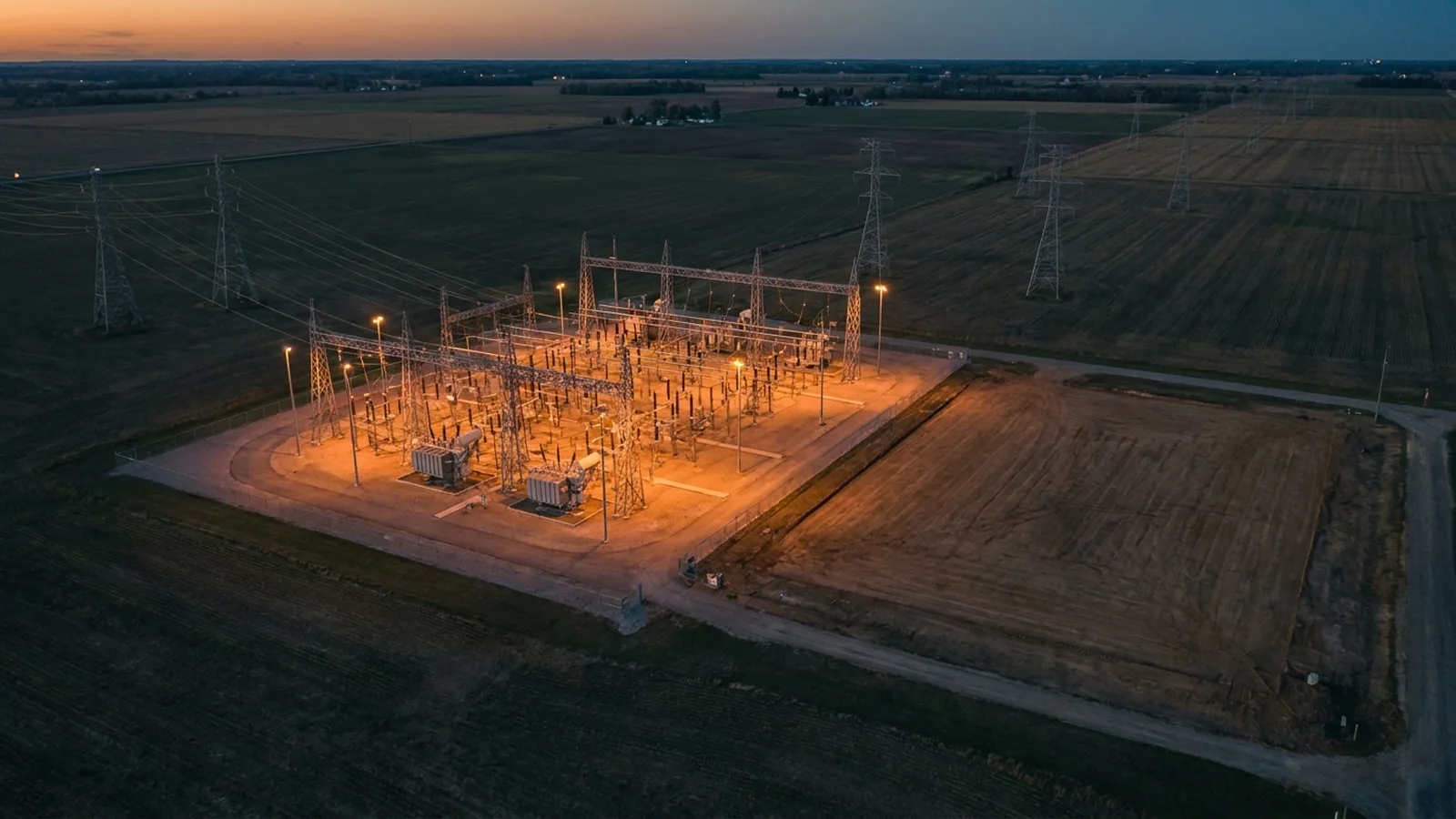
A data center site can be powered when a utility or grid operator has said so in writing for this load, at this location, by a date. Everything short of that is a lead. Most sites marketed as powered land rest on a map showing a substation nearby, which is the weakest evidence there is. This guide sorts power claims into five rungs, from a map to a metered connection, shows the documents that sit on each rung, and explains how a buyer can grade a broker's megawatt figure and push a site higher before spending money on parcels, surveys or options.
Before you start
- Distance to a substation tells you almost nothing about spare capacity. In one 2025 ERCOT study, only about 17% of substations near suitable land had any withdrawal headroom.
- Grade every power claim by the document behind it. A named MW figure is rung 2 until a current utility letter or study for this load is in hand.
- Queue and pipeline totals overstate deliverable power by a wide margin. ERCOT's large-load queue passed 470 GW in 2026, far above what it has classified for study.
- Kill disqualified sites before parcel work, then tier the rest: A documented power, B a named power path with a date, C land near capacity.
Proximity to a substation is the weakest evidence
The usual site pitch starts with a parcel and a line on a map: 200 acres, two miles from a 345 kV substation. That tells you where the wires are. It says nothing about whether the station or the lines behind it can carry another few hundred megawatts without overloading something under contingency. A buyer who searches by distance to a substation is screening for the cheapest attribute to check and the least predictive one.
Paces put numbers on this for Texas in a November 2025 white paper. Its team screened every Texas parcel against common developer criteria (at least 100 acres, slope under 15 degrees, favorable zoning, within 3 miles of a 345 kV substation or 1 mile of a 345 kV line, plus fiber and gas). It then added load bus by bus in ERCOT's 2028 summer-peak planning case, with full AC N-1 contingency analysis, until the first element overloaded. Only about 230 substations had suitable land within 3 miles, and only about 17% of the substations near those sites showed positive withdrawal capacity. The rest of the land was, in the paper's word, stranded.Paces
The same paper found that five overloaded elements limited headroom for roughly 250,000 acres, about 30% of the viable land. So a single transmission constraint can disqualify dozens of parcels that look identical on a map. Land data vendors now say the same thing in their own marketing. LandGate, for one, argues that power availability has to be confirmed with current numbers before any other site factor is seriously evaluated, and that a cheap, well located parcel with no grid capacity nearby is not a viable site.PacesLandGate
The practical conclusion is to search from power evidence first and only then look for land. Start with places where a utility, a planning record or an existing connection already shows megawatts. Parcels come second.
The five rungs of power evidence
We sort every power claim into one of five rungs, numbered 0 to 4. The rung is set by the strongest document in hand, not by what the seller says the document would show. A site can only be graded as high as its paperwork.
| Rung | What it shows | Example documents | Where to look in public |
|---|---|---|---|
| 0: map only | Nothing about power. A parcel with no identified line or station of the right voltage. | Broker flyer, aerial, listing with "power nearby" | Nothing to check yet |
| 1: proximity | A line or substation of a suitable voltage is near the parcel. No capacity figure. | Utility service territory map, transmission line map, distance study | Utility and ISO system maps, EIA-860 plant locations for nearby generation |
| 2: named MW at a named station | Someone with authority has put a MW figure on a specific station, or an existing large connection is there to reuse. | Utility economic development site sheet, preliminary power plan, ISO planning case or load forecast entry, retired plant with known nameplate, an energized industrial load being vacated | EIA-860 and 860M retired and planned generators, ISO load forecasts and planning cases, utility site programs |
| 3: study or approval for this load | The utility or grid operator has studied or approved this specific load at this site. | Load study or facilities study results, ERCOT large load classification, security posted, conditional will-serve letter tied to a load letter | ISO large load reports, PUC dockets for large load tariffs and contracts |
| 4: signed or energized | Service is contracted with a date, or the load is already metered. | Executed electric service agreement or interconnection agreement with an in-service date, meter and billing history | PUC filings of special contracts, utility earnings disclosures of executed agreements |
Two points about the middle rungs. Rung 2 includes existing connections, and these are often the best leads in a market. A retired or retiring generator had an export path sized to its nameplate, and EIA-860 lists generators by status, including retired and proposed units. EIA notes that the annual file's retired list covers only the current cycle, so use the monthly 860M inventory for a complete retirement history back to 2002. A retired plant's export path does not convert to load service automatically, but it does tell you where the transmission was built.U.S. Energy Information Administration
Rung 3 is where most real projects stall. Dominion Energy's Virginia process is a clear example of the steps. A customer files a site plan, a load letter and a load ramp through Dominion's data center portal. Dominion's team can then prepare an infrastructure evaluation and preliminary power plan, and a will-serve letter if needed. Dominion says projects over 50 MW will likely need a transmission extension and a new substation, and it often phases service with a bridging solution while the final plan is built. A preliminary power plan for your load is rung 3. A generic statement that the area has capacity is rung 2 at best.Dominion Energy
Queues and pipelines overstate available power
Headline demand numbers are useful for understanding how crowded a grid is. They are useless as evidence that any one site has power. Requests are cheap to file, and the same project often files at several utilities. The gap between requested load and studied or signed load is the clearest measure of how much of the market is speculative.
| Source | Requested or pipeline figure | Firmer figure |
|---|---|---|
| ERCOT, July 2026 Senate testimony | About 474 GW of large loads seeking interconnection, about 90% data centers | About 205 GW eligible for Batch Zero based on existing studies |
| ERCOT Board, September 2026 | Total queue as above | 66.4 GW conditionally classified as base load and 127.9 GW as studied load. 302.2 GW across 373 projects excluded |
| Oncor, Q2 2026 results | 298 GW of large load service requests | 44 GW qualified for Batch Zero |
| Duke Energy, Q1 2026 results | 15.4 GW data center pipeline including prospective load | 7.6 GW of executed agreements, nearly two thirds under construction |
| PJM, 2026 load forecast | Utility-submitted large load adjustments | Near-term years count only firm commitments; longer-term projects are derated as non-firm |
ERCOT's numbers show the pattern at scale. The grid operator told the Texas Senate in July 2026 that it was tracking about 474 GW of large loads seeking interconnection. For comparison, its own September 2026 board deck listed conditional Batch Zero classifications of 66.4 GW as base load and 127.9 GW as studied load, and it excluded 302.2 GW. Those classifications were themselves conditional on an eligibility audit, with ERCOT asking for evidence such as purchase orders for long-lead equipment, real estate agreements, land use approvals and end-user agreements.ERCOTERCOT
Utility disclosures tell the same story from the other end. Oncor reported 298 GW of service requests in its second quarter 2026 results, while 44 GW of its large load projects qualified for Batch Zero. Duke Energy separates executed agreements (7.6 GW) from a broader 15.4 GW pipeline that includes prospective load. PJM said its January 2026 forecast reflected improved vetting of requested data center adjustments and that it would derate longer-term projects without firm commitments. When a seller cites a utility's pipeline as proof that power is coming to their area, they are quoting the soft number.Utility DiveUtility DivePJM Inside Lines
Texas also shows how policy can freeze a rung. In August 2026 Governor Abbott directed the PUC and ERCOT to audit data centers in the interconnection process. ERCOT paused energization of new large-load data centers and crypto mining facilities pending that audit and a community impact review, with both reports due to the PUC by December 10, 2026. A September directive extended the pause to TCEQ permits. As of November 2026 we have not seen a public notice lifting it, so any Texas claim of a near-term energization date needs to say how it clears the audit.ERCOTDLA Piper
How to grade a broker's power claim
Take a common pitch: "450 MW available, utility confirmed." Grade it by asking for the document, then reading the document for five things. Until a current utility letter is in hand, the claim is rung 2 at most, and if the MW figure has no named station behind it, it is rung 1.
- Who wrote it. A utility, a transmission owner or an ISO counts. A broker summary of a phone call does not.
- Which station and voltage. A MW figure without a named substation or line is a guess about the area, not the site.
- Which load. A study for a 100 MW load does not cover 450 MW, and a study for someone else's project does not transfer to you without the utility saying so.
- What date. Capacity in 2031 after a new 345 kV line is different from capacity at energization. Ask for the enabling projects and their status.
- How old it is. Letters and studies age out as other loads sign. Treat anything over about a year old as needing refresh.
Then ask whether the seller has filed or paid for anything. A load letter on file, a study fee paid or security posted moves a claim toward rung 3, because it means the utility has a record of this load. In ERCOT, loads in the Batch Zero process had to bring financial security to $50,000 per MW. A seller who cannot show any of this is selling land and a hope.ERCOT
Watch for borrowed evidence. A will-serve letter issued to a previous owner for a different load, a slide from a utility investor presentation, or a county's statement that a new substation is planned are all real documents. None of them is a study of your load.
How to move a site up a rung
Going from rung 1 to rung 2 takes a phone call. Going from rung 2 to rung 3 takes a filing, a fee and usually months. Before you spend money on the second step, make sure the first step held up.
Start with the utility's economic development or large load team, not the local customer service line. Investor-owned utilities and many cooperatives have staff whose job is to answer site questions for large loads. Ask them for a short list of facts in writing:
- The serving substation and voltage they would expect to use for a load of your size at this parcel.
- Whether that station or the lines feeding it have capacity today, and if not, what upgrades would be needed and roughly when.
- Whether other large loads are already studying or signed at the same station. You are not asking for names, only whether you would be behind someone.
- The formal intake steps for a load of your size: load letter, study request, study fee, security and expected study time.
- Whether a preliminary power plan or conditional will-serve letter is available before a full study.
Going to rung 3 means filing. In Dominion's territory that is the load letter, site plan and ramp through its portal. In Texas, the PUC adopted large load interconnection standards in September 2026 that set a flat $100,000 study fee regardless of load size and dropped a proposed $50,000 per MW non-refundable fee. The final rule also gives 24 months of notice on missed energization milestones, applied to the schedule as a whole. Other utilities set their own fees and security through tariffs filed at their state commission, so read the current large load tariff in the PUC docket before budgeting.Dominion EnergyUtility Dive
Going to rung 4 means signing. An electric service agreement or interconnection agreement with an in-service date, minimum demand terms and security is the strongest evidence short of a meter. Read the conditions. A signed agreement that depends on a transmission project that has not cleared its own approvals carries that project's schedule risk.
Sites from our inventory that show the point
We grade every site we screen on this ladder and keep the result in one inventory, now more than 140 US sites. Three of them show how far apart two sites that both claim power can be.
| Region | Power evidence | Land | Where it stands |
|---|---|---|---|
| South of Dallas-Fort Worth, Texas | 150 MW listed at a planned 345 kV switch station in a utility load table filed in ERCOT regional planning. Rung 2. | About 860 acres | Kept. The station is dated 2028 and the land is listed with a broker, so the next step is a load study request. |
| Louisiana, former paper mill | 80 MW of grid service under an executed agreement, plus a 79 MW on-site turbine. Rung 4. | About 800 acres | Watch list. Documented power; the open questions are price and redevelopment scope. |
| Texas Gulf Coast, operating mine | About 100 MW in use; 600 MW described as approved only in company press releases. Rung 2 claim. | About 100 acres | Dropped. An operating site with an owner already shopping it, and the land and 138 kV service cap the scale. |
The first and third sites would both appear on a map as land near high-voltage lines. Only the documents separate them. Locations, owners and documents are shared on a call.
Kill disqualifiers first, then assign a tier
Power evidence decides where to look. A kill sheet decides which of those places to drop before anyone pays for title work or a survey. We check these at the station level, then at the parcel level:
- Already claimed: the capacity is under study, signed or operating for another load.
- Already controlled: the land is under option, under contract or listed with terms that rule out the buyer.
- Owner is an environmental-liability buyer that bought a retired plant to hold the remediation, not to sell the land.
- Coal ash, landfill or contamination on or next to the developable area.
- A county moratorium, pending zoning change or recent denial for data centers.
What survives gets a tier. Tier A is documented power: rung 3 or 4 evidence for this load at this site. Tier B is a named power path with a date: rung 2 evidence, a named station, the upgrades identified and a utility estimate of when they finish. Tier C is land near capacity: rung 1, a good parcel near the right voltage with no figure from anyone who would have to deliver it. Each tier comes with the next document that would move the site up, so a buyer knows what to ask for and who should produce it.
This is how Invariant screens sites before any introduction. We work from power records outward, run the kill sheet, and send a buyer the tier and the supporting documents together. If you have a requirement in MW, a state and an energize-by date, we can tell you what evidence exists in that market and what it would take to get a site from C to A.
Questions that come up.
How do I check if a data center site has power available?
Ask for the document behind the claim and grade it. A utility study, approval or signed service agreement for your specific load is real evidence. A map showing a nearby substation is not, because nearby stations often have no spare headroom. Paces found only about 17% of substations near suitable Texas land had positive withdrawal capacity.Paces
Is a will-serve letter proof of power for a data center?
It depends on what it says and who it was issued for. Dominion describes a will-serve letter as one output of its site evaluation, alongside a preliminary power plan, ahead of design, rights of way and construction. Read it for the load size, station, date and conditions, and confirm it was issued for your project.Dominion Energy
Why are large load interconnection queues so much bigger than what gets built?
Filing a request is cheap, so developers file early and often at several utilities. ERCOT reported about 474 GW of large loads seeking interconnection in mid-2026, while its September 2026 conditional Batch Zero classifications covered about 194 GW and excluded 302.2 GW. Signed agreements are a much smaller number again.ERCOTERCOT
What does it cost to get a large load study in Texas?
Under the large load interconnection standards the Texas PUC adopted in September 2026, the study fee is a flat $100,000 regardless of load size. Loads in ERCOT's Batch Zero process also had to post financial security of $50,000 per MW. Check the current PUC rule and your transmission provider's process before budgeting.Utility DiveERCOT
Can a retired power plant site be used for a data center?
Often it is one of the better leads, because the transmission was built for the plant's output. EIA-860 and its monthly 860M inventory list retired and planned generators with their capacity. The export path still has to be studied for load service, and the site needs a check for coal ash, contamination and who owns the remediation.U.S. Energy Information Administration
Sources and references.
Primary sources checked for this guide on . The location, equipment, and operating plan determine which requirements apply to a project.
- PacesThe grid is planning for data centers that will never exist: Aligning transmission investment with development reality ↗
- LandGateWhy power, not land, is the real bottleneck in data center site selection ↗
- U.S. Energy Information AdministrationForm EIA-860 detailed data with previous form data (EIA-860A/860B) ↗
- Dominion EnergyData Center Requests ↗
- ERCOTSenate testimony, July 29, 2026: Panel 1, Assessing the Grid ↗
- ERCOTItem 14: Batch Zero Update, Board of Directors, September 14-15, 2026 ↗
- Utility DiveFate of Oncor's nearly 300 GW load pipeline unclear following Texas data center order ↗
- Utility DiveDuke Energy earnings: data center agreements and pipeline ↗
- PJM Inside LinesPJM's updated 20-year forecast continues to see significant long-term load growth ↗
- Utility DiveTexas PUC adopts data center interconnection rules ↗
- DLA PiperGovernor Abbott expands data center permitting pause ↗