

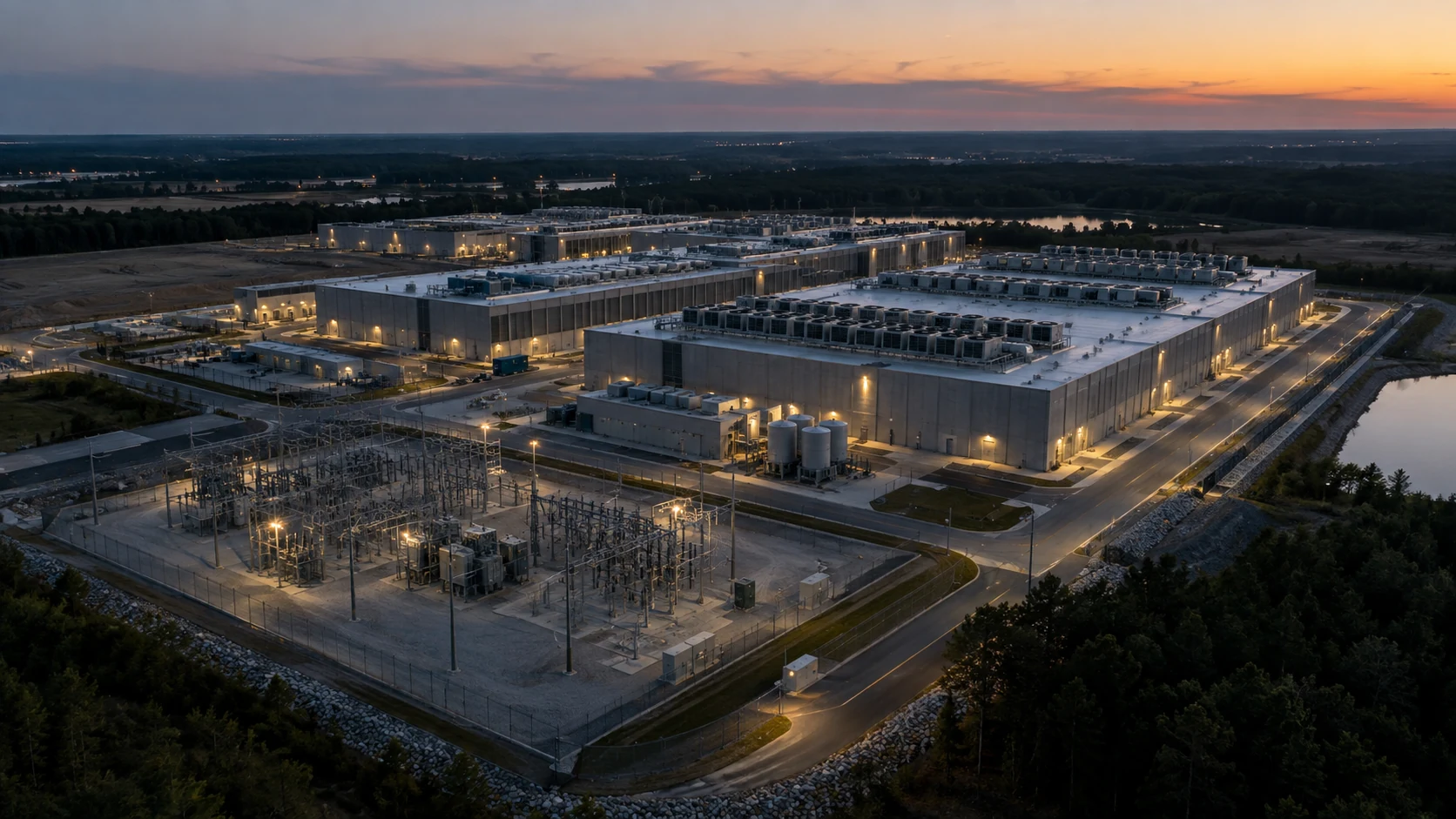
Before committing to a data center site, ask the project team to produce two drawings: the campus it wants to build and the infrastructure needed to make that campus work. Put the generator yard, substation, cooling equipment, water connections, access roads, and transmission route on them. Then ask which approvals cover each element. A parcel can look ready in a land presentation while the route to an operating facility remains unresolved.
Before you start
- Compare sites against one consistent campus design, including later phases and off-site infrastructure.
- Keep land-use permission, utility service commitments, and environmental authorizations as separate decisions.
- Attach a document, accountable owner, and unresolved condition to every claimed approval.
- Refresh the assessment when load, cooling, generation, layout, or ownership changes.
Define the project before comparing parcels
A useful comparison starts with a common design brief. State the initial and ultimate electrical demand, load ramp, building area, cooling approach, generator count, fuel storage, and commissioning strategy. Distinguish IT load from total facility load. Mark what is fixed, what is an estimate, and what could change with a tenant commitment. Otherwise, one site will appear easier simply because its assessment assumes a smaller or less demanding facility.
Give the brief a revision number and use it in every preliminary meeting. The utility, planning department, civil engineer, and air consultant should be evaluating the same project. Ask each reviewer to identify the assumptions that would require a new review. A useful answer is specific: an additional generator row, a relocated substation, a different discharge destination, or a larger second phase.
Treat the developable area as an engineering conclusion to be demonstrated. On the concept plan, reserve space for the infrastructure, access, screening, drainage, and setbacks identified during review. Record which constraints can be designed around and which would defeat the intended campus capacity.
Separate a power conversation from a power commitment
Dominion Energy's Virginia data center process illustrates the distinction. Its team can evaluate prospective sites and provide a preliminary power plan. Moving toward service involves a site plan, load letter, load ramp, infrastructure design, rights of way, permitting, and, where required, regulatory filings. Dominion also describes staged service while the final power plan is built. Those are distinct milestones, not a single confirmation that full capacity is available.Dominion Energy
For each candidate, request a written record of the proposed service voltage, initial energization capacity, ultimate capacity, enabling projects, customer obligations, and assumptions behind the date. Identify the stage of each response: preliminary feasibility, completed study, proposed agreement, executed agreement, or infrastructure under construction. Read a will-serve letter for its actual conditions rather than treating its title as a delivery guarantee.
Make the dependency visible when off-site work is involved. Who controls the substation parcel? Who obtains the necessary easements? Which approvals belong to the utility, and which belong to the developer? What happens to commissioning if staged service supports only part of the planned load? The answer should change the development schedule, procurement plan, or financing assumption.
Compare the decision gates, not a state's reputation
These examples show different questions a real site assessment must answer. They are not a ranking of jurisdictions or a substitute for parcel-specific advice. Local ordinances, previously approved plans, utility territories, and the proposed generation configuration can change the applicable path.
| Location | Verified decision gate | Evidence to obtain before commitment |
|---|---|---|
| Loudoun County, Virginia | The March 2025 zoning changes moved data centers from by-right treatment to conditional or special-exception treatment in affected areas. A separate grandfathering resolution addresses certain earlier applications. | Current zoning classification, application history, and a documented conclusion about whether a Special Exception is required. |
| Fairfax County, Virginia | For projects subject to the adopted data center standards, a noise study is required before site-plan approval and a post-construction study before the Nonresidential Use Permit. | Acoustic design assumptions, equipment layout, study scope, and responsibility for the completed facility's verification. |
| AEP Ohio service territory | The utility requires an application for new data centers and expansions. Applicable larger requests proceed through load studies and service contracts under its Data Center Tariff. | The applicable tariff, study status, proposed service plan, contract conditions, and infrastructure dependencies. |
| California | The California Energy Commission has jurisdiction over certain associated power-generation facilities. Its Small Power Plant Exemption process does not remove the need for the remaining permits. | Generation-jurisdiction analysis, environmental-review lead, and the relationship between CEC, local land-use, and air-district decisions. |
Loudoun is also reviewing a second phase of data center and substation standards. Separate the rules already adopted from changes still under consideration. Record the date of your zoning analysis and the documents supporting any reliance on an earlier approval. The county explicitly says its application-pathway guide is illustrative and that the ordinance and adopted grandfathering resolution control.Loudoun County
For an Ohio comparison, do not apply AEP Ohio's process to every parcel in the state. Confirm the serving utility first. AEP's published process distinguishes a study from an executed service agreement and describes an estimated energization date with infrastructure-related contingencies. That distinction belongs in the investment memo.AEP Ohio
Run environmental screening before the layout becomes expensive to change
Start with the proposed work, not just the parcel boundary. Access roads, utility corridors, outfalls, and temporary construction areas can create separate impacts. The Corps' Section 404 program addresses discharges of dredged or fill material into waters of the United States, including jurisdictional wetlands. Have the relevant aquatic resources investigated and the regulatory path confirmed before relying on a desktop map or assuming that work outside the main building footprint is immaterial.U.S. Army Corps of Engineers
Construction stormwater is a different authorization. EPA identifies discharges from construction disturbing one acre or more, including smaller disturbances that are part of a qualifying larger common plan. Identify the permitting authority and the applicable permit, then coordinate coverage with grading and erosion controls. A phased campus should be assessed as a development plan, not as a collection of unrelated work orders.U.S. Environmental Protection Agency
Bring the generator layout into site selection early. New Source Review includes major-source and minor-source permitting programs, generally administered by state or local air agencies. Applicability and permit conditions can affect the generation configuration and operating plan. A familiar engine model does not answer the site-specific permitting question.U.S. Environmental Protection Agency
Water infrastructure has its own approval path. For example, Loudoun Water requires approved construction drawings and its construction permit before work affecting existing or proposed water, sewer, or reclaimed-water infrastructure, including relevant grading. Its process can also require easements and flow or reclaimed-water agreements. Put these tasks on the same schedule as the civil works they enable.Loudoun Water
Turn the permit list into a sequence of decisions
A list that says zoning, air, water, building, and power is too coarse to manage. For each approval, record its issuing authority, prerequisite design inputs, required studies, public-review steps if applicable, conditions, and the activity it authorizes. Keep pending applications separate from issued permits. Ask the responsible specialist to identify the actual release point for the next package of work.
- Before land commitment: resolve the fatal constraints, define the remaining investigations, and align the contract milestones with those unresolved decisions.
- Before equipment commitment: check the proposed engines, cooling system, and substation arrangement against the design used for the applications.
- Before construction release: identify the precise work package and document which permissions allow it to proceed.
- Before commissioning: reconcile permitted operating conditions with load-bank testing, phased power delivery, water use, and the intended occupancy sequence.
Track changes through their consequences. If acoustic mitigation moves a generator enclosure, reopen the relevant layout, air, access, and civil assumptions. If the utility changes the service route, reassess the corridor rather than leaving the environmental review attached only to the original campus drawing. Assign one person to maintain the common design record.
What the investment decision should contain
A decision-ready site record should explain what can be built, what can be powered, what remains conditional, and who can resolve each condition. Include the current concept plan, utility correspondence, entitlement analysis, environmental findings, approval register, and a schedule tied to those documents. Use a short list of unresolved decisions with costs or schedule consequences where the team has evidence to estimate them.
The strongest site is not necessarily the one with the fewest applications. It is the one whose remaining decisions are understood well enough to support the proposed commitment. Keep that record alive through procurement and commissioning. Its value disappears if the facility changes while the approval assumptions stay frozen.
Questions that come up.
Does industrial zoning mean a data center can be built by right?
Not necessarily. Read the jurisdiction's use classification, use-specific standards, and any conditions affecting the parcel. Loudoun's changes and Fairfax's adopted standards show why an industrial label alone is insufficient.Loudoun CountyFairfax County
Is a utility will-serve letter enough to confirm the opening date?
Read its scope and conditions. A preliminary service statement is different from a studied power plan and executed agreements covering the proposed load ramp. Dominion lists several infrastructure and approval steps between site evaluation and delivery.Dominion Energy
Can permitting and utility planning proceed in parallel?
Often, yes. Dominion explicitly identifies opportunities for concurrent work. Manage the interfaces so a revised load, layout, or service route reaches every team whose submission depends on it.Dominion Energy
How long does data center permitting take in the United States?
There is no dependable national duration. Establish the required approvals and infrastructure first, then build a schedule from the project's actual studies, review steps, and unresolved conditions. A published utility study target is not an operating date.
Sources and references.
Primary sources checked for this guide on . The location, equipment, and operating plan determine which requirements apply to a project.
- Dominion EnergyData Center Requests ↗
- Loudoun CountyData Center Standards & Locations ↗
- Fairfax CountyAdopted Data Centers Zoning Ordinance Amendment, ZO 112.1-2024-9 ↗
- AEP OhioData Center Tariff and Service Request Process ↗
- California Energy CommissionData Centers: Permitting Associated Power Generation ↗
- U.S. Army Corps of EngineersSection 404 of the Clean Water Act ↗
- U.S. Environmental Protection AgencyStormwater Discharges from Construction Activities ↗
- U.S. Environmental Protection AgencyLearn About New Source Review ↗
- Loudoun WaterPermitting Your Approved Project ↗
Put the requirements to work
Bring the project.
Map the path to approval.
Connect the applicable requirements to the design, the evidence, and the people responsible for each decision.
Talk to an expert