

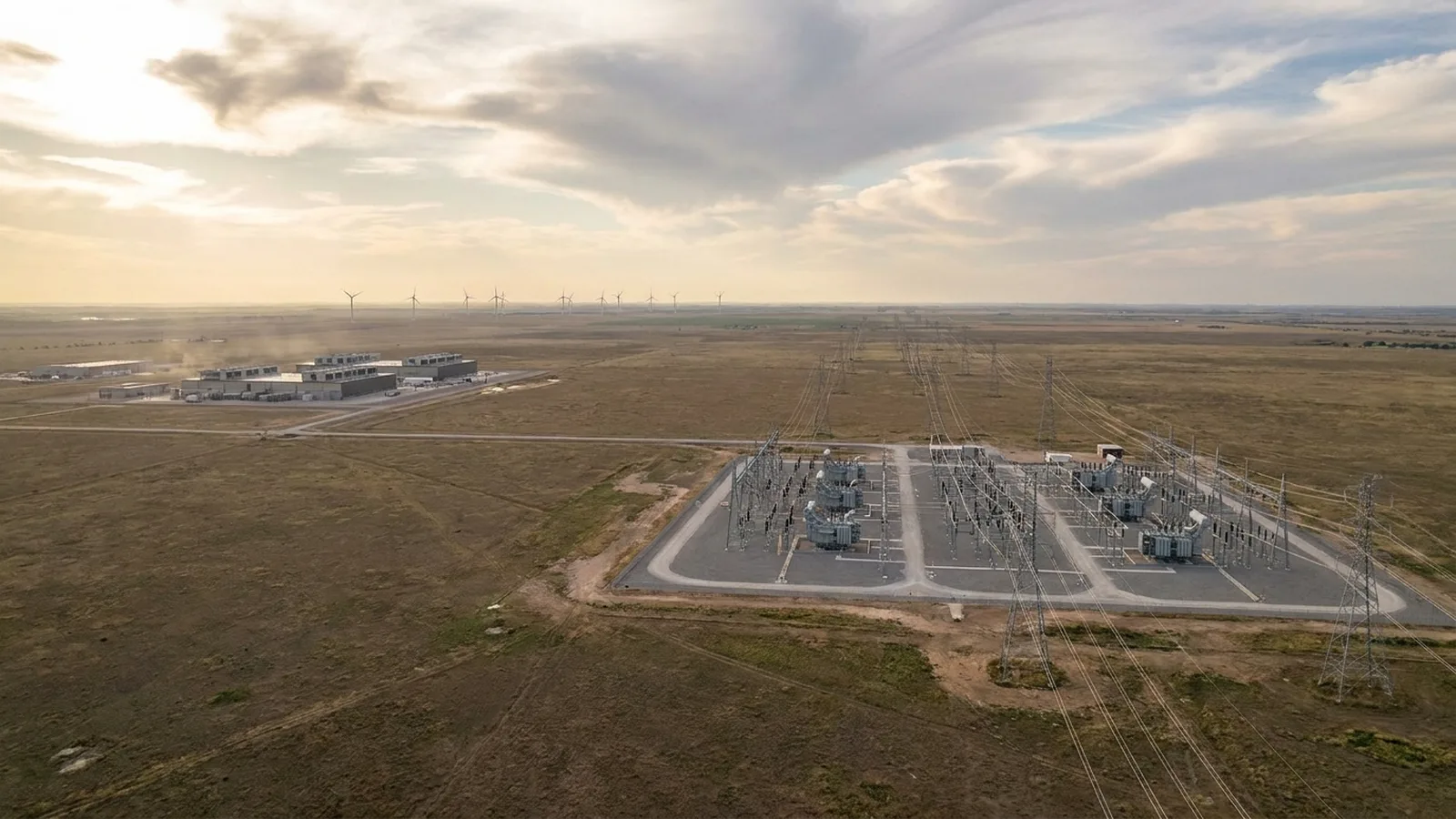
A data center that needs 75 MW or more from the ERCOT grid can't get approval to energize in Texas as of November 2026. Senate Bill 6 set new terms for large loads in 2025. The PUCT turned them into a rule in September 2026: a $100,000 study fee, $50,000 per MW of security and a long list of disclosures. ERCOT moved pending requests into a single Batch Zero study and, on August 3, 2026, stopped approving energization of new data center and crypto loads of 75 MW or more. The practical result for site selection is simple. Capacity that is already energized or classified is worth more than it was a year ago, and a substation map is worth less.
Before you start
- SB 6 applies to new or expanded ERCOT loads of 75 MW and up, and the PUCT's §25.194 rule now requires a $100,000 study fee and $50,000 per MW of security before any study.
- ERCOT's Batch Zero replaced one-by-one studies. Of about 474 GW in the queue, roughly 194 GW was conditionally classified and 302.2 GW excluded.
- Since August 3, 2026, ERCOT has not approved energization of new data centers or crypto loads of 75 MW or more, and since September 21 TCEQ has paused data center permits statewide.
- El Paso, the Panhandle and parts of East Texas are outside ERCOT and run on their own utility tariffs, but the permit pause still applies there.
What Senate Bill 6 changed for loads of 75 MW and up
Senate Bill 6 was signed in June 2025 and took effect immediately. It rewrote the terms on which large loads connect to the ERCOT grid. The trigger is a new or expanded interconnection at a single site above a demand threshold the Public Utility Commission of Texas (PUCT) sets at 75 MW, unless the PUCT finds a lower number is needed.Weil, Gotshal & MangesTexas Legislature Online
The statute does six things a site buyer has to price in:Texas Legislature Online
- Disclosure of duplicate requests. A customer must say whether it is pursuing a substantially similar interconnection request elsewhere in Texas that would change, delay or withdraw this one.
- A study fee of at least $100,000 for the initial transmission screening, credited toward later obligations at the same site.
- Site control, shown through ownership, a lease or another legal interest the PUCT accepts.
- Uniform financial commitments, which can include per-MW security, contributions in aid of construction or advance payment for equipment.
- Curtailment during firm load shed. Loads interconnected after December 31, 2025 must be curtailable under a protocol the utility develops with ERCOT, with the equipment needed to do it. Weil's summary calls it a remote kill switch for grid emergencies.
- Review of co-location with existing generation. A net-metering arrangement between a new large load and a generator registered as stand-alone on September 1, 2025 goes to ERCOT for a study within 120 days and then to the PUCT, which has 60 days to approve, deny or add conditions.
SB 6 also created a competitively procured demand reduction program for loads of 75 MW or more and requires disclosure of on-site backup generation that can carry at least half the site's demand. ERCOT can direct that backup generation to run in an emergency.Texas Legislature OnlineWeil, Gotshal & Manges
Where the PUCT rulemakings stand as of November 2026
The PUCT tracks its SB 6 work in Project No. 58317. Its September 22, 2026 status report lists the projects below. The one that matters most for site value is 16 TAC §25.194, the large load interconnection standard, adopted at the September 18, 2026 open meeting.Public Utility Commission of Texas
| PUCT project | Subject | Status in the September 2026 report |
|---|---|---|
| 58479 | Net metering for large loads co-located with existing generation (PURA §39.169) | Adopted March 26, 2026 |
| 58480 | Large load forecasting criteria | Adopted February 6, 2026 |
| 58481 | Large load interconnection standards, new 16 TAC §25.194 | Adopted September 18, 2026 |
| 58482 | Large load demand management service | Comments filed, adoption order expected January 2027 |
| 58000 | Wholesale and retail transmission cost recovery in ERCOT | Comments filed, adoption order expected December 2026 |
| Not yet numbered | Standard large load interconnection agreement | Proposal expected October 2026, adoption no later than March 2027 |
Under §25.194, a large load customer has to sign an intermediate agreement before ERCOT will include it in an interconnection study. It pays a $100,000 study fee and posts $50,000 per MW of requested peak demand as security. Expansions count too: a site already above 75 MW that adds 75 MW or more is treated as a new request for the increment. The disclosures go well beyond the statute. The customer must report the type of site control (a signed purchase or lease option counts, and a lease option must run at least five years), any substantially similar request with its ERCOT serial number and size, water volumes, backup generation, how it plans to buy power and whether it will register as a controllable load resource.Public Utility Commission of Texas
The duplicate-request rule has a hard definition. A request elsewhere counts as material if approving it would delay this project by a year or more, change its peak demand by 20% or more, or move its point of interconnection. That ends the habit of filing the same campus at four substations and keeping the best answer.Public Utility Commission of Texas
ERCOT replaced one-by-one studies with Batch Zero
Until July 2026, transmission providers studied each large load on its own under ERCOT's Large Load Interconnection Study (LLIS) process. That process closed to new reviews on July 10, 2026. The PUCT approved its replacement, Planning Guide Revision Request 145 and Nodal Protocol Revision Request 1325, on June 18, 2026.ERCOTWillkie Farr & Gallagher
Batch Zero is a one-time, system-wide study of every qualifying load. It sorts each load into one of two groups. A Base Load already energized, sat in a quarterly stability assessment by May 1, 2026, or holds a complete and validated prior study. It is modeled as background and gets no new MW allocation. A Studied Load had enough maturity to get in but still needs an allocation. It receives a Low Power Consumption amount it can draw firm, and it can only go higher by registering as a Provisional Controllable Load Resource and following ERCOT dispatch. There is also a bring-your-own-generation path, the Withdrawal-Limited Private Use Network, which caps net draw at the point of interconnection. A load that qualifies for neither group can't get approval for initial energization and waits for a future batch.Willkie Farr & Gallagher
The numbers explain why. ERCOT told the Texas Senate on July 29, 2026 that it was tracking about 474 GW of large loads seeking interconnection as of June, about 90% of them data centers. Only about 205 GW had a study that qualified for Batch Zero. On September 3, ERCOT gave transmission providers conditional classifications. 204 projects totaling 66.4 GW conditionally qualified as base load, 158 projects totaling 127.9 GW as studied load, and 373 projects totaling 302.2 GW were excluded. Eleven projects elected the bring-your-own-generation path.ERCOTERCOT
Geography is uneven. Dallas and Harris counties lead conditional base load at roughly 5.7 GW each. Cameron, Jones and Childress counties show up near the top once studied load is added, which means the next wave is aimed well outside the metro substations.ERCOT
The August 2026 energization pause and the September permit pause
On August 3, 2026, Governor Abbott directed the PUCT and ERCOT to complete a verification and audit of every data center moving through the interconnection process before letting it proceed. ERCOT acted the same day. It paused the Batch Zero study, delayed final classification of all large loads and stopped approving energization for data centers and crypto mining facilities of 75 MW or more. The pause hits loads that are not yet connected. Loads already on the system keep running.ERCOT
Two reviews are now running. The eligibility verification checks the attestations behind each Batch Zero load. ERCOT's July deck listed the evidence it expects: purchase orders for long-lead equipment, real estate agreements, land use approvals, end-user agreements and construction contracts. A separate community impact review covers data centers and crypto loads of 25 MW and up, including the 25 to 75 MW band that sits below the Batch Zero threshold. ERCOT said it would file both reports with the PUCT by December 10, 2026 and give final Batch Zero inclusion in December. It hasn't said how far the study will slip past its original April 9, 2027 deadline.ERCOTERCOT
On September 21, 2026, the Governor told the Texas Commission on Environmental Quality to stop issuing permits sought by data centers until the audits finish, and said no state agency should advance data center approvals in the meantime. That covers every permit a data center seeks from TCEQ, which includes air permits for backup generators. TCEQ had to report its compliance by October 19, 2026. No end date has been published.Office of the Texas Governor
So, as of November 2026, a 75 MW data center in ERCOT that is not already energized cannot get energization approval, cannot get a TCEQ permit and cannot know its Batch Zero allocation until at least December.
Texas outside ERCOT runs on different rules
ERCOT carries about 90% of Texas electric load. El Paso and Far West Texas sit in the Western Interconnection. The Panhandle and parts of East Texas sit in the Eastern Interconnection. Batch Zero and ERCOT's energization pause are ERCOT processes, so they don't govern El Paso Electric, Southwestern Public Service (Xcel) in the Panhandle, Entergy Texas around Beaumont or SWEPCO in Northeast Texas. Weil's reading of SB 6 also frames its interconnection and curtailment provisions around the ERCOT region.ERCOTERCOTWeil, Gotshal & Manges
These utilities are writing their own large load terms. SPS filed a large load tariff at the PUCT on October 5, 2026 (Docket 60332) for customers of 75 MW and up. It would let a large load meet its demand through dedicated generation, including third-party generation contracted through SPS or customer-owned generation.Energy Choice Matters
Two cautions. The TCEQ permit pause applies to data center projects anywhere in Texas, so leaving ERCOT doesn't get a project its air permit. And a smaller utility's will-serve letter still needs the same reading as any other: what transmission it assumes, what it costs the customer and what date it supports.Office of the Texas Governor
Sites from our inventory that show the point
In Texas the regime decides the shortlist. Sites that already hold approved or energized capacity are a short list of known facilities. Three from our inventory show the spread.
| Region | Power evidence | Land | Where it stands |
|---|---|---|---|
| West Texas campus | 466 MW of provisional base load under the ERCOT large-load process, 234 MW already energized. Rung 3. | Campus | Kept. Approved capacity in hand, which is the scarce thing in ERCOT right now. |
| South of Dallas-Fort Worth | 150 MW in a utility load table at a planned 345 kV switch, in service 2028. Rung 2. | About 860 acres | Kept, behind the pause. Listed with a broker. |
| Texas Panhandle listing | Listing gives 300 MW in the title, 1,000 MW in a field and about 900 MW in the text, with no utility document. Rung 1. | About 3,400 acres | Watch list. Three numbers for one site means none of them is from a utility. |
Only the first site can promise power on a date today. Locations, owners and documents are shared on a call.
Sites with approved or energized capacity are now worth more
Power was already the scarce input in Texas. Paces' November 2025 analysis of ERCOT found that only about 17% of substations near land suitable for data centers had positive withdrawal capacity. The 2026 rules add a second filter. A site's value now depends on where its load sits in the Batch Zero classification and whether it has already energized.Paces
We grade Texas sites on a five-rung power evidence ladder. Rung 0 is a map. Rung 1 is proximity to a line or substation of the right voltage. Rung 2 is a named MW figure at a named station from a utility or planning record. Rung 3 is a utility study or approval for this load, which in ERCOT now means a Batch Zero classification and posted security. Rung 4 is an executed agreement with a date, or energized and metered. A broker's "450 MW available" stays at rung 2 until a current utility letter is in hand.
| Site state (ERCOT, November 2026) | Ladder rung | What it means for timing |
|---|---|---|
| Energized and metered, load running | 4 | Outside the energization pause. Expanding by 75 MW or more is a new request under §25.194. |
| Conditional Batch Zero base load, not yet energized | 3 | No new allocation needed, but energization waits on verification. Final status due December 2026. |
| Conditional Batch Zero studied load | 3 | Firm draw capped at the Low Power Consumption amount the study sets. More only as a controllable load. Study timeline not yet reset. |
| Excluded from Batch Zero or no qualifying study | 1 to 2 | Waits for a future batch under rules still being written. Plan on years, not quarters. |
| Substation proximity only, no request filed | 0 to 1 | Needs the $100,000 study fee, $50,000 per MW security and site control before entering any study. |
| Behind-the-meter or co-located generation | Depends on the generator | Co-location with existing generation needs ERCOT study and PUCT review. Air permits still sit behind the TCEQ pause. |
Before any parcel work, kill the disqualifiers. Is the site already claimed or operating? Under option? Listed? Owned by a buyer of environmental liabilities? Coal ash or contamination? A county moratorium? Then ask for the documents behind the power claim: the ERCOT classification notice, the security posting confirmation from the transmission provider, the intermediate agreement and the duplicate-request disclosure. Invariant screens Texas sites this way before any introduction, and sorts them into tier A (documented power), tier B (a named power path with a date) and tier C (land near capacity).
Questions that come up.
Did ERCOT stop approving new data centers in 2026?
ERCOT paused approvals to energize data centers and crypto mining facilities of 75 MW or more on August 3, 2026, after a directive from Governor Abbott. Loads already connected were not affected. ERCOT said it would file its verification report by December 10, 2026.ERCOT
What does a large load have to pay to enter an ERCOT interconnection study?
Under 16 TAC §25.194, adopted September 18, 2026, the customer signs an intermediate agreement, pays a $100,000 study fee and posts $50,000 per MW of requested peak demand as financial security. It also has to file disclosures on site control, duplicate requests, water, backup generation and power supply.Public Utility Commission of TexasPublic Utility Commission of Texas
What is ERCOT Batch Zero?
Batch Zero is a one-time, system-wide study of qualifying large loads that replaced ERCOT's one-by-one Large Load Interconnection Study process in July 2026. Loads are classified as base load or studied load, and studied loads get a firm draw limit plus an option to consume more under ERCOT dispatch.Willkie Farr & GallagherERCOT
How big is the ERCOT large load queue?
ERCOT reported about 474 GW of large loads seeking interconnection as of June 2026, roughly 90% data centers. Its September conditional classification put about 194 GW in Batch Zero and excluded 302.2 GW.ERCOTERCOT
Can a data center avoid the ERCOT pause by locating in El Paso or the Panhandle?
Those areas are outside ERCOT, so Batch Zero and ERCOT's energization pause don't govern them, and SPS has filed its own large load tariff. The September 2026 TCEQ permit pause applies to data center projects statewide, though.ERCOTEnergy Choice MattersOffice of the Texas Governor
How does Invariant check a Texas site's power claim?
Invariant places the claim on a power evidence ladder and asks for the document behind it, such as the Batch Zero classification, the security posting or the executed agreement. Sites are screened for disqualifiers and graded before any introduction.
Sources and references.
Primary sources checked for this guide on . The location, equipment, and operating plan determine which requirements apply to a project.
- Texas Legislature OnlineSenate Bill 6, enrolled version (89th Legislature, Regular Session) ↗
- Weil, Gotshal & MangesSenate Bill 6 Reforms Interconnection and Co-Location Rules for Data Centers and Other Large Loads in ERCOT ↗
- Public Utility Commission of TexasProject No. 58317, SB 6 Implementation: rulemaking status report (filed September 22, 2026) ↗
- Public Utility Commission of TexasProject No. 58481, Order Adopting New 16 TAC §25.194, Large Load Interconnection Standards ↗
- Willkie Farr & GallagherERCOT Approves Implementing New "Batch Zero Process" for Large Load Interconnections ↗
- ERCOTItem 14: Batch Zero Update, Board of Directors Meeting, September 14 to 15, 2026 ↗
- ERCOTERCOT Update: Senate Panel 1, Assessing the Grid (July 29, 2026) ↗
- Office of the Texas GovernorGovernor Abbott Directs TCEQ To Halt Data Center Permits ↗
- Energy Choice MattersNon-ERCOT Utility Proposes Allowing Large Loads To Satisfy Their Load With Third-Party Generation ↗
- ERCOTERCOT Fact Sheet ↗
- ERCOTERCOT and PUC presentation to the NERC Member Representatives Committee (November 5, 2019) ↗
- PacesThe grid is planning for data centers that will never exist: Aligning transmission investment with development reality ↗