

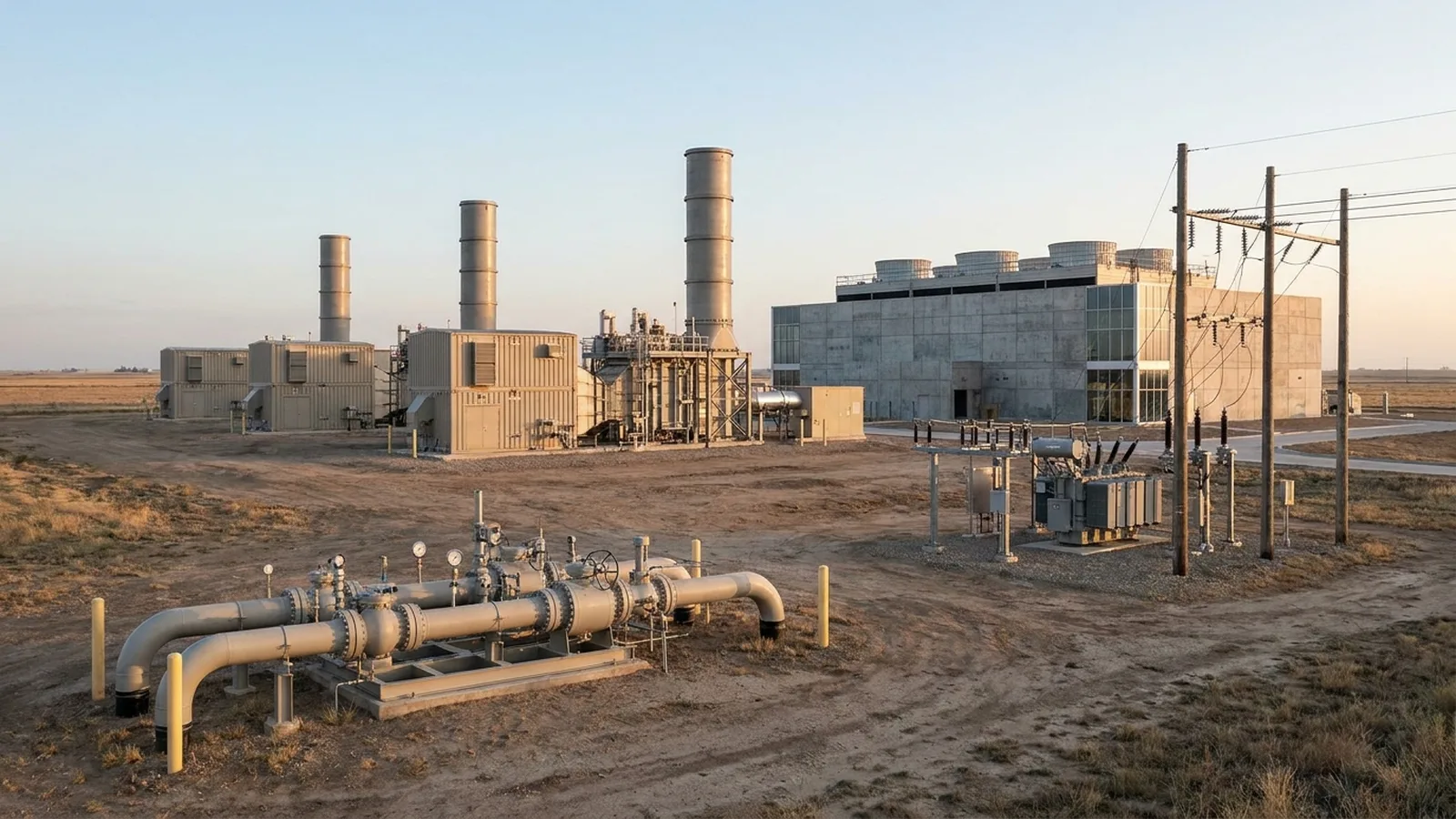
An on-site gas plant can make a data center site work when the grid date is years away, but only if four things line up: firm gas supply, an air permit sized for the whole campus, generation equipment with a real delivery slot, and a regulatory structure that lets the power reach the load. Verify each with a document. A pipeline on a map or a broker's "gas available" line is not that evidence. This guide covers what recent projects show, how the main BTM configurations compare and what to ask for on each.
Before you start
- Treat a BTM site as four approvals on four clocks: gas, air, equipment and regulation.
- Ask the pipeline for firm capacity, pressure and gas quality in writing before any equipment order.
- Get the emissions calculation for the full build-out, since phased minor permits draw aggregation challenges.
- Plan the grid path from day one so the bridge generation has an end state.
Why buyers are pricing sites with their own generation
The grid answer at most good substations is a date several years out. Paces looked at ERCOT substations that had suitable land nearby and found only about 17% showed positive withdrawal capacity, meaning room to add load without making existing overloads worse. That is one market and one method, but it matches what site selectors hear from utilities across the country.Paces
Behind-the-meter (BTM) generation is the workaround. The site makes its own power from gas turbines, reciprocating engines or fuel cells, either for the whole load or as a bridge until utility service arrives. Small modular reactors come up in every pitch deck. Treat them as a later-decade option. None of the sources below rely on one for first power.
A BTM site doesn't remove the power question. It moves it. Instead of asking whether the utility has headroom, you are asking whether the gas, the air permit, the turbines and the regulator will all line up by the same date. Each of those can fail on its own schedule.
What recent on-site gas projects show
xAI's Colossus site in Memphis is the case everyone cites. SELC says xAI began operating there in June 2024 using as many as 35 unpermitted gas turbines, removed them after a Clean Air Act notice of intent to sue, and obtained permits for the remaining 15. The permits came after the turbines were already running, which is the order of operations a lender or tenant will ask about.Southern Environmental Law Center
The fight then moved across the state line. In April 2026 SELC and Earthjustice sued on behalf of the NAACP over 27 turbines, up to 495 MW, at xAI's Southaven, Mississippi facility. As of November 2026 we have not seen a final ruling. The lesson for a buyer is plain: installing turbines faster than the permit record creates litigation risk that can outlast the speed advantage.Southern Environmental Law Center
Stargate in Abilene took a different route. Floodlight and The Texas Tribune report the developers built 10 gas turbines and 62 backup diesel generators under minor Texas permits, with a 360 MW on-site gas plant, then applied for a major air permit to add 41 more turbines and 18 more generators. Crusoe describes the turbines as backup, though the permits allow continuous use. A former EPA enforcement chief quoted in the piece argued the project should have been permitted as one source.The Texas Tribune / Floodlight
Homer City, Pennsylvania, is the brownfield version. The developers announced up to 4.5 GW of gas generation on the 3,200-acre former coal plant site, seven GE Vernova turbines with first deliveries expected in 2026, gas from the Texas Eastern system about five miles away, and existing ties to PJM and NYISO. The coal unit, 1,884 MW, shut in mid-2023. Reuse of a retired plant site gave the project an existing grid connection and an industrial land use to build on.Utility Dive
Two utility-led models sit at the other end. In Ohio, PUCO approved AEP Ohio's on-site fuel cell project for AWS and Cologix data centers, with the customers covering full project cost and the fuel cells described as a way to start operating while the grid expands. In Louisiana, regulators approved Entergy's three gas plants, about 2.3 GW, for Meta's Richland Parish campus. That is gas built for one customer but owned by the utility and delivered through the grid, so it is a front-of-meter deal with different risks.AEPBloomberg via Insurance Journal
BTM configurations compared
The table lays out the common setups. Use it to decide which documents to ask for, not which option is best. The answer changes with gas basin, air district and utility.
| Configuration | Why buyers choose it | Main constraints | What to verify |
|---|---|---|---|
| Aeroderivative or industrial gas turbines, islanded | Fast to site in modular blocks; no utility study needed for first power | Air permit size, turbine supply, full fuel exposure, no grid backstop | Signed equipment slots, permit class for the full build-out, firm gas transport, N+1 design |
| Reciprocating engine farm | Smaller units, finer redundancy steps, good part-load behavior | Many stacks to permit, more maintenance, noise | Engine count against HAP and NOx thresholds, maintenance plan, noise study at the fence line |
| Fuel cells (for example solid oxide) | Low local NOx, modular, utility-owned options exist | Higher cost per MWh in most cases, still gas-dependent | Who owns the units, tariff or contract approval, gas pressure and quality spec |
| Large frame or combined cycle on site | Lowest fuel cost per MWh at scale | Multi-year turbine lead times, major source permit, water for cooling | Turbine reservation date, PSD and Title V path, water rights or supply contract |
| Co-location at an existing power plant | Uses existing generation and a grid tie | Regulatory review of the arrangement, curtailment terms, plant owner priorities | In ERCOT, whether SB 6 net metering review applies and what conditions were imposed |
| Bridge generation, then grid | Earlier first power while the utility builds | Stranded asset risk, two sets of approvals, changing tariff terms | Utility letter or agreement with a date, plan for the generators after grid service starts |
Verify gas supply before anything else
A pipeline on the map is rung 1 evidence. It says nothing about whether that line has capacity at the pressure you need. Ask the pipeline operator, in writing, for available firm capacity at the nearest interconnect, the required lateral length and who builds it, the delivery pressure, and the gas quality spec. Turbine and fuel cell vendors publish fuel requirements. Check heating value and contaminants against them before an equipment order, not after.
Firm transport matters more than commodity price. An islanded campus with interruptible gas has no backstop on a cold day when residential demand takes priority. Price the firm transport contract and its term. Ask whether dual fuel or on-site storage is part of the design, and how many hours of operation it covers.
The Permian shows the other side of the problem. Waha hub prices were negative for a record 25 straight days by March 12, 2026, because pipelines could not move the gas out. Cheap gas at the wellhead is why operators pitch data centers on mineral and gas acreage in West Texas, eastern New Mexico and the Plains states. Takeaway relief was expected mainly in the second half of 2026, so a site that depends on stranded gas pricing should model what happens once new pipes narrow that discount.Pipeline & Gas Journal
For acreage sites, confirm who holds the mineral rights and the surface rights, whether they are severed, and whether drilling or pipeline easements limit where buildings can go. A gas producer as landlord can be a strong supply partner. It can also mean your fuel price is tied to one counterparty.
Air permits, water and local opposition
Air permitting sets the real size of an on-site plant. Under EPA's Title V program, a major source is one with the potential to emit 100 tons per year of any air pollutant, 10 tons per year of a single hazardous air pollutant, or 25 tons per year of combined HAPs. Thresholds drop in ozone nonattainment areas, as low as 10 tons per year of NOx in extreme areas. Major new sources in attainment areas also face Prevention of Significant Deterioration review, which requires best available control technology and public involvement.US EPA
Floodlight found that more than half of the Texas data centers it reviewed reported NOx estimates just under the thresholds that trigger fuller review, such as 249.1 or 99.8 tons per year. That is legal when the numbers are real. It also invites the aggregation argument raised at Abilene: regulators or opponents can claim that phased minor permits are one major project. Ask for the emissions calculation for the full campus, not phase one.The Texas Tribune / Floodlight
Read the local record too. In both Memphis and Southaven, a notice of intent to sue came before the permit question was settled. Pull the air agency's comment docket for any nearby generation permit and check county minutes for opposition that has already organized.Southern Environmental Law Center
Water gets missed. Combined cycle plants and some turbine inlet cooling designs need water, and a dry-cooled design costs output on hot days. Get the water source in writing: municipal allocation, groundwater permit or rights, or a reuse contract. Homer City's developers pointed to their own water supply as part of the pitch.Utility Dive
Equipment lead times, redundancy and cost
Large gas turbines are the long pole. GE Vernova reported 116 GW of gas equipment backlog and slot reservations at the end of the second quarter of 2026, up from 83 GW at the end of 2025. It is booking reservations about four to five years out and taking slots for 2031 delivery. A seller who says turbines are available should show a reservation agreement with a delivery quarter.Utility Dive
Smaller aeroderivative units and reciprocating engines are often quoted on shorter timelines, and the secondary market for used units is active. Get dated quotes. Lead times in this market have moved quarter to quarter.
An islanded data center has no grid to fall back on, so redundancy is part of the generation design. Size for N+1 at minimum on the generating units, and decide how you'll handle a gas supply outage, a failed transformer and planned maintenance. Grid-parallel operation lowers that burden but brings an interconnection agreement, protection studies and the utility's standby or backup service terms back into scope.
On cost, Lazard's 2026 analysis puts unsubsidized gas combined cycle at $51 to $129 per MWh and gas peaking at $144 to $276 per MWh. Those are utility-scale figures. Small on-site turbines and engines usually run closer to peaker economics than combined cycle, and the result swings with gas price and capacity factor. Lazard also points to a 15-year high in gas LCOE and long development lead times.Utility Dive
Sites from our inventory that show the point
Two sites in our inventory pair on-site gas with a grid path, which is the structure most buyers ask about.
| Region | Power evidence | Land | Where it stands |
|---|---|---|---|
| West-central Ohio | 350 MW of behind-the-meter gas committed, plus a 400 MW utility load study with results expected around the end of 2026, dual 345 kV on site. | About 514 acres | Watch list. Gas bridges the years before the grid study turns into service. |
| West Virginia, former quarry | Two 138 kV substations adjacent per the listing, with a behind-the-meter gas plan. | About 300 acres | Watch list. The gas supply and air permit are the documents to see first. |
Both sites are worth a call only once the gas supply agreement and the air permit path are on paper. Locations, owners and documents are shared on a call.
Regulatory treatment and the path to the grid
Who is allowed to sell power to whom is a state question. In many states, a third party selling electricity to a data center on the same site can look like a retail sale inside a utility's service territory. Self-generation by the load owner is usually treated differently. Get a short opinion from state utility counsel before structuring a developer-owned plant that sells to a tenant.
Texas is the clearest example of new rules. SB 6, signed June 20, 2025, requires ERCOT study and PUCT approval when a new large load sets up a net metering arrangement with an existing generator, with exemptions such as a parent company holding a majority interest in the generator as of January 1, 2025. It also requires large loads to disclose on-site backup generation in their interconnection requests, and lets ERCOT direct qualifying new loads to switch to backup generation during an emergency.Baker Botts
The PUCT adopted the implementing net metering rule, 16 TAC 25.205, on March 26, 2026. ERCOT revised its notice form on July 31, 2026, for loads of 75 MW or more seeking such an arrangement. If a Texas site plan depends on taking power from an existing plant, ask whether the review applies, whether it has been filed and what conditions came back.ERCOT
Plan the grid path even for a site that starts islanded. Long-term, the grid gives you a backstop and possibly an export route. Ask the utility for a load study now so the queue clock starts, and record whether the bridge generators will stay as backup, move to another site or be sold. AEP's Ohio fuel cells were approved explicitly as a bridge while the grid expands.AEP
Apply the same evidence ladder used for grid sites. Proximity to a pipeline is rung 1. A pipeline operator's written capacity figure at a named interconnect is rung 2. A firm transport agreement, a filed or issued air permit covering the full build-out and a turbine reservation are rung 3. Executed contracts with dates and units on site are rung 4. A broker's "gas available" claim is rung 1 until the pipeline letter is in hand.
Then run the kill sheet before parcel work. Drop sites already claimed or operating, sites in an air district where the full build-out cannot be permitted, and sites with organized opposition to an existing generation permit. Invariant screens BTM sites this way before any introduction, and grades them A for documented gas and permit evidence, B for a named supply path with a date, and C for land near a pipeline.
Questions that come up.
What does behind-the-meter power mean for a data center?
It means the data center uses electricity generated on its own side of the utility meter, usually from on-site gas turbines, engines or fuel cells. It can run fully islanded or alongside a grid connection. The site still needs gas supply, an air permit and equipment, so it has its own approvals.AEP
How long does it take to get gas turbines for a data center?
For large gas turbines, GE Vernova was booking reservations about four to five years out in 2026 and taking slots for 2031 delivery. Smaller units can arrive sooner, but get a dated quote or a reservation agreement before relying on any schedule.Utility Dive
Do on-site gas turbines need an air permit?
Yes. The permit class depends on potential emissions. Under EPA's Title V rules, 100 tons per year of any pollutant, or 10 tons per year of a single hazardous air pollutant, makes a major source, with lower thresholds in some nonattainment areas. The xAI disputes in Memphis and Southaven show the cost of running turbines before the permit record is settled.US EPASouthern Environmental Law Center
Can a Texas data center take power directly from an existing power plant?
Possibly, but SB 6 requires ERCOT study and PUCT approval for net metering arrangements between new large loads and existing generators, unless an exemption applies. The PUCT adopted the implementing rule on March 26, 2026. Check whether the arrangement has been filed and what conditions were set.Baker BottsERCOT
Is on-site gas power cheaper than grid power?
Not always. Lazard's 2026 figures put gas combined cycle at $51 to $129 per MWh and gas peaking at $144 to $276 per MWh, and small on-site units usually sit closer to peaker economics. Cheap local gas, such as Permian supply during pipeline constraints, can change the math, though that discount may narrow as new pipelines open.Utility DivePipeline & Gas Journal
How does Invariant evaluate a behind-the-meter site?
Invariant applies the same power evidence ladder it uses for grid sites, with gas supply, air permits and equipment as the rungs. A pipeline on a map counts as proximity. A written capacity figure, a permit covering the full build-out and an equipment reservation move a site up a tier.
Sources and references.
Primary sources checked for this guide on . The location, equipment, and operating plan determine which requirements apply to a project.
- PacesThe grid is planning for data centers that will never exist: Aligning transmission investment with development reality ↗
- Utility DiveGE Vernova gas turbine backlog climbs to 116 GW ↗
- Southern Environmental Law CenterxAI built an illegal power plant to power its data center ↗
- The Texas Tribune / FloodlightPlanned Texas data centers could emit more greenhouse gases than many countries ↗
- Utility DiveLargest US gas-fired power plant planned for data centers in Pennsylvania ↗
- AEPPUCO Approves Onsite Power Project for Data Centers ↗
- Bloomberg via Insurance JournalEntergy to Build Three Gas Plants for Meta's Biggest Data Center ↗
- US EPAWho Has to Obtain a Title V Permit? ↗
- Baker BottsTexas Senate Bill 6: Understanding the Impacts to Large Loads and Co-located Generation ↗
- ERCOTM-F073126-01 Revised Notice of Proposed Net Metering Arrangement Form ↗
- Pipeline & Gas JournalPermian Pipeline Constraints Push Waha Gas Prices Negative for 25th Straight Day ↗
- Utility DiveRenewables remain cheapest, but their LCOE is rising: Lazard ↗