

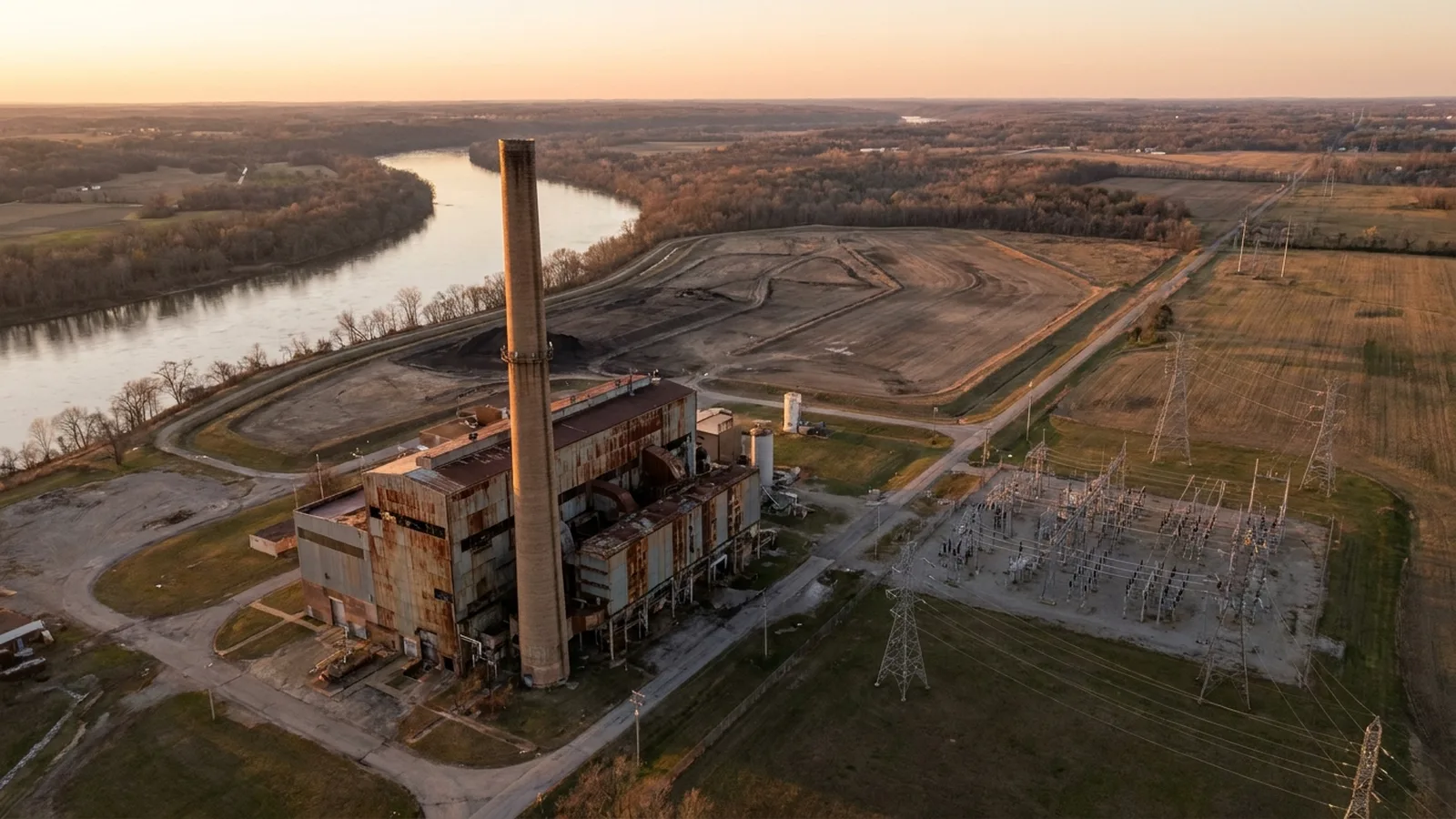
A retired coal or gas plant is one of the best places to look for data center power, because the switchyard, transmission lines, water and heavy industrial zoning are already there. What does not come with the site is the right to draw power. The plant's interconnection let it push energy onto the grid. A data center needs a withdrawal right from the utility and the grid operator, and that has to be studied and granted again. Buy for the infrastructure, verify the load path separately, and price the coal ash before you price the land.
Before you start
- A plant's generator interconnection is an export right. Load service for a data center needs its own utility study and agreement.
- PJM and MISO let replacement generation reuse a retiring unit's rights on fixed terms, and FERC's 2025 and 2026 orders set PJM's co-location rules.
- Coal ash units, groundwater findings and recorded covenants decide how many acres are actually buildable.
- Find candidates in EIA-860M retirements, then confirm the unit stopped and check the owner before any parcel work.
What a retired plant site brings to a data center
A coal or gas plant was sited for the same things a large data center needs. It sits on a high-voltage switchyard with lines that once carried hundreds of megawatts, sometimes more than a gigawatt, out to the grid. It usually has a cooling water intake and the permits behind it. The land is zoned and taxed as heavy industrial, the neighbors are used to a large facility, and many sites have a rail spur and a gas lateral. None of that guarantees power for a new load, but it puts the site on a different rung of evidence than a farm field three miles from a substation.
Homer City in Pennsylvania is the public example most people cite. The former coal station, once the largest in the state, is being redeveloped as a 3,200-acre campus with up to 4.5 GW of gas generation from seven GE Vernova turbines, and the developers said much of the critical infrastructure was already in place from the legacy plant. FracTracker documented demolition blasts and the start of vertical construction there in April 2026.Data Center KnowledgeFracTracker Alliance
Notice what that project did. It did not plug a data center into the old plant's grid connection. It built new generation on site. That choice says a lot about how interconnection rights work, which is the subject of the next section.
Owners are also changing hands with data centers in mind. In March 2026 a data center developer announced a deal to buy the Morgantown Generating Station in Maryland, whose coal units shut in 2022 while four smaller oil-fired units still run. The acquisition needed FERC approval, and the buyer had not said how power would be generated.E&E News
A generator interconnection is not a load connection
This is where most retired-plant pitches go wrong. A power plant holds an interconnection agreement that lets it inject energy at a point on the transmission system. In PJM the deliverable part of that right is called Capacity Interconnection Rights. A data center needs the opposite: the right to withdraw energy, which comes from transmission service and retail service from the local utility. A 1,000 MW export right does not become a 1,000 MW load right when the boilers go cold.PJM Inside Lines
The grid studies are different too. A plant's interconnection study asked whether the network could carry its output away under stress. A load study asks whether the network can deliver power in, often during the same peak hours. The answer at the same bus can be very different. The physical assets help a lot: the switchyard, the breakers, the line rights of way. The paper right to withdraw has to be earned again through the utility's large-load process.
FERC addressed this directly for PJM. In its December 18, 2025 order in Docket EL25-49, the Commission found PJM's tariff unjust and unreasonable because it lacked clear rates, terms and conditions for co-located load, meaning load connected behind or next to a generator. It directed PJM to spell out how generators can use provisional interconnection service, service below nameplate and Surplus Interconnection Service to serve co-located load. It also said an existing generator cannot withdraw its capacity from the system to start serving a co-located load until the network upgrades needed to keep existing customers reliable are in service, with the generator paying the full cost.Federal Energy Regulatory Commission
On June 18, 2026, in EL25-49-002, FERC largely sustained that order on rehearing and accepted rates, terms and conditions for three transmission services for co-located load: Interim Network Integration Transmission Service, Firm Contract Demand and Non-Firm Contract Demand. It also required more compliance changes, including a load-based materiality threshold for behind-the-meter generation. As of November 2026, treat the PJM co-location rules as still being finished through compliance filings and check the docket before relying on a specific term.Troutman Pepper Locke
For a buyer, the practical reading is short. Co-location at an operating plant is a path with rules now. Co-location at a retired plant usually means new generation, a new or replacement interconnection, and a transmission service election for the load. A retired plant's old agreement is evidence of what the bus once carried. It is not a service commitment for your campus.
How ISOs let a site reuse its interconnection
The grid operators have built paths that let new generation reuse an old plant's injection rights faster than a fresh queue position. These are generator rules. They matter to a data center when the plan includes on-site or adjacent generation, as at Homer City.
PJM's generator replacement process took effect January 30, 2026 after FERC accepted a revised filing on January 29, 2026. It lets a replacement resource take over a deactivating unit's Capacity Interconnection Rights through an expedited study, if the new resource connects at the same substation, runs at the same voltage and does not exceed the retiring unit's maximum output. Under PJM's existing rules a deactivated unit keeps its CIRs for one year, so the clock starts at deactivation.PJM Inside Lines
MISO has run a generator replacement process since 2019. Utility Dive reported in April 2025 that about 5.9 GW of replacement requests had been approved and 4.9 GW were under study, and that replacements generally have to connect at the same point as the retiring unit. MISO had asked FERC to allow an electrically equivalent point instead. Check the current MISO tariff for the status of that change.Utility Dive
Both processes are built around the owner of the retiring unit. A buyer of the land alone, without the generating assets and the interconnection agreement, should not assume it can use them. Ask who holds the agreement, whether it has been assigned, and how many months remain before the rights lapse.
A retirement date is also not final until the unit stops. Since May 2025 the Department of Energy has used Federal Power Act section 202(c) emergency orders to keep plants that were scheduled to retire available to run. J.H. Campbell in Michigan, slated to close May 31, 2025, was under a 90-day order running to November 14, 2026, and DOE's 2026 list also covers units including Eddystone in Pennsylvania, Centralia in Washington and Craig in Colorado. A site whose plant is under a 202(c) order cannot be demolished or repurposed on the schedule the seller describes.U.S. Department of Energy
What transfers and how to verify it
Use one row per asset. The question in each row is whether the right moves to you, in writing, at the size you need. A seller's description of the site is a starting point. The document in the right column is the evidence.
| Asset | What to verify | Document to get |
|---|---|---|
| Switchyard and substation | Who owns each piece after closing: plant owner, transmission owner or utility. Voltage, breaker positions, transformer condition. | One-line diagram, ownership demarcation in the interconnection agreement, transmission owner asset records |
| Generator interconnection rights | MW level, deactivation date, whether rights are still live, who may use the replacement path. | Interconnection agreement, ISO deactivation notice, CIR or replacement filings |
| Load service at the site | Whether the utility will serve the new load, at what MW and date, and which transmission service applies. | Utility large-load study or facilities study, service agreement, transmission service election |
| Co-location arrangement | Whether load will sit behind an operating or new generator and which PJM service it takes. | Co-location application, network upgrade study, ISO compliance tariff sections |
| Retirement status | Whether the unit has actually stopped or is held open by an emergency order. | ISO deactivation records, DOE 202(c) order list |
| Coal ash units | Every landfill and impoundment, closure method, closure status, who keeps post-closure care. | CCR public website: closure plans, location restriction demonstrations, annual groundwater reports |
| Groundwater | Detection or assessment monitoring, exceedances, any corrective action remedy. | Annual groundwater monitoring and corrective action reports, state agency correspondence |
| Deed and use limits | Environmental covenants, groundwater use bans, residential bans, access easements for monitoring wells. | Title commitment, recorded covenants, state cleanup program files |
| Buildings and demolition | Asbestos and other regulated materials, who demolishes, who pays. | Asbestos inspection report, demolition notification, demolition contract |
| Water | Intake and discharge permits, withdrawal rights, whether they transfer to a new use. | Water withdrawal permit or right, NPDES permit, state transfer rules |
| Zoning, rail and gas | Whether industrial zoning allows a data center use; rail spur ownership; gas lateral capacity. | Zoning letter, rail siding agreement, pipeline interconnect records |
Rank what you collect on a simple ladder. A map showing the plant is rung 0. Proximity to a high-voltage switchyard is rung 1. A retired plant's documented export level at a named station is rung 2, the same rung as a broker's "500 MW available". A utility study for your load is rung 3. An executed service or interconnection agreement with a date, or energized and metered service, is rung 4. Most retired plant sites sit on rung 2 when they first reach a buyer, and that's fine as long as everyone says so.
Coal ash and other liabilities that can sink the deal
Coal ash is the item that kills the most coal plant reuse plans, because it rarely leaves the site. EPA's 2015 CCR rule set national requirements for ash landfills and surface impoundments, including groundwater monitoring, corrective action for releases, closure and a public website where each facility posts its compliance records. The May 8, 2024 legacy rule extended coverage to inactive impoundments at inactive plants and added requirements for CCR management units, meaning ash placed outside regulated units, such as old fill areas.U.S. Environmental Protection AgencyFederal Register
The schedule has moved since then. A final rule published February 10, 2026 extended several legacy-rule deadlines. Groundwater monitoring systems at affected units are now due February 10, 2031 instead of May 8, 2028. Closure and post-closure care plans are due August 11, 2031, and closure must start by February 9, 2032. The first part of the facility evaluation report moved to February 9, 2027. The 2024 rule is also under challenge in the D.C. Circuit, a case the notice describes as in abeyance, and EPA has said it plans to reconsider the rule.Federal Register
EPA has more changes in progress. In November 2025 it proposed moving the closure deadline for certain unlined impoundments over 40 acres from October 17, 2028 to October 17, 2031, and in April 2026 it proposed further amendments to the Part 257 rules. Neither was shown as final on EPA's page when we checked in November 2026.U.S. Environmental Protection Agency
Longer deadlines do not shrink the liability. They mean the investigation that tells you how much ash is in the ground, and whether it is reaching the aquifer, may not happen until years after you buy. Get the facility's CCR website records yourself. Read the closure method: closure in place leaves capped ash and decades of post-closure care, often in the middle of what a site plan shows as buildable acres.
Then look at the paper on the land. Closed ash units and remediated areas usually come with recorded environmental covenants that limit groundwater use, bar residential use, require access for monitoring wells, or prohibit digging through a cap. Those restrictions run with the land and can block a building pad, a duct bank or a stormwater pond. Pull the title commitment early, not at the end.
Check who owns the plant. Some retired plants are bought by firms whose business is taking on environmental liability: they acquire the site, run the remediation and demolition, and resell parcels later. That owner may be a good counterparty, but it controls the timing, it often keeps the ash units, and its deed may carve out the parts of the site with the most electrical value. Put it on the kill sheet as a question before parcel work starts.
Demolition is its own budget line. Older boiler houses and turbine halls often contain asbestos. EPA's asbestos NESHAP requires a thorough inspection before demolition, notice to the delegated agency, and work practices such as wetting regulated material and sealing it in leak-tight containers. Find out who has already done that work and who pays for what remains.U.S. Environmental Protection Agency
Sites from our inventory that show the point
Retired plants are one of the channels we search first. Two from our inventory show the range of outcomes.
| Region | Power evidence | Land | Where it stands |
|---|---|---|---|
| Western Kentucky | Former 443 MW plant with its switchyard on the parcel, 161 kV. The seller is also the power supplier, and a neighboring load won a state-approved service agreement in 2026. Rung 2. | About 500 acres | Kept. The strongest fit we have found for a mid-size campus; the next document is a load study for the buyer's ramp. |
| East Texas, retired lignite plant | Plant exported about 1,150 MW; 345 kV switch next door. Rung 2. | About 850 acres | Dropped. The owner buys plants for their environmental liabilities, an ash landfill is being mined to 2035, groundwater exceeds federal limits and the deed carries a notation. |
The Texas site looked better on paper: bigger export, higher voltage, more land. It failed on checks that take ten minutes, which is why we run them before any parcel work. Locations, owners and documents are shared on a call.
How to find retired plant sites worth screening
Start with EIA. The EIA-860M monthly generator inventory tracks existing and proposed units at plants of 1 MW and up, and since March 2017 data it has included a tab of generators retired since 2002. The October 2026 file came out October 23, and the next is scheduled for November 24, 2026. Filter for coal and gas steam units by state, sum retired nameplate capacity by plant, and keep the plant ID so you can join it to other records.U.S. Energy Information Administration
- Sort plants by retired capacity at a single site, then check whether any units at the same plant still run.
- Cross-check the DOE 202(c) list and the ISO deactivation records to confirm the unit really stopped.
- Open the CCR public website for each coal plant before visiting. No website at a coal plant is itself a question.
- Look up current owner and recent transfers in county records, and flag liability buyers.
- Check for announced redevelopment, options and listings so you don't spend time on a site already claimed.
- Search the county for data center moratoria or zoning text changes.
That order matters. Power evidence first, then the disqualifiers, then parcels. A plant that survives gets a tier: A when there is documented power for a new load, B when there is a named power path with a date, such as a replacement filing or a utility load study under way, and C when it is land next to capacity with nothing yet on paper. Invariant screens retired plant sites this way before any introduction, and most of them land in B or C until the utility puts a number in writing.U.S. Energy Information AdministrationU.S. Department of Energy
Questions that come up.
Can a data center use a retired power plant's interconnection?
Not directly. A plant's interconnection agreement lets it inject power, while a data center needs to withdraw power through utility and transmission service. The switchyard and lines help, but the load still needs its own study and service agreement.Federal Energy Regulatory Commission
What is co-location in PJM?
Co-location means a large load connected at or next to a generator. FERC's December 2025 order required PJM to set clear rules for it, and a June 2026 order accepted three transmission services for co-located load: Interim NITS, Firm Contract Demand and Non-Firm Contract Demand. Compliance filings were still refining the rules in 2026.Federal Energy Regulatory CommissionTroutman Pepper Locke
How long do interconnection rights last after a plant retires in PJM?
Under PJM's rules a deactivated unit keeps its Capacity Interconnection Rights for one year. The replacement process that took effect January 30, 2026 lets a new resource at the same substation and voltage, no larger than the retired unit, use those rights through an expedited study.PJM Inside Lines
Is coal ash a deal breaker for a data center site?
Not always, but it often takes the best acres. Closed-in-place ash units come with post-closure care and recorded land-use limits, and EPA's 2026 extension pushed groundwater monitoring at legacy units to 2031. Read the facility's CCR website records before any parcel work.Federal RegisterU.S. Environmental Protection Agency
Where can I find a list of retired power plants?
EIA's monthly EIA-860M inventory includes a tab of generators retired since 2002, with plant IDs that link to other records. Cross-check it against DOE's 202(c) orders, since some plants scheduled to retire are being kept available to run.U.S. Energy Information AdministrationU.S. Department of Energy
How does Invariant evaluate retired plant sites?
Invariant starts from the power evidence at the station, removes sites with disqualifiers such as coal ash, liability owners or existing claims, and only then looks at parcels. Each surviving site gets a tier based on the documents behind its power.
Sources and references.
Primary sources checked for this guide on . The location, equipment, and operating plan determine which requirements apply to a project.
- Federal Energy Regulatory CommissionOrder Directing PJM to Revise Its Tariff for Co-Located Load, Docket No. EL25-49-000 (December 18, 2025) ↗
- Troutman Pepper LockeFERC Addresses Arguments on Rehearing and Requires Additional PJM Tariff Revisions to Accommodate Co-Located Load ↗
- PJM Inside LinesFERC Approves Streamlined Process To Replace Retiring Facilities ↗
- Utility DiveMISO proposal to let replacement generators use different interconnection points ↗
- U.S. Department of Energy2026 DOE 202(c) Orders ↗
- U.S. Environmental Protection AgencyCoal Ash (Coal Combustion Residuals, or CCR) Rule ↗
- Federal RegisterDisposal of Coal Combustion Residuals From Electric Utilities; CCR Management Unit Deadline Extension Rule, 91 FR 5806 ↗
- U.S. Environmental Protection AgencyAsbestos National Emission Standards for Hazardous Air Pollutants (NESHAP) ↗
- U.S. Energy Information AdministrationPreliminary Monthly Electric Generator Inventory (EIA-860M) ↗
- Data Center KnowledgeMajor AI Data Center Planned for Former Pennsylvania Coal Power Plant ↗
- FracTracker AllianceFrom Coal Plant to AI Campus: FracTracker Documents Construction at Homer City ↗
- E&E NewsData centers could revive a shuttered Maryland coal plant ↗