

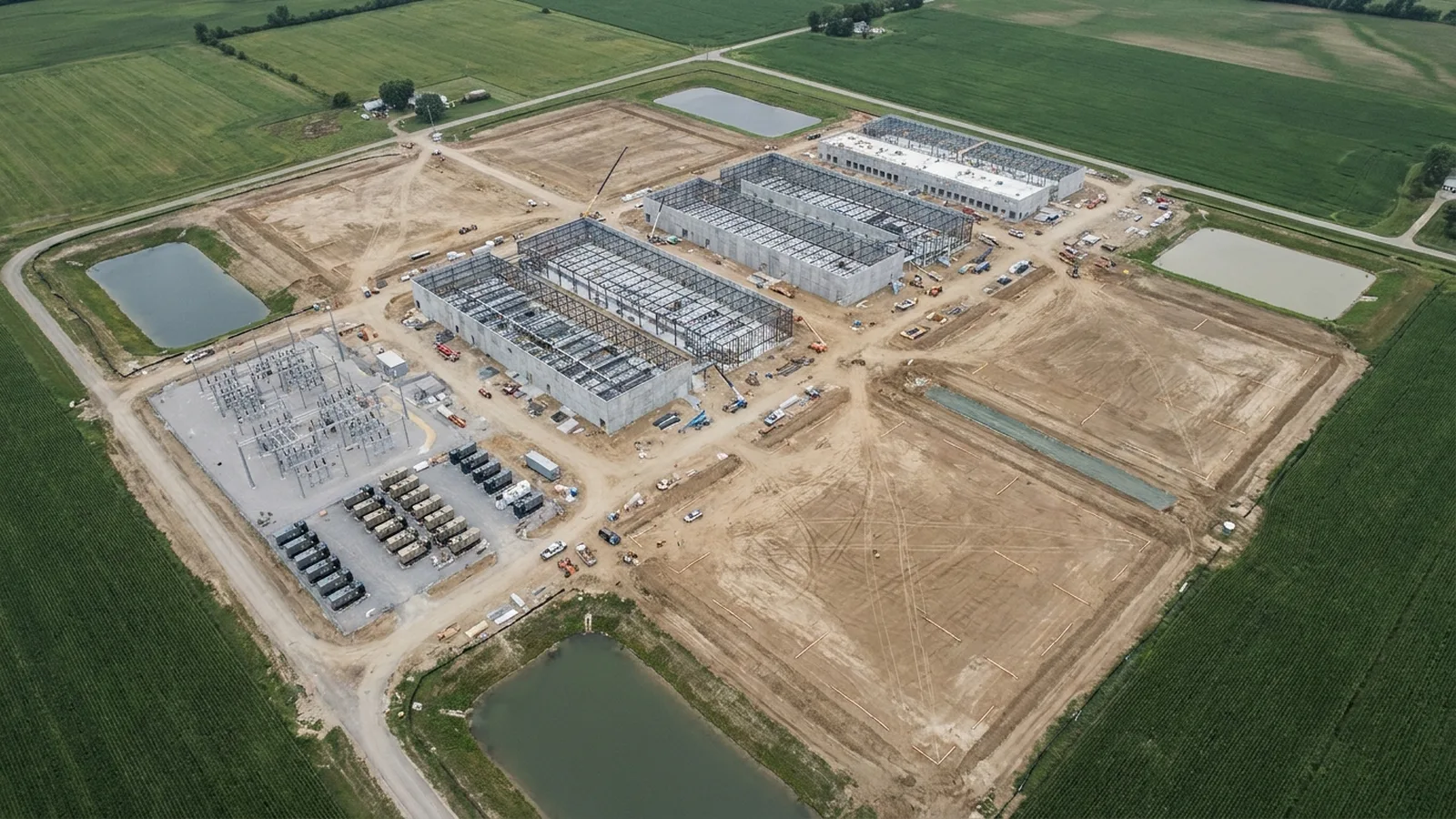
A modern data center campus needs roughly 0.5 to 2 acres of gross land per MW of total facility load, and a bitcoin mine can get by on a quarter of that. Those are rules of thumb, not standards. The building itself is a small share of the site. Substations, cooling yards, generators, stormwater ponds, setbacks and land held for later phases take most of it. This guide shows how to size the land from the power number, what each piece of infrastructure takes, how announced campuses compare, and how to check whether a listing's acreage fits the MW it claims.
Before you start
- Size land from total facility load (IT load times PUE), not from rack count or building area.
- Buildings cover a small share of an AI campus. Fairwater puts about 1.2 million square feet of floor area on 315 acres.
- Reserve about 3 acres for a 138 kV substation and 8.5 to 16.5 acres for 345 kV before laying out halls, using ComEd's 2026 guidelines as a reference.
- Acreage almost never limits a site. Check usable acres for fit, then ask for the utility document behind the MW.
Size the load before you size the land
Every acreage question starts with a power number, and there are two of them. IT load is what the servers draw. Total facility load adds cooling, power conversion losses, lighting and offices. The ratio between them is power usage effectiveness, or PUE. Uptime Institute put the average per-site PUE across its survey at 1.58 for 2023, and 1.47 when weighted by IT capacity, with large new hyperscale builds designed for 1.4 or lower and some cloud operators claiming 1.2 or lower at certain sites.Uptime Institute
So a 100 MW IT campus at a PUE of 1.3 needs about 130 MW at the meter. The utility sizes its service to the facility number. The land plan has to hold the gear for both: the halls for the IT load and the yards for everything that turns 130 MW into 100 MW of useful compute. Ask which number a listing means when it says "100 MW." Brokers often don't say.
Rack density is the other input, and it has split the market in two. Uptime's 2025 survey found average densities still rising slowly, driven by racks in the 10 to 30 kW range, with few facilities above 30 kW.Uptime Institute
AI racks sit far above that. NVIDIA's GB200 NVL72 rack is rated at about 120 kW and is direct liquid cooled, roughly double the rack designs that came before it.eeNews Europe
Higher density shrinks the white space per MW. It doesn't shrink the substation, the chillers or the dry coolers, because those scale with heat and power, not with how tightly servers are packed. That's why a dense AI campus can still need a lot of land. The building gets smaller per MW while the yard around it stays about the same size per MW.
Most of a campus is not building
Microsoft's Fairwater AI campus in Mount Pleasant, Wisconsin is a useful reference. Microsoft describes three buildings with about 1.2 million square feet under roof on a 315-acre site. That is about 28 acres of floor area. Even if every square foot sat on one level, the roofs would cover less than a tenth of the land. The same post describes a water-cooled chiller plant, a closed-loop system and 172 twenty-foot fans on cooling fins along the buildings.Microsoft
A concept plan should show all of the following before anyone quotes MW per acre.
- On-site substation. ComEd's January 2026 guidelines call for at least 784 by 472 feet (about 8.5 acres) for a 345 kV interconnection substation on one line, expandable to 784 by 914 feet (about 16.5 acres), and 413 by 324 feet (about 3.1 acres) for 138 kV, all excluding stormwater detention.
- Customer substation. PSE&G's data center guidance lists 2.5 acres of equipment space at 69, 138 and 230 kV, 2.5 to 5 acres at 345 kV and 7 acres at 500 kV.
- Generator yards and fuel. Diesel or gas backup units, belly tanks or bulk fuel storage, and the separation and noise screening around them. Many campuses line the generators along the long walls of each hall.
- Heat rejection. Air-cooled chillers, dry coolers, or cooling towers, on the roof or in a ground-level yard. Liquid-cooled AI halls still reject heat outside.
- Water. Storage tanks for fire protection and, for evaporative designs, makeup water and treatment.
- Stormwater detention. Ponds or vaults sized to local rules, which grow with every acre of roof and pavement.
- Setbacks, buffers and screening. Zoning setbacks from property lines and residential uses, plus berms and landscaping that noise and visual conditions often require.
- Roads, parking, security and laydown. Perimeter fencing, guard posts, truck access and construction staging.
- Future phases. Pad sites held for the second and third buildings, and a second substation position.
The substation figures come from two utilities and are not a national standard. Still, they set a floor. A 345 kV switching station plus a customer substation can take 10 to 20 acres before a single hall goes up.ComEd via PJMPSE&G
Behind-the-meter generation adds its own footprint: turbines or reciprocating engines, gas metering and regulation, switchyard, emissions controls and the setback from the property line that an air permit and a noise study usually require. Crusoe's 1.2 GW Abilene campus pairs a grid interconnection with behind-the-meter batteries and solar, and gas turbines for backup power. Solar needs far more acreage per MW than the data center it supports.Crusoe
MW per acre by facility type
The ranges below are Invariant's working rules of thumb for gross acres, measured against total facility load at full build. They are not published standards. Real projects land outside them for good reasons, usually stories, cooling type or land held for later phases.
| Facility type | Rule-of-thumb MW per gross acre | What drives the number |
|---|---|---|
| Bitcoin mining (containers or air-cooled sheds) | 2 to 5 | Single-story, little redundancy, no generator yard, minimal parking. Density limited mainly by airflow, noise setbacks and the substation. |
| Enterprise or colocation, suburban | 0.5 to 2 | Lower rack density, generator yard sized for full redundancy, more parking and office space, often one or two stories. |
| Enterprise or colocation, urban multi-story | 2 to 6 | Three or more stories, rooftop heat rejection, tight lot lines. The land is expensive, so the building goes up. |
| Hyperscale cloud campus | 0.5 to 1.5 | Many halls, large generator and chiller yards, buffers to neighbors and land held for future phases. |
| AI training campus (liquid cooled, 100+ kW racks) | 0.7 to 2 | Dense halls but large heat rejection yards, high-voltage substations and phased pads for multi-GW plans. |
| Campus with on-site gas generation | 0.3 to 1 | Adds the plant, gas yard, switchyard and air-permit setbacks. Solar or batteries on site push the ratio lower still. |
Public campus numbers sit inside those bands. The examples below divide announced MW by announced acres. Treat them as rough: acreage and MW are reported at different dates, and "capacity" in a press release can mean IT load, facility load or a compute figure.
| Campus (as announced) | Announced MW | Announced acres | Approx. MW per acre |
|---|---|---|---|
| Riot Platforms, Corsicana, Texas (bitcoin mining) | 1,000 planned, 400 MW first phase | 265 | About 3.8 at full build |
| Crusoe, Abilene, Texas (AI campus) | 1,200 | 1,100 for the wider Abilene Clean Campus | About 1.1, counting the whole campus |
| Meta Hyperion, Richland Parish, Louisiana (AI) | 2,000 original plan, 5,000 expanded | 2,250 original, about 1,400 added | About 0.9 original, about 1.4 expanded |
| Microsoft Fairwater, Mount Pleasant, Wisconsin (AI) | Not published | 315 | Not computable |
Riot's 265 acres were bought for a 1 GW mining site energized from a 400 MW substation in its first phase. Crusoe's eight buildings total about 4 million square feet, which is roughly 92 acres of floor area for 1.2 GW. Meta's original Hyperion plan was nine buildings with about 4 million square feet on 2,250 acres, and the campus was expanded to 5 GW in July 2026 after Meta added roughly 1,400 adjacent acres.Riot PlatformsCrusoeBaxtel
Land is rarely the binding constraint
Run the numbers on almost any rural listing and the land is ample. A 300-acre parcel at 1 MW per acre holds 300 MW. The question is whether 300 MW can be delivered there, and by when.
Paces ran a power-flow analysis on ERCOT's 2028 summer-peak planning case and found that only about 17% of substations near land suitable for data centers had positive withdrawal headroom. In other words, most substations with good parcels next to them could not take new load without making existing overloads worse.Paces
That result matches what we see. Search from power evidence first and then find the parcel, not the other way round. We grade power claims on a ladder. Rung 0 is a map. Rung 1 is proximity to a line or substation of the right voltage. Rung 2 is a named MW figure at a named station from a utility or planning record, or an existing large connection such as a retired plant's export capacity or an energized load. Rung 3 is a utility study or approval for this load. Rung 4 is an executed service or interconnection agreement with a date, or service that is already energized and metered.
A broker's "450 MW available" sits at rung 2 until a current utility letter is in hand. Acreage doesn't move a site up the ladder at all.
Usable acres are smaller than gross acres
Listings quote gross acres. A campus gets built on usable acres, and the gap between the two can be a third of the parcel or more. Take these off before dividing MW by acres:
- Wetlands and streams, which usually need a delineation and may need a federal permit to fill.
- Mapped floodplain, where critical electrical and mechanical equipment belongs above the base flood elevation, if it goes there at all.
- Steep slope, which adds grading cost and limits the large flat pads that halls and substations need.
- Easements: existing transmission, pipeline, rail and road rights of way that cross the parcel and cannot be built on.
- Zoning setbacks and any buffer conditions from a rezoning or special use permit.
- Irregular shape. A long thin parcel can lose much of its area to setbacks on both sides.
Utility siting rules bite here too. ComEd wants the interconnection substation reachable from at least two sides for future lines, with no river, forest, wetland or other transmission line on those sides, and within half a mile of the existing line. The developer also buys the land for the tie-line, the access road and the substation's own stormwater detention. A parcel that looks big on a map can fail those tests at the one corner near the line.ComEd via PJM
Sites from our inventory that show the point
Listings in our inventory show why acreage alone says little about capacity.
| Region | Power evidence | Land | Where it stands |
|---|---|---|---|
| Arizona | Listing claims 1,000 MW with no utility document cited. | About 100,000 acres | Candidate. Land is not the constraint here; the power claim is. |
| Houston, Texas | 50 MW studied and approved per the listing, available mid-2027, 138 kV line under a mile away. | About 25 acres | Candidate. About 2 MW per acre, dense but workable for a single-building campus. |
| Western Kentucky | Former 443 MW plant, switchyard on site. | About 500 acres | Kept. Under 1 MW per acre leaves room for phases, buffers and on-site generation. |
Divide the claimed MW by the usable acres before anything else. A ratio far outside the ranges above usually means the MW figure or the acreage needs a second look. Locations, owners and documents are shared on a call.
How to sanity-check a listing's acreage against its MW
This takes about ten minutes with a parcel map and the listing sheet.
- Pin down which MW is quoted: IT load, facility load, or a utility service figure. Convert with a PUE of 1.2 to 1.5 if needed.
- Find the usable acres. Subtract wetlands, floodplain, slope and easements from the gross figure.
- Reserve the substation. Use about 3 acres at 138 kV and 8.5 to 16.5 acres at 345 kV as a starting reference, plus detention.
- Divide facility MW by usable acres and compare with the table above for the facility type the buyer plans to build.
- If the ratio is far above the band, the listing is overstating MW or assuming stories and rooftop cooling it hasn't designed. If it is far below, ask whether the extra land is for on-site generation, future phases or simply for sale at a higher price.
- Then ignore the ratio and ask for the power document. Where does the MW figure sit on the evidence ladder?
Before parcel work goes far, clear the disqualifiers. Is the site already claimed, under option or operating? Is it listed with another buyer in diligence, or owned by an environmental-liability buyer? Is there coal ash or contamination, or a county moratorium? Any one of those ends the review regardless of acreage.
Invariant screens sites this way before any introduction. We sort them into three tiers: A for documented power, B for a named power path with a date, and C for land near capacity without either. Acreage is a check on the claim. The power document is the claim.
Questions that come up.
How many acres does a 100 MW data center need?
As a rule of thumb, a 100 MW hyperscale or AI campus needs roughly 50 to 150 gross acres, including substation, cooling yards, generators, stormwater and buffers. A bitcoin mine of the same size can fit on 20 to 50 acres. A multi-story urban colocation building can use far less. These are working ranges, not standards, and usable acres matter more than gross acres.
How many MW per acre is typical for a data center?
Most US campuses land between about 0.5 and 2 MW per gross acre of total facility load. Announced examples include Meta's original Hyperion plan at about 0.9 MW per acre and Riot's Corsicana mining site at about 3.8 MW per acre at full build. Stories, cooling type and land held for future phases explain most of the spread.
How much land does a data center substation take?
ComEd's January 2026 guidelines call for at least 784 by 472 feet, about 8.5 acres, for a 345 kV interconnection substation on one line, expandable to about 16.5 acres, and about 3.1 acres at 138 kV, excluding stormwater detention. PSE&G lists 2.5 acres of equipment space at 69 to 230 kV and 7 acres at 500 kV. Check the serving utility's own standard.
Do AI racks reduce the land a data center needs?
They reduce white space per MW, since a GB200 NVL72 rack draws about 120 kW versus 10 to 30 kW for typical racks. They do not reduce the substation, heat rejection or backup power, which scale with MW. Land per MW falls less than the rack numbers suggest.
How does Invariant check whether a site's acreage fits its MW?
Invariant works out usable acres, reserves room for the substation and detention, and compares facility MW per usable acre with the range for the planned facility type. Then it looks for the utility document behind the MW figure. A site only moves up a tier on power evidence, not on acreage.
Sources and references.
Primary sources checked for this guide on . The location, equipment, and operating plan determine which requirements apply to a project.
- Uptime InstituteLarge data centers are mostly more efficient, analysis confirms ↗
- Uptime InstituteUptime Institute Global Data Center Survey 2025 ↗
- eeNews EuropeNvidia offers 120kW liquid cooled Blackwell rack as industry standard ↗
- MicrosoftInside the world's most powerful AI datacenter ↗
- ComEd via PJMComEd guidelines on land requirements for interconnection substations (Rev-2, January 2026) ↗
- PSE&GPowering your data center needs ↗
- CrusoeCrusoe expands AI data center campus in Abilene to 1.2 gigawatts ↗
- Commercial SearchCrusoe to build AI data center in North Texas ↗
- BaxtelMeta expands Louisiana data center campus to 5GW ↗
- Riot PlatformsRiot energizes new Corsicana facility in Navarro County, Texas ↗
- PacesGrid planning for data centers and transmission investment ↗