

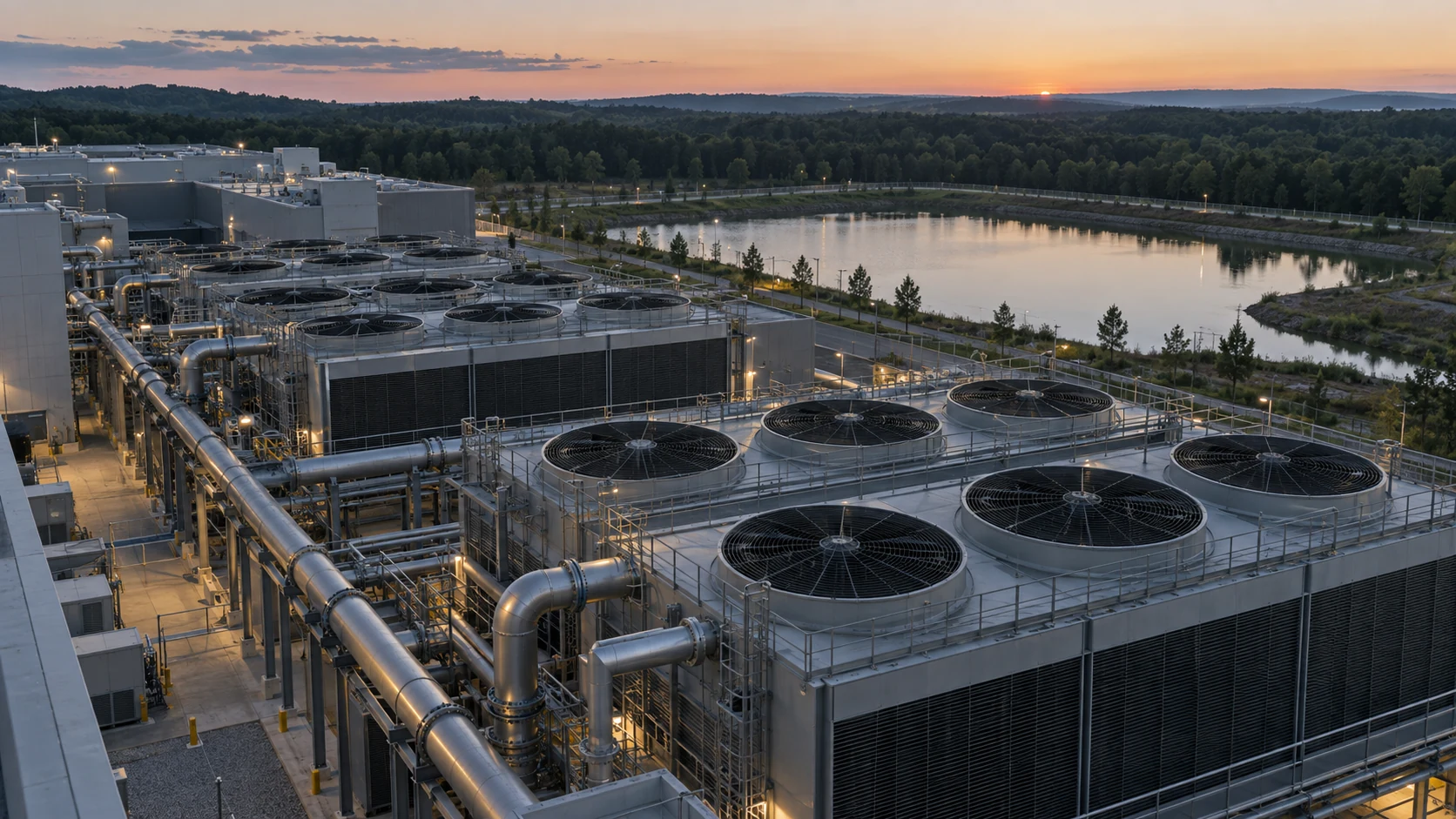
Start with a water balance and a drainage drawing. Show where each stream comes from, what changes its quality, where it goes, and who controls that destination. Include cooling, sanitation, equipment flushing, construction dewatering, rainfall, and spills. A water-service agreement answers a supply question. It does not establish that every resulting discharge is acceptable.
Before you start
- Confirm supply and discharge arrangements separately, including temporary construction and commissioning flows.
- Determine construction and industrial stormwater applicability independently. A facility's name does not settle its operating classification.
- Screen the whole development footprint, including off-site connections, for water and wetland impacts.
- Carry approved flow, chemistry, drainage, and fuel-storage assumptions into the operating team's procedures.
Start with supply capacity and the actual discharge route
Ask the water provider to evaluate initial and ultimate demand, peak conditions, fire protection, connection points, and any reclaimed-water proposal. Record which infrastructure must exist before each phase can receive service. If the project proposes its own surface-water withdrawal, investigate that separate authorization: Virginia, for example, administers a surface-water withdrawal permitting program through DEQ.Virginia Department of Environmental Quality
Utility infrastructure has its own approval sequence. Loudoun Water requires approved drawings and a construction permit before work affecting its existing or proposed water, sanitary-sewer, or reclaimed-water infrastructure, including relevant grading. Its process can also require easements, estimated-flow acknowledgments, reclaimed-water allocation agreements, and process-wastewater metering arrangements.Loudoun Water
Next, trace the outgoing water. A pollutant discharge from a point source to waters of the United States requires NPDES authorization. A discharge to a municipal sanitary sewer instead raises the receiving utility's requirements and applicable pretreatment obligations. A storm drain is a different destination again; do not assume it is an acceptable route for cooling or commissioning wastewater.US Environmental Protection AgencyUS Environmental Protection Agency
Send the receiving authority a discharge profile, not just an annual consumption estimate: flow, temperature, expected constituents, treatment chemicals, frequency, and any concentrated or intermittent releases. Those facts let the authority evaluate the proposed stream and identify missing information. Keep the response with the cooling-system design revision it evaluated.
Build the approval matrix around individual streams
| Project activity | Question to resolve | Evidence to collect |
|---|---|---|
| Potable or reclaimed supply | What service and infrastructure approvals apply to this phase? | Provider response, demand basis, connection design, easements, allocation conditions. |
| Cooling blowdown or equipment flushing | Will the sewer authority accept this composition and flow, and under what conditions? | Discharge profile, treatment-chemical information, sampling and metering requirements. |
| Direct wastewater outfall | Which NPDES authority and authorization cover this discharge? | Outfall location, receiving water, pollutant profile, permit conditions. |
| Construction runoff or dewatering | Which construction coverage and discharge conditions fit the work and destination? | Disturbance plan, drainage routes, controls, authorization and inspection responsibilities. |
| Operating stormwater | Do the actual industrial activities and state rules require coverage? | Classification analysis, material-exposure inventory, drainage map, authority response. |
| Oil storage and handling | Does SPCC apply, and how will releases be contained and managed? | Container-capacity inventory, drainage review, applicable spill-prevention plan. |
Temporary work deserves a row of its own. San José's industrial wastewater program, for example, provides short-term authorizations for activities including construction dewatering to the sanitary sewer. Resolve the local path before a contractor chooses a discharge point. A future operating arrangement is not evidence that today's temporary discharge has been reviewed.City of San José
Distinguish construction runoff from operating stormwater
Under the federal construction-stormwater framework, stormwater discharges from activities disturbing at least one acre generally require permit coverage. Smaller disturbances also qualify when part of a common plan that ultimately disturbs at least one acre. Clearing, grading, and excavation count. Identify the state or EPA permitting authority and the applicable permit before relying on a generic construction checklist.US Environmental Protection Agency
Use the permit to assign responsibility for the pollution-prevention plan, installed controls, inspections, corrective work, and records. Check how its conditions address construction dewatering and stabilization. Put those responsibilities into the contractor's scope, and identify who keeps the evidence if the general contractor or site operator changes.
Operating industrial-stormwater coverage is a separate applicability decision. EPA's federal framework identifies regulated categories of industrial activity; state programs administer most coverage and must be checked for their requirements. Assess the facility's actual activities and relevant classification. Neither a data-center label nor the existence of a fuel tank alone answers every industrial-stormwater question.US Environmental Protection Agency
There is a specific September 2026 issue in EPA-administered areas: EPA's 2021 Multi-Sector General Permit expired on February 28, 2026. Previously covered operators retain administratively continued coverage and obligations. New facilities and new operators cannot obtain coverage under that expired permit. EPA describes a conditional No Action Assurance for certain eligible operators, but explicitly says it does not confer NPDES permit coverage. Confirm the available path with the responsible EPA office. This federal permit status is not the status of every state's general permit.US Environmental Protection Agency
Screen the connections as well as the campus
A workable building footprint can still depend on a road, water line, or power connection crossing an aquatic feature. Section 404 regulates discharges of dredged or fill material into waters of the United States, including jurisdictional wetlands. Include temporary construction impacts in the review. A map flag should prompt investigation; it does not establish either federal jurisdiction or permission to proceed.US Environmental Protection Agency
Where an activity requiring a federal permit or license may result in a discharge into waters of the United States, Clean Water Act Section 401 can add a state or authorized tribal water-quality certification decision. The applicable certification must be obtained or waived before the federal authorization can issue. Review state water requirements separately as well. These reviews are related, but a construction-stormwater authorization does not resolve a fill-permit question.US Environmental Protection AgencyUS Environmental Protection Agency
Keep alternative connection routes on the table until the impacts are understood. Show the environmental reviewer the grading limits, access works, staging areas, and utility corridors, not only the finished campus rendering.
Check fuel storage against drainage and spill requirements
For SPCC applicability, EPA asks whether a non-transportation-related facility handles oil and could reasonably discharge harmful quantities to navigable waters or adjoining shorelines. One capacity trigger is aggregate aboveground oil storage greater than 1,320 US gallons, counting containers of 55 gallons or more subject to the rule's exclusions. A separate test addresses completely buried storage. Evaluate capacity, not just today's tank contents.US Environmental Protection Agency
Reconcile the storage inventory with the generator plan and site drainage. For a facility subject to SPCC, translate its plan into physical controls and operating responsibilities. Keep fuel delivery, containment inspection, spill response, and changes in storage configuration visible in the handover. A spill-prevention plan does not serve as wastewater-discharge authorization.US Environmental Protection AgencyUS Environmental Protection Agency
Hand over the approved assumptions, not just the drawings
Before commissioning, assemble a stream-by-stream record: destination, approval or documented applicability conclusion, limits, sampling point, reporting owner, and the design assumptions behind it. Include one-time flushing and testing. Mark unresolved conditions clearly so an issued document is not mistaken for completion of every prerequisite.
Then define the changes that reopen review: cooling technology, treatment chemicals, discharge flow, drainage connections, site expansion, and oil-storage capacity. Industrial users have applicable notification duties for changed discharges and other specified events. The operating team needs to recognize those triggers before making the change.US Environmental Protection Agency
Questions that come up.
Does a water-service commitment authorize cooling wastewater discharge?
No. Confirm the discharge destination and its applicable requirements separately. The sewer authority evaluates an indirect discharge; a qualifying direct discharge requires NPDES authorization. Keep the supply and discharge decisions in separate records.US Environmental Protection AgencyUS Environmental Protection Agency
Does every US data center need an industrial-stormwater permit?
Do not infer applicability from the facility name. Evaluate its activities against the applicable industrial categories and the responsible state's or EPA's program. Construction-stormwater requirements need a separate assessment.US Environmental Protection AgencyUS Environmental Protection Agency
Does an air-cooled design eliminate water-related permitting?
It changes the cooling-water assumptions. It does not answer questions about construction runoff, sanitary service, oil storage, or work affecting jurisdictional waters. Rebuild the approval matrix for the actual design rather than carrying over a cooling-specific conclusion.US Environmental Protection AgencyUS Environmental Protection AgencyUS Environmental Protection Agency
Sources and references.
Primary sources checked for this guide on . The location, equipment, and operating plan determine which requirements apply to a project.
- Virginia Department of Environmental QualitySurface Water Withdrawal ↗
- Loudoun WaterPermitting Your Approved Project ↗
- US Environmental Protection AgencyNPDES Permit Basics ↗
- US Environmental Protection AgencyPretreatment Roles and Responsibilities: Industrial Users ↗
- City of San JoséIndustrial Wastewater Discharge Permits ↗
- US Environmental Protection AgencyStormwater Discharges from Construction Activities ↗
- US Environmental Protection AgencyStormwater Discharges from Industrial Activities ↗
- US Environmental Protection AgencyAdministrative Continuance of EPA's 2021 MSGP ↗
- US Environmental Protection AgencyOverview of Clean Water Act Section 404 ↗
- US Environmental Protection AgencySection 401 of the Clean Water Act ↗
- US Environmental Protection AgencyDoes the Spill Prevention, Control, and Countermeasure Rule Apply to Your Facility? ↗
Put the requirements to work
Bring the project.
Map the path to approval.
Connect the applicable requirements to the design, the evidence, and the people responsible for each decision.
Talk to an expert