

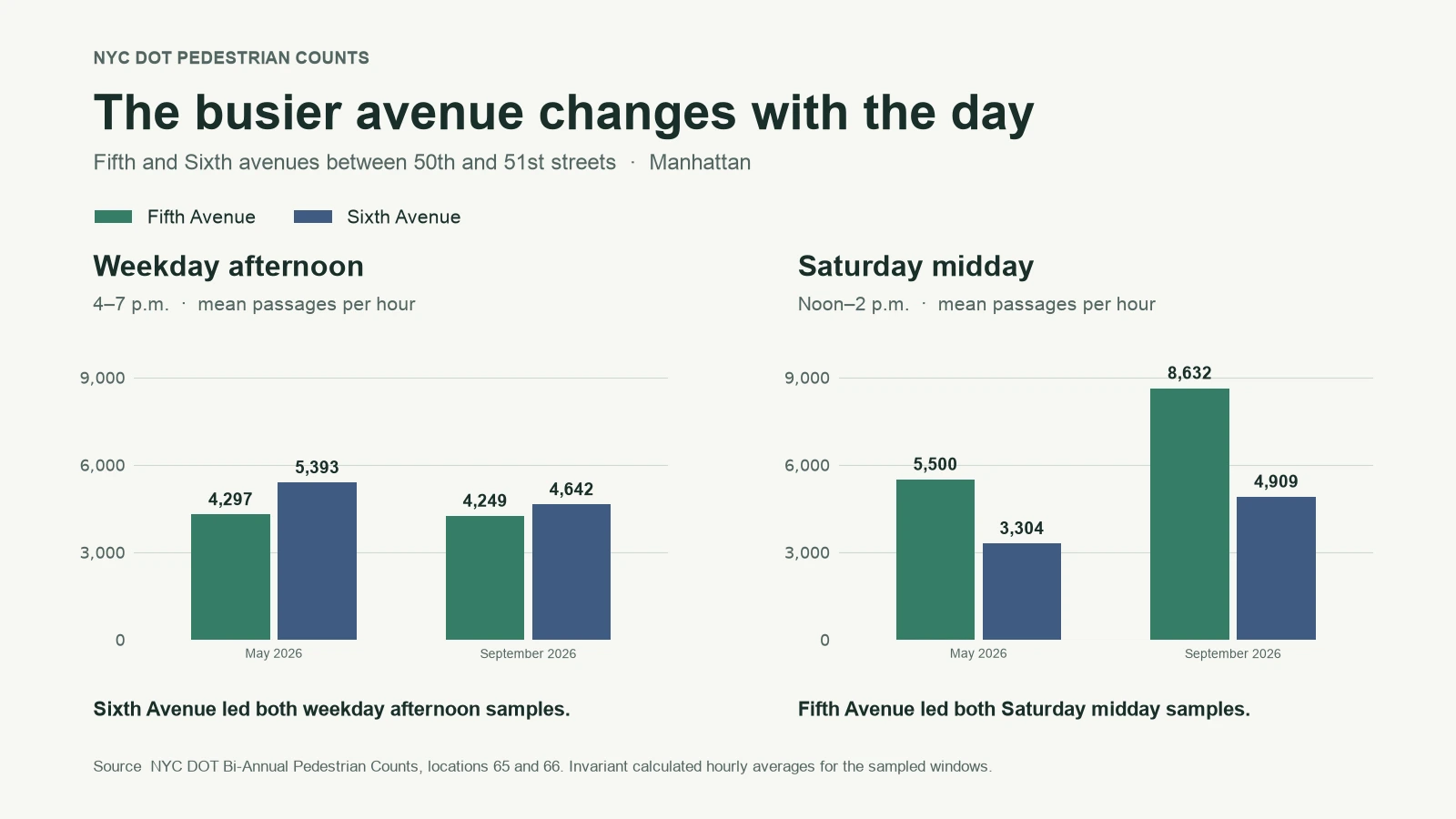
Start with a count on the block and during the hours your store depends on. In September 2026, NYC DOT counted 13,925 pedestrian passages on Sixth Avenue between 50th and 51st streets during its weekday afternoon sample, against 12,747 on Fifth Avenue between the same cross streets. On Saturday midday, Fifth Avenue led with 17,264 passages against 9,818. The May samples gave the same ordering for each window.
Before you start
- Use pedestrian passages to compare street exposure during matched windows. Measure the actual storefront approach separately.
- Compare raw totals only for windows of equal duration. Use passages per hour when comparing an afternoon sample with a shorter Saturday sample.
- Keep missing counts out of rankings. NYC DOT’s historical zero convention means a count was not collected. The selected Jay Street row omits all six 2026 fields.
- For a store visitation trial, ask for the property boundary, visit definition, sample coverage and how the provider handles nearby activity.
Find a count on the block you need
Map the proposed entrance and identify the block, frontage, and pedestrian approaches. Then find the city’s published count location and compare the cross streets. A count from a nearby avenue can reflect a different route to transit or another concentration of stores. Save the sensor or count location ID with the place you are evaluating.
NYC DOT’s biannual count program samples pedestrian passages across a line on the sidewalk. Its methodology describes both sides of the street where applicable, a weekday morning window of 7 to 9 a.m., a weekday afternoon window of 4 to 7 p.m., and a Saturday window from noon to 2 p.m. The case locations are Fifth Avenue, ID 65, and Sixth Avenue, ID 66, both between 50th and 51st streets.NYC count methodologyExact source rows
Fifth and Sixth avenues change places by daypart
| NYC DOT sample | Fifth Avenue | Sixth Avenue |
|---|---|---|
| May 2026 weekday, 4–7 p.m. | 12,892 in 3 hours · 4,297 per hour | 16,178 in 3 hours · 5,393 per hourExact source rowsNYC count methodology |
| May 2026 Saturday, noon–2 p.m. | 10,999 in 2 hours · 5,500 per hour | 6,607 in 2 hours · 3,304 per hourExact source rowsNYC count methodology |
| September 2026 weekday, 4–7 p.m. | 12,747 in 3 hours · 4,249 per hour | 13,925 in 3 hours · 4,642 per hourExact source rowsNYC count methodology |
| September 2026 Saturday, noon–2 p.m. | 17,264 in 2 hours · 8,632 per hour | 9,818 in 2 hours · 4,909 per hourExact source rowsNYC count methodology |
Sixth Avenue recorded 9.2% more passages in the September weekday afternoon window. Fifth Avenue recorded 75.8% more on Saturday midday. A store that depends on evening commuters and one that depends on Saturday shoppers could shortlist different blocks. Use multiple comparable counts at the proposed entrance before treating either sampled window as a typical week.Exact source rows
We used the NYC DOT release updated November 17, 2026. The table labels the campaigns by month. The selected records give no exact date for each count, so the comparison matches the sampling windows and campaigns. Hourly figures are count divided by window length and rounded here. The downloads retain the raw values and the calculation to two decimals.Source release timestampExact source rowsNYC count methodology
NYC DOT Midtown pedestrian passages by weekday and Saturday window
Download the matched pedestrian counts and hourly rates CSVCite dataset
Invariant (2026). NYC DOT Midtown pedestrian passages by weekday and Saturday window [Data set]. https://invariant-ai.com/blog/foot-traffic-data-by-address#dataset
NYC DOT compiled the source counts. Invariant selected the rows and calculated the hourly averages. NYC DOT and the City of New York disclaim accuracy, suitability and liability for errors or omissions. Observe posted signs.NYC DOT source notice
Keep missing observations visible
The same query returns a location record for Jay Street between Willoughby Street and Metrotech Walk in Brooklyn. Its May and September 2026 count fields are absent. Retain the location with a blank observation and ask the publisher or collect a new count before comparing it. NYC DOT’s methodology also treats an explicit zero in this series as a marker for no count collected.Exact source rowsNYC count methodology
Store the count location, exact source field, sample window, raw count, normalized rate, and missing-value status. Track the date you checked the source. For a store opening, add local conditions that can change passersby, including construction, weather, transit closures and unusual events.
Choose the measure that matches the decision
| Decision | Use | Trial check |
|---|---|---|
| Which block gets more street exposure during opening hours? | City pedestrian counts or your own screenline counts in comparable windows. | Check the cross streets, both sides of the street where applicable, period and uptime.NYC count methodology |
| How many people enter an existing store? | An entrance counter or authorized estimates of visits to the mapped location. Placer documents separate visit and visitor metrics. | Validate the entrance or property footprint, count employees and repeat visits consistently, and check for indoor or adjacent activity.Placer metric definitionsPlacer coverage notes |
| What demand can this store draw from the surrounding area? | Travel-time and demographic data, customer origins where available, and competitor locations. | Preserve the travel mode and period. Check the sales or visits evidence separately. |
In a vendor trial, use a real short list with an inline store, a stand-alone location and a space in a dense or multistory building. Ask how the vendor handles places it cannot measure. Nearby street activity can help compare areas when the estimate for a particular venue is unavailable.Placer coverage notes
Use Invariant Earth to resolve candidate addresses and match them to parcels before joining a count or visit dataset. Keep the storefront entrance, count point and parcel geometry as separate records so you can review the match later.Invariant Earth address workflow
Questions that come up.
Can I get foot traffic data by address?
Use the address to locate the proposed entrance, then check the nearest published pedestrian count on the same block and during the hours you need. For actual store entries, use a door counter or a visit dataset with a verified property boundary.NYC pedestrian countsNYC count methodologyPlacer metric definitions
How do I compare a weekday afternoon count with a Saturday count?
Divide each observed count by its own sampling duration to compare the passage rate. Keep each day and time window visible. NYC DOT’s weekday afternoon sample spans three hours, while the Saturday midday sample spans two.NYC count methodology
What does zero mean in the NYC DOT pedestrian count file?
NYC DOT’s methodology uses zero for a window in which the count was not collected. An omitted value has no published count either. Preserve both as unavailable when ranking sites.NYC count methodologyExact source rows
Sources and references.
Primary sources checked for this guide on .
- New York City Department of TransportationSelected NYC DOT pedestrian count records for locations 26, 65 and 66 ↗
- New York City Department of TransportationBi-Annual Pedestrian Counts table cqsj-cfgu ↗
- New York City Department of TransportationCurrent NYC DOT table metadata and source rowsUpdatedAt value ↗
- New York City Department of TransportationBi-Annual Citywide Pedestrian Count sampling windows and missing-value conventions ↗
- New York City Department of TransportationNYC DOT source and publication notice ↗
- Placer.aiPlacer API metric definitions for visits, visitors and estimated foot traffic ↗
- Placer.aiPlacer API coverage for flagged venues and Nearby Activity reports ↗
- Invariant Earth APIAddress and parcel lookup with Invariant Earth ↗
Try Invariant Earth on a site you know.
Pick a US coordinate and inspect the source, dataset vintage, and status for each field.
Open the API quickstart