

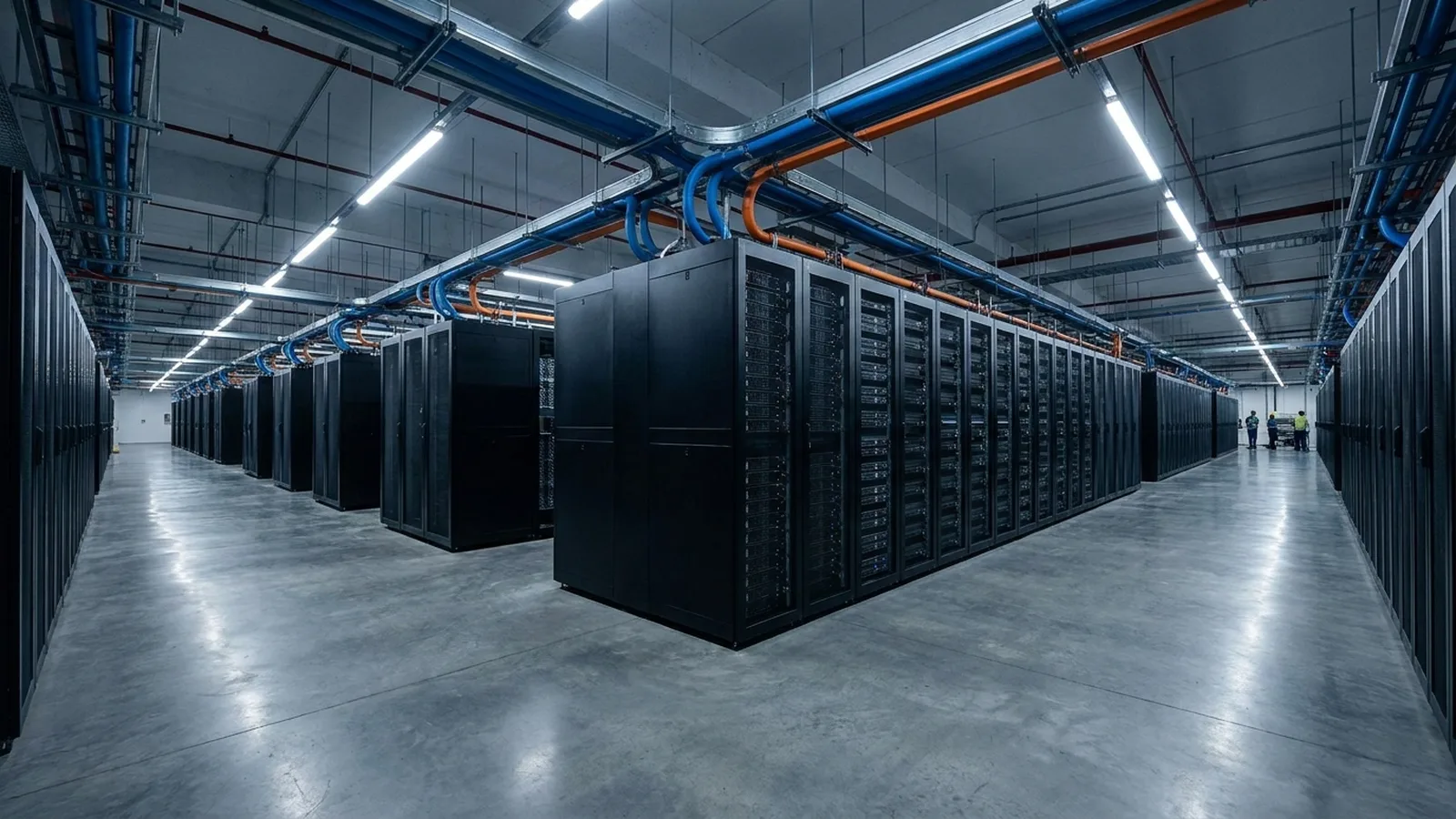
Neoclouds and smaller AI labs find capacity in three places: colocation halls that can take dense liquid-cooled racks, built or energized sites they can lease whole, and powered land they build on. The right one depends on cluster size and how soon you need it. A 1,024-GPU B200 cluster draws about 2.6 MW at the meter; 16,384 GB200 GPUs need about 39 MW. Below roughly 5 MW, colocation is usually fastest. From 5 to 50 MW, energized sites and built halls win. Above that, you are buying a power date, and the date is what you should check first. Invariant finds capacity that fits and checks the power behind it.
Before you start
- Start from MW and date, not square feet. Power is the binding constraint for every option.
- Dense racks change the shortlist. GB200 NVL72 racks run near 120 kW and need liquid cooling.
- A provider’s power date is a risk you inherit. Leases now carry longstop dates for exactly this reason.
- Send the GPU count, rack density and date. We send capacity that fits, with the evidence behind each MW figure.
How much power your cluster needs
System power comes from NVIDIA’s own figures: 10.2 kW for an eight-GPU DGX H100, 14.3 kW for an eight-GPU DGX B200, and about 120 kW for a 72-GPU GB200 NVL72 rack. We add about 10% for networking and storage and a PUE of 1.3 for the building.NVIDIANVIDIAeeNews Europe
| GPUs | H100, facility MW | B200, facility MW | GB200 NVL72, facility MW |
|---|---|---|---|
| 256 | 0.5 MW | 0.7 MW | 0.6 MW |
| 1,024 | 1.9 MW | 2.6 MW | 2.4 MW |
| 4,096 | 7.5 MW | 10 MW | 9.8 MW |
| 16,384 | 30 MW | 42 MW | 39 MW |
| 32,768 | 60 MW | 84 MW | 78 MW |
| 100,000 | 182 MW | 256 MW | 238 MW |
These are planning figures for sizing a search, not a substitute for your own bill of materials. The full method is in our GPU power guide.
The three ways to get capacity
| Option | Typical size | Time to power | What decides it |
|---|---|---|---|
| Colocation in a built hall | A few racks to about 10 MW | Weeks to a few months if the hall has liquid cooling and spare power | Rack density the hall can cool, power per cabinet, contract term |
| Lease a built or energized site whole | About 5 to 100 MW | Months; fit-out and cooling retrofit set the date | Whether the MW is energized or only contracted, cooling, fiber |
| Build on powered land | 50 MW to 1 GW+ | Usually 18 months or more, set by the utility date and long-lead equipment | The document behind the power date, large-load tariff terms, permits |
Most smaller labs start in colocation and move as they grow. Neoclouds selling capacity on to labs tend to lease or build, because their margin depends on owning the power.
What to check before you commit
- The power evidence: an energized service, a signed service agreement, a load study, or just a map near a line?
- Power per cabinet and the cooling plan for your density: rear-door, direct-to-chip, or immersion?
- The date power is available and what it depends on: upgrades, transformer deliveries, a utility study cycle.
- Minimum bills and terms in the utility agreement, which you may inherit through the lease.
- Fiber routes and latency to where your users or your training data sit.
- Local approvals: zoning, moratoriums, and air permits for any on-site generation.
Capacity we can talk about now
A sample of US capacity in our inventory, from built Tier III rooms to powered campuses. Every row has been checked against utility documents.
| Region | Power | Land or building | Timing |
|---|---|---|---|
| US (3 facilities) | Tier III data centers, 3.5 to 10 MW | Built | Now |
| Iowa | 2 MW+ edge site | Leased | Now |
| Texas (Houston) | 3 MW ERCOT | Leased | Now |
| Oklahoma | 55 MW contracted | ~80 acres | Now |
| Wisconsin | 80 MW marketed at a reported 150 MW substation | 130 acres marketed as developable | Confirm current service terms |
| Texas metro | 44 MW, +250 MW | ~50 acres, 1M sq ft | Now |
| North Carolina | 18 MW live, path past 100 MW | ~200 acres | Now |
| Indiana | 200 MW, load study done | ~80 acres | Substation planned |
| Ohio | 300 MW marketed as approved | 300+ acres | First-half 2027 target |
| Pennsylvania | 350 MW, signed utility service agreement | Former plant campus, lease | 50 MW end 2026, 300 MW end 2027 |
Exact locations, the utility documents behind each MW figure and terms are shared on a call. Some capacity we know of is not listed anywhere; owners ask for discretion.
How we work with neoclouds and labs
You send the cluster: GPU type and count (or MW), rack density, the date and the regions you would consider. We send options that fit, each graded by the document behind its power. If you already have a provider or site in mind, we run a power check on it instead, so the date in your contract holds.
We are paid on the work, and we say which capacity is listed and which is off-market.
More for neoclouds and AI labs
Questions that come up.
Where can a neocloud find data center capacity for GPUs?
In colocation halls that can cool dense racks, in built or energized sites leased whole, or on powered land. Invariant tracks all three across the US and checks the power behind each before introducing it.
How much power does a 1,000 GPU cluster need?
About 1.8 MW for H100, 2.6 MW for B200 and 2.4 MW for GB200 NVL72 at the meter, using NVIDIA system power, about 10% for networking and storage, and a PUE of 1.3.NVIDIANVIDIAeeNews Europe
What is a neocloud?
A cloud provider built mainly to rent GPU compute for AI training and inference, as distinct from the general-purpose hyperscalers. Neoclouds lease or build data center capacity and sell it on to AI labs and enterprises.
How fast can I get capacity for a GPU cluster?
Colocation with spare power and liquid cooling can take weeks to a few months. Energized sites take months, set by fit-out. New builds usually take 18 months or more, set by the utility date.
How do I request capacity from Invariant?
Email pranav@invariant-ai.com or call (628) 220-8972 with the GPU count and type, rack density, date and regions. You can also book a 30 minute call from this page.
Sources and references.
Primary sources checked for this guide on . The location, equipment, and operating plan determine which requirements apply to a project.
- NVIDIAIntroduction to the NVIDIA DGX H100 system ↗
- NVIDIAIntroduction to the NVIDIA DGX B200 system ↗
- eeNews EuropeNvidia offers 120 kW liquid-cooled Blackwell rack as industry standard ↗
- Lawrence Berkeley National Laboratory and The Brattle GroupElectricity rate designs for large loads (August 2026) ↗
- US EPAWho has to obtain a Title V permit ↗