

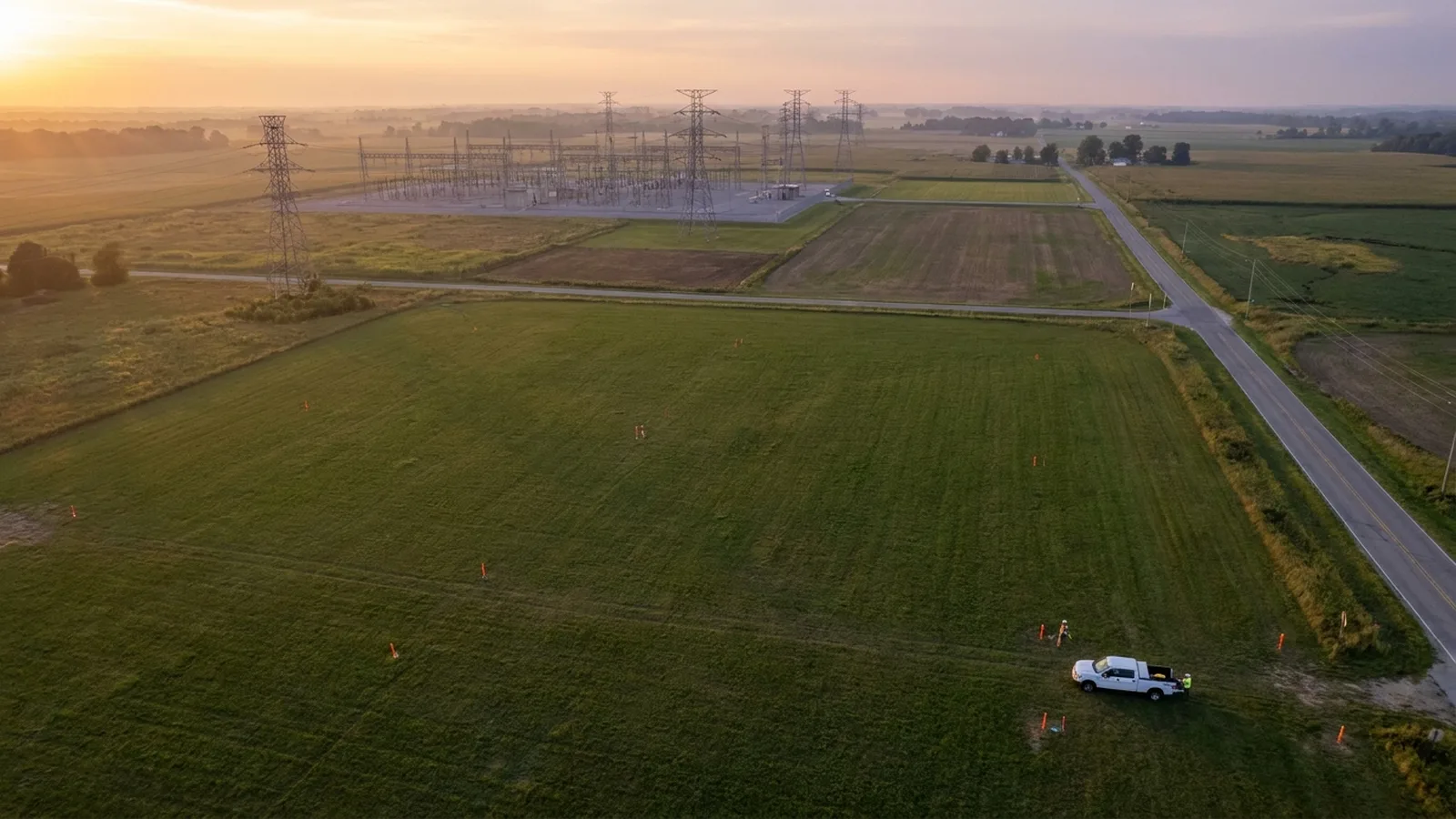
Data center site due diligence answers two questions in order. Is this site worth more money and time? And how much power can it get, by when, and at what cost? Invariant splits the work the same way. Step one is a feasibility screen: from a coordinate and a MW figure we check power at the nearest substations, flood zone, seismic hazard, wetlands, airports, zoning and the parcel, and end in a go or no-go. Step two is a utility-grade power study for the sites that pass: an AC power flow with N-1 contingency tests at each connection option, the upgrades that lift the limit, an indicative cost and an energization date.
Before you start
- Screen many sites cheaply, then study the few that survive. Most sites fail on something you can check in a day.
- Distance to a line is not capacity. Paces found only about 17% of ERCOT substations near suitable land had any withdrawal headroom.
- A utility load study costs $10,000 to $100,000 or more and needs site control. Run your own study first so you file at the right point with the right MW.
- Our MW figures are screening figures built to utility planning methods. The utility’s own study is what makes a number firm.
The two steps and what each one decides
Most site deals die for boring reasons: a floodway across the pad, a county moratorium, a substation that is already spoken for. None of those need a power flow to find. So the first pass is wide and fast, and the expensive work only goes to sites that have earned it.
| Step 1: feasibility screen | Step 2: utility-grade power study | |
|---|---|---|
| Question | Should we keep going on this site? | How many MW, at which point, by when, for how much? |
| Input | Coordinate or parcel, target MW, energize-by date | The same, plus phasing, power factor and any utility letters you hold |
| Power work | Nearest substations and lines, screening MW range by year, binding constraint | Full AC power flow, N-0 and N-1 contingencies, short circuit, upgrade search |
| Site work | Flood, seismic, wetlands, species, FAA, zoning, moratoriums, parcel, water, fiber | Zoning and permitting path, environmental and flood, airspace, county sentiment, ownership file |
| Output | Go, no-go or conditional go, with the reason | A report you can take into an LOI: MW by connection point and year, upgrades, cost range, date range, utility path |
| Turnaround | Within 24 hours | Usually within 48 hours |
Who buys this? Developers deciding which options to exercise, investors and lenders underwriting powered land, AI companies and neoclouds choosing between shortlisted sites, landowners who want to know what their land is worth to a data center, and brokers and advisers who want the work done behind their own name.
Step 1: the feasibility screen
The screen is a set of kill checks run in a fixed order, cheapest first. The power check comes first because it kills the most sites. A site 20 miles from any 138 kV or higher station rarely makes sense above a few MW, whatever else it has going for it.
| Check | What we look at |
|---|---|
| Power | Serving utility and ISO, nearest substations and lines with voltage and distance, a screening MW range at each for the next three study years, the constraint that sets it |
| Flood | FEMA flood zone on the pad and the access road, base flood elevation where mapped, coastal surge and sea level exposure |
| Seismic and ground | USGS ground motion, ASCE 7 site values, mapped faults, soils and slope |
| Environment | Wetlands, listed species, contamination records nearby, and whether a Phase I ESA is the next step |
| Airspace | Airports and heliports nearby and whether FAA notice is likely for the buildings, stacks or cranes |
| Land and local | Parcel, owner and acreage, zoning, data center moratoriums and county sentiment |
| Utilities | Water and wastewater, fiber routes, gas for on-site generation |
| Verdict | Go, no-go or go with conditions, with the kill reason or the one question that decides it |
Every finding carries its source. Where we cannot settle something from records, the report says so and names the document or call that would settle it.
Step 2: the utility-grade power study
A utility decides how much load a site can take by running a power flow on its planning model and testing what happens when a line or transformer trips. We run the same kind of study, on a model of the network we rebuild around your site, before you spend a study deposit or post security.NERC
| Part | What it covers |
|---|---|
| Network model | The transmission system around the site rebuilt for each study year, checked against flows the ISO publishes |
| Cases | Summer peak, winter peak and light load, near-term and later study years, with competing loads in and out |
| Load injection | Your MW, ramp and power factor at each candidate point of interconnection, including new switching stations on nearby lines |
| Contingencies | AC power flow at N-0 and N-1 for every element in the study area (NERC TPL-001 P1), plus selected breaker and common-tower events |
| Limits | Thermal limits against normal and emergency ratings, voltage limits, the element that binds first and at what MW |
| Grid strength | Short circuit level and short circuit ratio at the point of interconnection, with a flag where dynamic studies are likely |
| Upgrades | The fix for each violation and the MW it unlocks: reconductoring, a second transformer, a new bay, a new line |
| Cost and date | Indicative cost ranges from unit costs and a dated energization range from the utility process and lead times |
| Utility path | Tariff, study fees, security, minimum bills and the questions to bring to the pre-application meeting |
The answer comes out as a MW figure per connection point per study year, the line or transformer that sets each figure, and what it would take to lift it. That is the information you need to pick a point of interconnection, size a first phase and judge a seller’s claims.
Why proximity to a line misleads
The most common mistake in powered land is reading a transmission map as a capacity map. A 345 kV line beside the parcel tells you a tap is physically possible. It says nothing about whether the line, the next substation or the transformers upstream can carry another 200 MW when one element is out of service.
In a 2025 analysis of ERCOT, Paces found only about 17% of substations near suitable land had any withdrawal headroom.Paces
We see the same pattern in our own studies. In one recent Gulf Coast study, the two nearest 138 kV substations could take only a few MW in the first study year, while a new 345 kV switching station on circuits running past the site could take about 200 MW. Same parcel. Very different answer depending on where you connect.
Where our study sits next to the utility’s
Utilities run their own studies once you apply with site control, and those are the only studies that commit them. AEP Ohio charges $10,000 to $100,000 for a data center study depending on size. Texas set a $100,000 study fee for large loads in ERCOT.AEP OhioUtility Dive
Our study does not replace that step. It makes it count: you file at the connection point most likely to work, at a MW figure the network can carry, with a list of questions that gets real answers in the pre-application meeting. Every report states that its figures are screening figures and that the utility’s study makes them firm.
Equity investors buy this kind of diligence too. Ankura’s case study of a 300 MW brownfield for an institutional investor covered 230 kV line and substation feasibility, ISO timing, zoning, gas supply, cooling water and a risk matrix.Ankura
More due diligence guides
Questions that come up.
What is data center site due diligence?
It is the work that tells a buyer whether a site can be built on and powered, by when and at what cost. It covers power and interconnection, flood, seismic and ground conditions, wetlands and species, airspace, zoning and local approval, water, fiber and the parcel. Invariant runs it in two steps: a feasibility screen, then a utility-grade power study.
What is the difference between a feasibility study and a power study for a data center?
A feasibility screen checks whether a site has a fatal flaw and gives a first range of MW at nearby substations. A power study runs an AC power flow with N-1 contingency tests at each connection option and returns MW by year, the binding element, the upgrades needed, an indicative cost and an energization date.
How long does data center site due diligence take?
Invariant returns a feasibility screen within 24 hours of receiving a coordinate and a MW figure, and a utility-grade power study usually within 48 hours. A utility’s own load study takes months; AEP Ohio, for example, quotes 45 to 60 days for its data center study after an application is complete.AEP Ohio
Can a site be judged by its distance to a transmission line?
No. Distance shows a connection is physically possible, not that the network can carry the load. Paces found only about 17% of ERCOT substations near suitable land had withdrawal headroom.Paces
How do I request a site screen from Invariant?
Email pranav@invariant-ai.com or call (628) 220-8972 with the coordinate or parcel, the target MW and the date you need power. You can also book a 30 minute call from any of these pages.
Sources and references.
Primary sources checked for this guide on . The location, equipment, and operating plan determine which requirements apply to a project.
- NERCTPL-001-5.1: Transmission system planning performance requirements ↗
- AnkuraBrownfield to data center: technical due diligence to de-risk 300 MW of capacity ↗
- PacesGrid planning for data centers and transmission investment ↗
- AEP OhioData center tariff ↗
- Utility DiveTexas PUC adopts data center interconnection rules ↗