

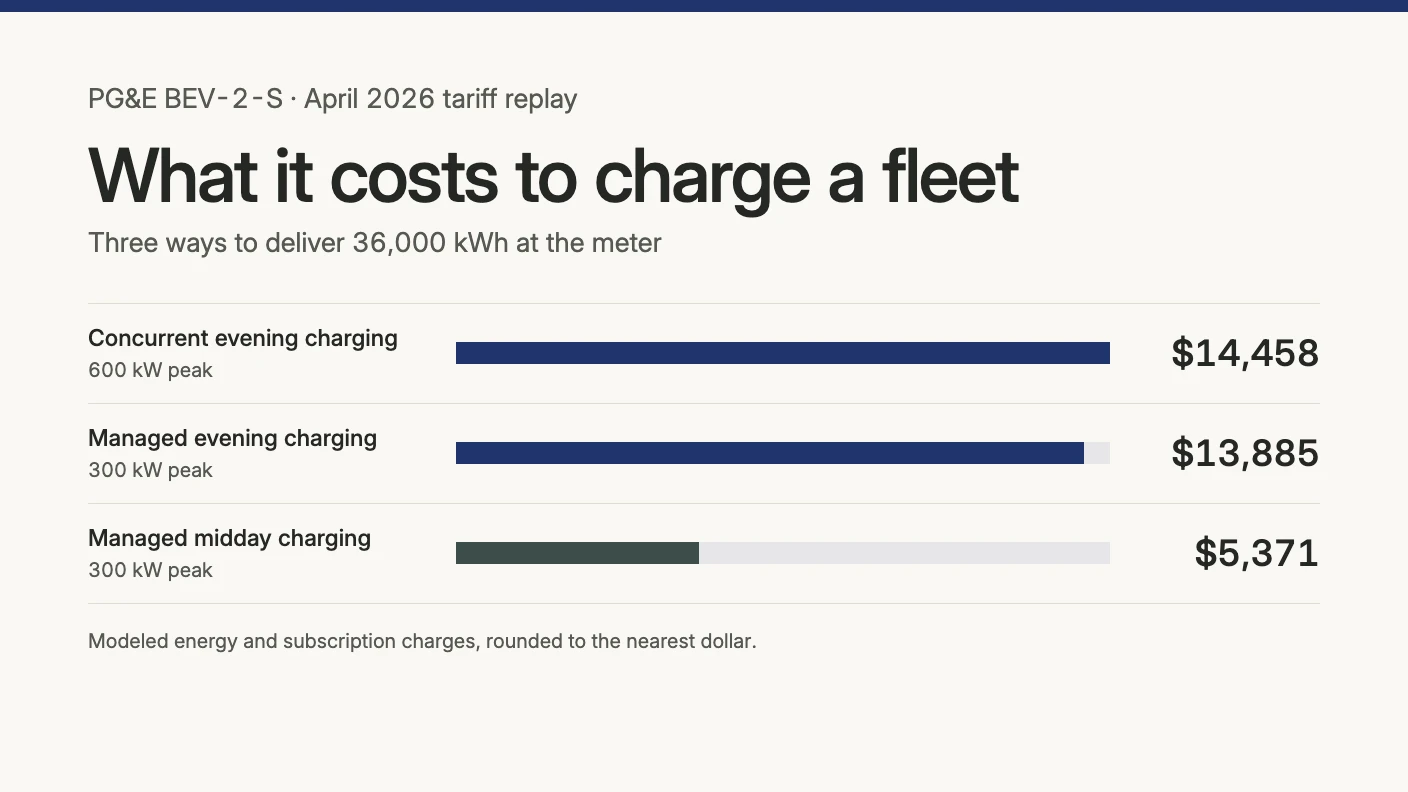
To estimate the electricity bill for a fleet depot or fast charging station, use the rate available at the proposed meter and a 15-minute estimate of what the site will draw. Price the energy by time of day and calculate the charge tied to peak demand separately. In a PG&E example, halving the peak draw saved $573.36 for the month. Moving the same charging to midday saved another $8,514.00. The savings depend on when vehicles are actually available to charge.
Before you start
- Use power at the utility meter in kilowatts (kW) and energy in kilowatt-hours (kWh). A charger’s advertised output to the vehicle measures a different part of the system.
- Ask the serving utility which rates, meter configurations and service voltages it will offer at the parcel before underwriting the site.
- Replay the same loads under each eligible tariff and check both an ordinary month and the busiest month you expect.
How do you estimate a commercial EV charging bill?
Start with the number of vehicles, when they arrive, when they must leave and how much energy each needs. Turn that schedule into intervals of power drawn at the utility meter, including charger losses and loads served by that meter. For a fast charging station, use expected session arrivals and duration and test a busy period with several sessions overlapping.AFDC fleet electrification guidance
| Line item | How to estimate it |
|---|---|
| Energy | Multiply each interval’s metered kWh by the applicable rate for that time of day. Sum the interval charges. |
| Demand or subscription | Apply the tariff to the metered peak or subscribed kW. Check the measurement interval, demand windows, minimums and whether prior peaks carry into later months.PG&E Schedule BEVSCE business EV rates |
| Other bill items | Use the actual rate terms for fixed charges, riders, taxes and credits. Confirm whether your energy supplier and your delivery utility bill separately.PG&E Schedule BEV |
| Connection and site costs | Carry the utility upgrade, meter and customer-side work, charger costs, rent and maintenance in the broader site model.AFDC fleet electrification guidanceEVI-FAST project economics |
At a candidate address, identify the serving utility and request the applicable rate code, delivery voltage, metering arrangement and expected service date. Ask whether the charging load can be metered on its own and which fees apply to that account. A published rate helps price the load after the utility confirms eligibility and the service it can deliver.PG&E business EV enrollmentSCE business EV rates
What would a 600 kW charging depot pay under PG&E’s business EV rate?
This example uses a dedicated EV meter on PG&E’s bundled secondary-voltage BEV-2-S rate for April 2026, outside the subscription grace period. Each scenario uses 1,200 metered kWh a day for 30 days. The model assumes vehicles are available for the entire charging window. The meter draws a constant 600 kW for two hours or 300 kW for four hours.PG&E Schedule BEVMarch 2026 filed BEV rates
The March 2026 sheet lists $95.56 per 50 kW subscription block and $3.82 per excess kW. Energy costs $0.36977 per kWh from 4 p.m. to 9 p.m. and $0.13327 per kWh from 9 a.m. to 2 p.m. PG&E lists $0.15654 per kWh for the remaining hours. These windows apply every day under this schedule.March 2026 filed BEV ratesPG&E Schedule BEV
| April scenario and local charging time | Modeled subtotal | Peak / subscribed kW | Energy | Subscription | Overage |
|---|---|---|---|---|---|
| Concurrent evening charging · 4–6 p.m. | $14,458.44 | 600 / 600 | $13,311.72 | $1,146.72 | $0.00March 2026 filed BEV rates |
| Managed evening charging · 4–8 p.m. | $13,885.08 | 300 / 300 | $13,311.72 | $573.36 | $0.00March 2026 filed BEV rates |
| Managed midday charging · 9 a.m.–1 p.m. | $5,371.08 | 300 / 300 | $4,797.72 | $573.36 | $0.00March 2026 filed BEV rates |
| Concurrent charging with a 300 kW subscription · 4–6 p.m. | $15,031.08 | 600 / 300 | $13,311.72 | $573.36 | $1,146.00March 2026 filed BEV rates |
Spreading the evening load keeps all usage in the same energy band and saves six subscription blocks, or $573.36. Moving that 300 kW schedule to midday cuts the energy charge by $8,514.00. The final row shows the exposure when the subscribed demand stays at 300 kW but the meter still reaches 600 kW. That adds $1,146.00 in overage for the billing period.PG&E Schedule BEVMarch 2026 filed BEV rates
Under this tariff, the overage uses the highest 15-minute average in the billing period. It is assessed once per period, even when multiple intervals exceed the subscription. For the example, multiply the 300 kW excess by the filed $3.82 per kW. The subtotal excludes taxes, account-specific credits and the cost of building or operating the site.PG&E Schedule BEV
Commercial EV charging tariff replay for PG&E BEV-2-S
Download all four 15-minute meter profiles CSVCite dataset
Invariant (2026). Commercial EV charging tariff replay for PG&E BEV-2-S [Data set]. https://invariant-ai.com/blog/ev-charging-electricity-cost-demand-charges#dataset
Screen a charging site and its utility by address
Download the tariff inputs and modeled monthly totals JSONWhich tools can compare EV electricity rates for a proposed site?
Give each provider the same address, rate version, service voltage, meter arrangement and interval file. Ask for the billed peak, energy by time band, the subscribed kW, the overage and the source sheet for each charge. Use a recent bill from the same account to check the result when one is available.PG&E Schedule BEVArcadia tariff calculation API
| Source | What it helps you do | What to verify in a trial |
|---|---|---|
| Invariant Earth | Screen the property and bring the serving utility, access and site context into the same diligence file. | Confirm the parcel match, service availability and evidence date. Then use the eligible tariff and metered profile to price the load.Invariant Earth charging site workflow |
| Utility tariff and account team | Confirm rate eligibility and the terms and timing for serving the proposed load. | Request the written service and meter assumptions and the filed schedule for the expected service date.PG&E business EV enrollmentSCE business EV rates |
| OpenEI Utility Rate Database | Find structured energy and demand rates as inputs for a tariff screen. | Check the effective date and representation of subscription and overage against the sheet.Utility Rate Database API |
| Arcadia Signal | Look up tariff versions and model itemized electricity costs. | Ask whether the specific tariff version can price the subscription and monthly overage in the replay.Arcadia tariff calculation API |
| NLR EVI-FAST | Compare charging project economics, with electricity and demand costs as inputs. | Trace the electricity input to the verified site tariff. Add utilization, charging revenue, installation and financing assumptions.EVI-FAST project economics |
Run the comparison again with your busiest operating day, a cold-weather charging assumption and a service or charging interruption. A lower subscription works only when the fleet can reliably stay within the planned peak or the expected overages fit the budget. A public fast charging operator also has to account for lost sales or queues when the load cap slows service.AFDC fleet electrification guidancePG&E Schedule BEV
Questions that come up.
Do all commercial EV rates have a demand charge?
No. The rate varies by utility and schedule. PG&E’s BEV-2-S model uses a kW subscription plus an overage. Check the applicable tariff for fixed charges, demand charges, subscription terms and any temporary exclusions.PG&E Schedule BEVSCE business EV rates
Can you estimate the bill from a charger’s kW rating?
The rating helps bound what one charger can deliver to a vehicle. To estimate utility charges, model simultaneous sessions and total AC draw at the meter, then price the 15-minute intervals under the applicable tariff.PG&E Schedule BEVAFDC fleet electrification guidance
How much is a 300 kW subscription on PG&E’s BEV-2-S example rate?
At the rate effective March 1, 2026, six 50 kW blocks cost $573.36 per billing period. Time-of-use energy charges and any overage are separate.March 2026 filed BEV ratesPG&E Schedule BEV
Sources and references.
Primary sources checked for this guide on .
- Pacific Gas and Electric CompanyElectric Schedule BEV, sheets 1–7 ↗
- Pacific Gas and Electric CompanyAdvice 7846-E, Schedule BEV sheet 2, effective March 1, 2026 ↗
- Pacific Gas and Electric CompanyBusiness EV rate eligibility, subscription and enrollment ↗
- Southern California EdisonBusiness electric vehicle rate plans TOU-EV-7, TOU-EV-8 and TOU-EV-9 ↗
- U.S. Department of EnergyElectric Vehicles for Fleets, charging needs and infrastructure ↗
- OpenEIUtility Rate Database API version 7 ↗
- ArcadiaCalculate Cost, Signal API ↗
- National Laboratory of the RockiesElectric Vehicle Infrastructure Financial Analysis Scenario Tool ↗
- InvariantScreen an EV truck charging site by address ↗
Try Invariant Earth on a site you know.
Pick a US coordinate and inspect the source, dataset vintage, and status for each field.
Open the API quickstart