

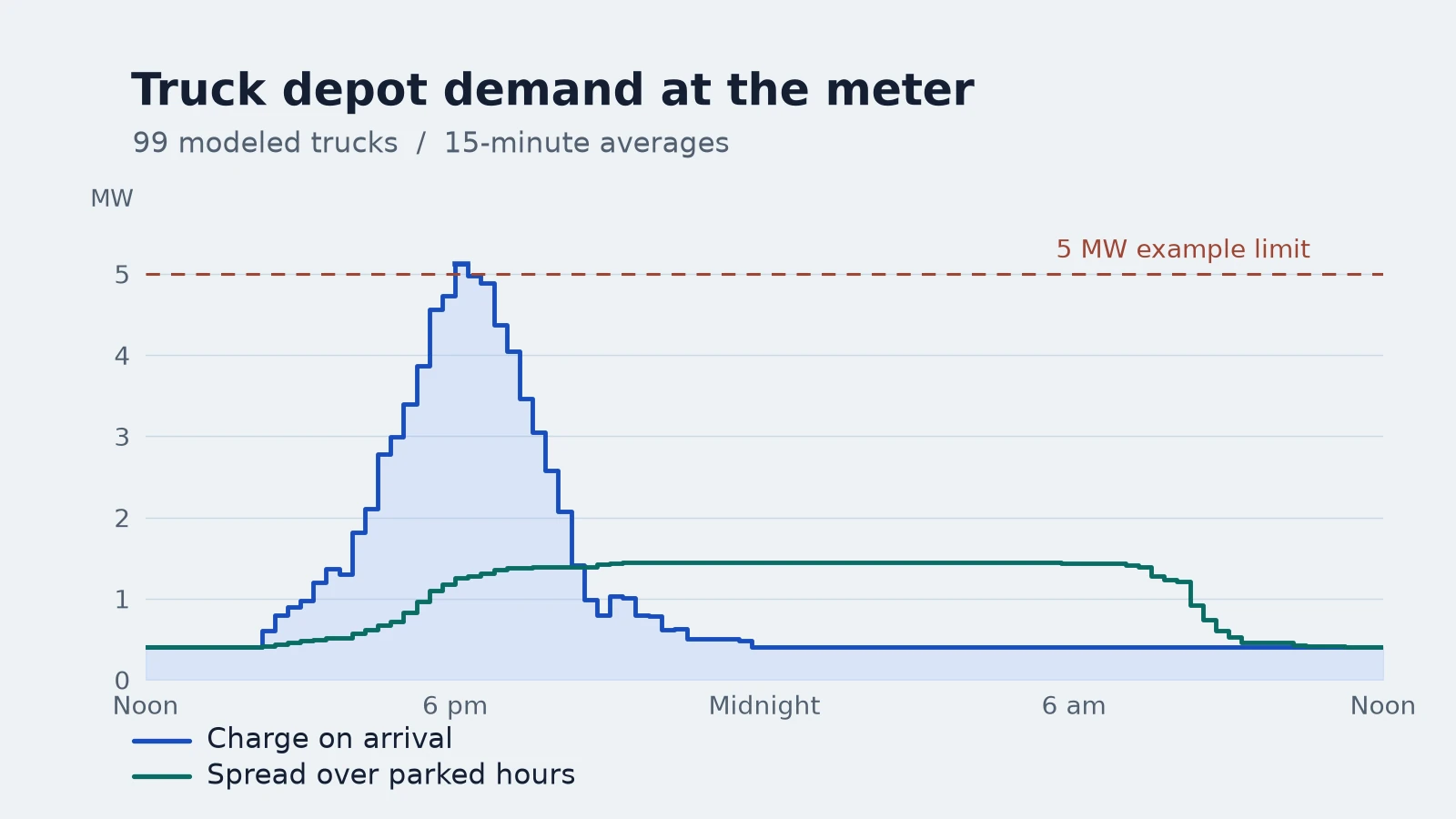
A 5 MW service limit can work for a truck charging depot when enough trucks stay parked long enough. Start with the energy each truck needs before its next dispatch, the time it can stay plugged in, and the load the rest of the site already uses. In our 99-truck example, charging on arrival peaks at 5.13 MW at the meter. Spreading the same energy over parked hours reduces the peak to 1.45 MW. The same 5 MW limit falls short when all trucks have only three hours.
Before you start
- Model the busy dispatch day with return times, departure deadlines, required battery energy, and realistic charger limits.
- Route a loaded truck to the proposed gate and draw its movement inside the yard. A parcel close to the interstate can still have an unusable entrance.
- Ask the serving utility for the meter limit, service date, upgrade scope, and rate for each phase. Compare those terms with the site and truck commitments.
What changes when trucks charge overnight?
We built an example day from 99 single-shift operating patterns published with Brennan Borlaug and colleagues’ 2021 study. Each pattern represents one truck in the example, with its published route mileage and return and departure times. The model repeats that day, rounds each parking window inward to complete 15-minute intervals, and assumes 1.8 kWh per mile at the battery and 92% charging efficiency. Each truck can draw up to 100 kW AC at its port. Other site demand stays at 400 kW. This is a constructed fleet day using published inputs.Borlaug et al., Nature EnergyNational Renewable Energy Laboratory
| Charging plan | Result at the meter | Decision under a 5 MW limit |
|---|---|---|
| Charge on arrival | 5.13 MW peak, starting at 6 p.m. | One 15-minute interval exceeds the limit. |
| Spread charging over each truck’s parked hours | 1.45 MW peak with the same 15.83 MWh of charging energy. | The example stays below the limit and supplies each truck’s route energy. |
| Give all trucks the same three-hour window | A maximum of 13.80 MWh for charging after other site load. The fleet needs 15.83 MWh. | The fleet is short about 2.03 MWh. Four trucks also need more energy than a 100 kW port can deliver in three hours. |
The two overnight schedules each assume one working port per truck, constant efficiency, and no battery storage. Vehicle charging power can fall as batteries fill. Late returns, reserve requirements, charger downtime, and shared cabinets can change what is possible. Test those cases with your actual trucks before treating the lower peak as a design input.U.S. Department of Energy AFDCU.S. Department of Energy AFDC
Truck depot charging load profiles
Download the 96 demand intervals, assumptions, and source files JSONCite dataset
Invariant (2026). Truck depot charging load profiles [Data set]. https://invariant-ai.com/blog/truck-depot-charging-site-selection#dataset
Screen a depot parcel near I-35
Pick the interchange your trucks will actually use. In Texas, local truck routes and posted restrictions can change the last mile. Check the route in both directions with the dimensions and loaded weight of your tractor and trailer. Review the driveway and traffic movements with the road authority or local jurisdiction before you rely on a route.TxDOTTxDOT freight programEsri ArcGIS
| Screening check | Evidence to collect |
|---|---|
| Truck access | Route to the actual gate, turn restrictions, clearances, posted bridge limits, approach grade, and space to queue without blocking the road. |
| Usable yard | Parcel and survey, swept paths for a loaded truck, parking and trailer movements, charger cable reach, and areas needed for maintenance and emergency access. |
| Land and approvals | Documented site control, zoning and use permissions, drainage and flood screening, access and construction rights, and the easements required for service. |
| Utility service | Named utility and delivery point, current interval demand, proposed incremental and total import by phase, energization milestones, dependencies, and project cost responsibility. |
| Backup charging | An accessible station with a compatible connector and enough room for the fleet’s vehicles. Confirm access, operating hours, current port availability, and fallback terms with the operator. |
Advance a parcel when the truck path, concept layout, and service path can all support the same dispatch plan. A parcel whose only workable gate sends tractor-trailers across a weight-restricted bridge stays off the shortlist until there is a documented alternate route. A parcel with good access and a utility date after the planned truck delivery needs a phased fleet plan or a different site.TxDOTU.S. Department of Energy AFDC
Which data and APIs answer which questions?
| Question | Starting source | What to verify |
|---|---|---|
| How much energy is needed before dispatch? | Fleet telematics, dispatch logs, and vehicle specifications. The national lab’s EVI-X tools support fleet and charging analysis. | Use arrival time, next departure, state of charge and usable battery capacity. Check charger-to-vehicle compatibility and how power changes during a session.National Laboratory of the RockiesU.S. Department of Energy AFDC |
| Can the truck reach the parcel? | A truck-routing API such as ArcGIS, together with state and local route restrictions. | Set the right truck dimensions and route to the actual gate. Confirm posted and private restrictions, then review the turns on the site plan.Esri ArcGISTxDOT |
| Is a backup charger usable? | DOE’s Alternative Fueling Station Locator tracks station status, access, connectors, and maximum vehicle class where available. | Check the date and confirm with the operator. A listed vehicle class describes physical access. It cannot establish the current wait time, reserved capacity, or access rights.AFDC Station LocatorAFDC release notes |
| What can I learn about the parcel and nearby infrastructure? | Invariant Earth’s catalog lists parcel, terrain, floodplain, and nearby grid-asset fields. | Retain the source, vintage and field status. Use them to eliminate or prioritize parcels and take the proposed load to the serving utility.Invariant Earth catalogInvariant Earth docs |
What to send the utility before you sign a lease
Send the parcel and proposed service location, fleet and port counts by phase, the requested service dates, and a busy-day load profile showing both charging and other site demand. Identify the charge-management limit you can enforce and explain how the fleet will operate when a charger is down or a shift gets back late. Ask which study and agreements are required, which upgrades or easements are on the critical path, and what deposits or construction costs the customer would carry.U.S. Department of Energy AFDCOncorU.S. Department of Energy AFDC
Ask for the applicable tariff and the meter’s billing rules, including demand charges and time-of-use periods. A lower modeled peak helps evaluate the design. Your business case also depends on energy delivered, the rate and any contractual obligations. For a candidate with an existing service, confirm which load and delivery date the utility can support for your phase and configuration.
Questions that come up.
How many 100 kW chargers fit within a 5 MW meter limit?
With 400 kW of other site demand, 4.6 MW remains. That supports 46 concurrent 100 kW AC draws in the simple example. The number of trucks the site can serve over a day also depends on parking time, dispatch deadlines, per-vehicle energy, and shared equipment.
Does a nearby substation tell me whether the depot can get 5 MW?
A nearby substation helps identify where to ask about service. Confirm the actual connection point, available service by phase, required work, and delivery date with the serving utility.U.S. Department of Energy AFDCOncor
What should I send with an EV fleet charging site inquiry?
Send the parcel or gate coordinate, the truck and trailer dimensions, the return and departure schedule, energy needed before each dispatch, existing site load, requested phase limits and dates, and any minimum operating requirements during charger outages.U.S. Department of Energy AFDCU.S. Department of Energy AFDC
Sources and references.
Primary sources checked for this guide on .
- Borlaug et al., Nature EnergyHeavy-duty truck electrification and the impacts of depot charging on electricity distribution systems ↗
- National Renewable Energy LaboratoryPinned Fleet 2 warehouse-delivery inputs used in the model ↗
- U.S. Department of Energy AFDCElectric vehicle fleet planning and working with the utility ↗
- U.S. Department of Energy AFDCMedium- and heavy-duty charging infrastructure planning ↗
- National Laboratory of the RockiesEVI-X tools for fleet and charging infrastructure analysis ↗
- TxDOTTexas truck routes and municipal rerouting ↗
- TxDOT freight programTexas Connected Freight Corridors and I-35 ↗
- Esri ArcGISRouting restrictions for truck height, weight, and trailers ↗
- AFDC Station LocatorAlternative Fuel Station Locator fields and vehicle classes ↗
- AFDC release notesStation Locator connector and vehicle-class updates ↗
- Invariant Earth catalogPublic parcel, terrain, flood, and grid field catalog ↗
- Invariant Earth docsField response and provenance contract ↗
- OncorTexas fleet electrification and electric utility contact ↗
Try Invariant Earth on a site you know.
Pick a US coordinate and inspect the source, dataset vintage, and status for each field.
Open the API quickstart