

The FEMA 50% rule compares the cost of improving or repairing a building with the market value of the building itself. Before using it to review a commercial property, verify the local threshold and how far back the authority counts work. Miami Beach publishes a one-year cumulative improvement period at 50%. Charleston County’s current flood ordinance uses 49% and a five-year period for substantial improvement.
Before you start
- Use the market value of the building at the required date, excluding land. Ask which valuation method the floodplain authority accepts.
- For damage, estimate the cost to restore the building to its pre-damage condition. For improvement, confirm which prior permits, work and costs the local rule counts.
- Record the floodplain determination separately from the policy terms. An insurer may need both before evaluating coverage for required compliance work.
How do you calculate the FEMA 50% rule?
Divide the eligible cost of work by the accepted market value of the building and multiply by 100. The federal substantial improvement definition uses value before the start of construction. The substantial damage definition compares the full cost to restore the building with its value before the damage. For example, $500,000 of qualifying work on a building the authority values at $1 million is exactly 50%.Federal Emergency Management AgencyFederal Emergency Management Agency
Use the building value, excluding land, accessory structures and landscaping. Ask the local administrator which appraisal or adjusted assessment they accept. Have the contractor itemize the full scope, including labor and materials. When reviewing damage, carry the cost to restore the building even when the owner plans to repair only part of it.Federal Emergency Management Agency
How far back does the 50% rule count permits?
Start with the jurisdiction that issues the floodplain or building permit. Match its adopted rule to the date of review, then record the work it counts and the period it uses. A statewide rule of thumb can send a portfolio analyst to the wrong set of permits.
| Applicable rule | Improvement threshold | Prior work to review |
|---|---|---|
| Federal NFIP baseline | 50% of pre-construction building market value | Check the adopted local rule for cumulative treatment.Federal Emergency Management Agency |
| City of Miami Beach, Florida | 50% in the city’s published procedure | One year of prior work. The city directs applicants to sum the job values on its relevant permits.City of Miami Beach |
| Charleston County, South Carolina | 49% in Ordinance 2306 | Qualifying improvements over any five consecutive years. The county building official determines the building value.Charleston County CouncilCharleston County |
Charleston County’s hurricane FAQ describes a 50% threshold, while its Building Inspection Services page lists Ordinance 2306 as current. The ordinance gives 49% for both substantial improvement and substantial damage. Use the adopted text for a preliminary screen, then ask the building official which rule governs the particular address and work.Charleston County Emergency ManagementCharleston CountyCharleston County Council
Can a prior permit make a renovation substantial?
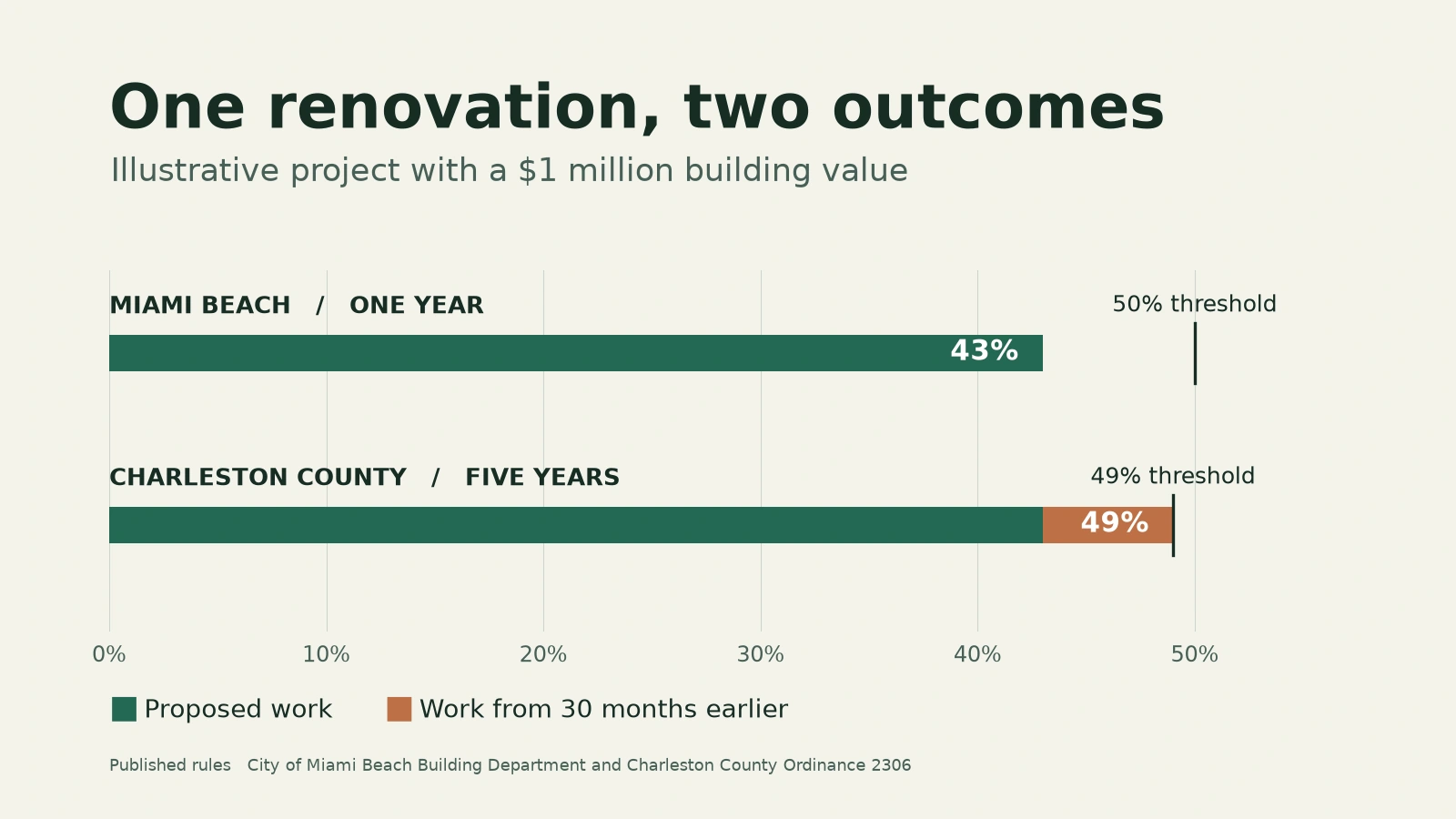
Consider a commercial building with an accepted building value of $1 million. The proposed renovation costs $430,000. Another $60,000 of qualifying improvements took place 30 months earlier. Assume the work is within the applicable flood hazard area, the local authority accepts these costs and the value, and there are no other qualifying improvements. This is an illustration using published rules.
| Published procedure | Qualifying costs in the example | Screening result |
|---|---|---|
| Miami Beach, one-year period | $430,000. The older work is outside the period. | 43%. Below the published 50% threshold.City of Miami Beach |
| Charleston County, five-year period | $490,000. The older work falls inside the period. | 49%. Meets the 49% threshold in Ordinance 2306.Charleston County Council |
For a real building, reconcile the permit ID, address, structure identifier, scope, cost and relevant date. Check for phased work or duplicate records before totaling costs. Request the authority’s written determination before using the result to budget repairs, code work or a reopening date.
Floodplain improvement thresholds and permit lookback example
Download the comparison, calculations and evidence fields JSONCite dataset
Invariant (2026). Floodplain improvement thresholds and permit lookback example [Data set]. https://invariant-ai.com/blog/fema-50-percent-rule-commercial-property#dataset
What belongs in the underwriting or loan file?
- Confirm the structure and the applicable flood map. Keep the building identifier, map panel, effective date and any relevant map change with the file.
- Record the administering authority, rule version, threshold and lookback period. Attach the contractor’s scope, local permit history and the accepted building valuation.
- Log the written determination and any required work. Ask which documents establish elevation or floodproofing, along with the related repair budget, completion dates and open approvals.
The permit decision and the insurer’s coverage decision have different inputs. The NFIP General Property Form provides up to $30,000 in Increased Cost of Compliance coverage for eligible flood losses on buildings with building coverage, subject to policy terms and the statutory combined limit. Ask the insurer how the actual policy and the written determination apply before carrying any expected payment in the project budget.Federal Emergency Management Agency
Questions that come up.
Does land value count toward the 50% rule?
The federal calculation uses only the market value of the structure, excluding land, accessory structures and landscaping. Confirm which valuation the local authority will accept for the building.
Does prior renovation work count?
Some jurisdictions count multiple improvements over a specified period. Miami Beach publishes one year for its cumulative improvement procedure. Charleston County Ordinance 2306 uses five consecutive years and a 49% threshold in its jurisdiction.
Does the rule apply only to flood damage?
The federal substantial damage definition covers damage from any cause. The local floodplain authority determines whether its requirements apply. Insurance eligibility, including NFIP Increased Cost of Compliance, follows the policy and the cause of loss.
Sources and references.
Primary sources checked for this guide on .
- Federal Emergency Management Agency44 CFR 59.1, federal definitions of substantial improvement and substantial damage ↗
- Federal Emergency Management AgencyFEMA P-758, substantial improvement and substantial damage desk reference ↗
- Charleston County CouncilCharleston County Ordinance 2306, Sections 9-10 and 9-20, adopted August 13, 2024 ↗
- Charleston CountyBuilding Inspection Services, current and historical flood ordinances ↗
- Charleston County Emergency ManagementHurricane planning FAQ on improvements in a flood zone ↗
- City of Miami BeachMiami Beach Building Department guidance on the 50% rule and one-year cumulative period ↗
- Federal Emergency Management AgencyNFIP General Property Form, Section III.D, Increased Cost of Compliance ↗
Try Invariant Earth on a site you know.
Pick a US coordinate and inspect the source, dataset vintage, and status for each field.
Open the API quickstart