

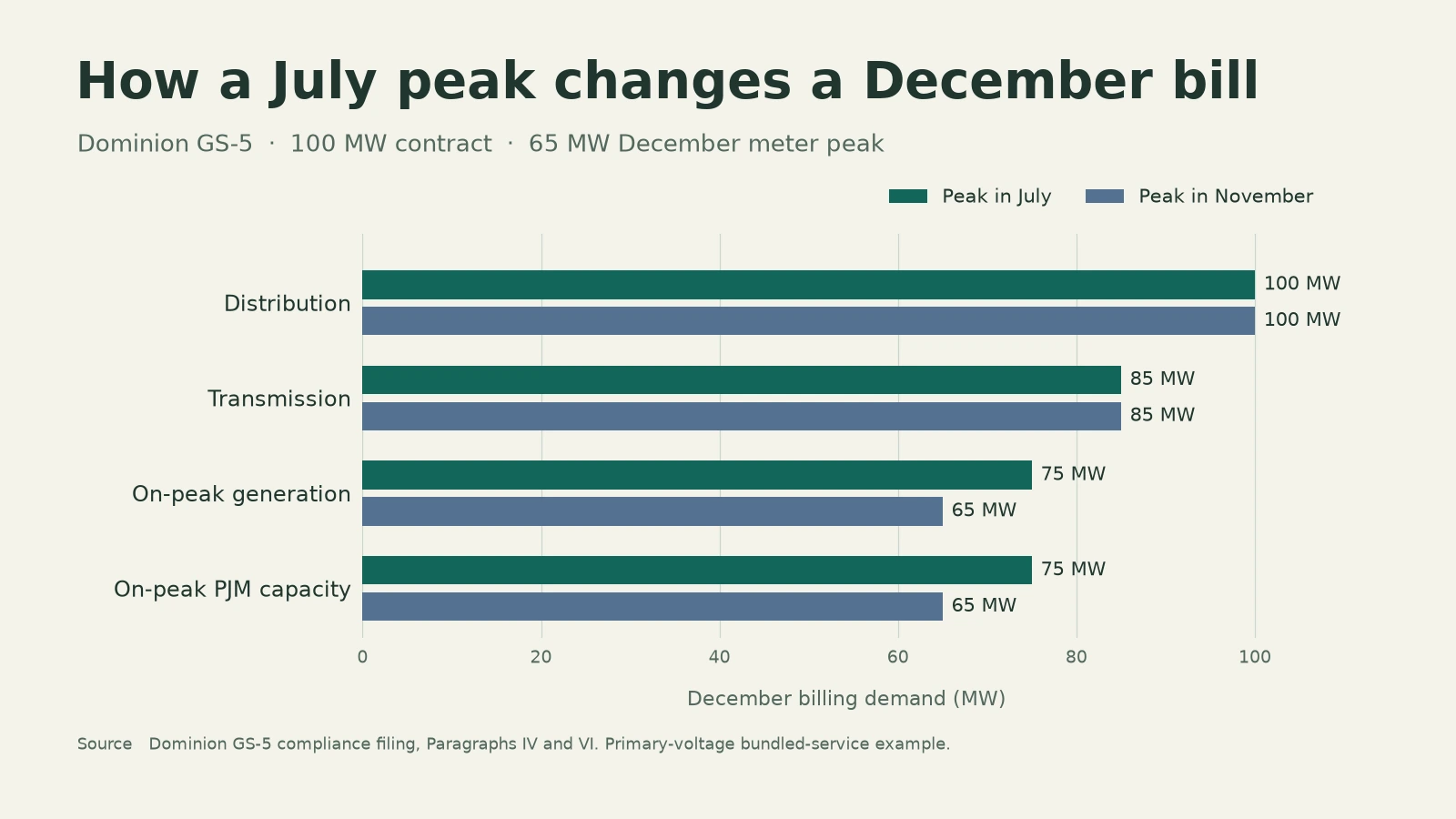
Dominion Energy Virginia’s GS-5 schedule is filed for usage from January 1, 2027. It can use different demand figures for distribution, transmission and generation on the same bill. For a qualifying primary-voltage customer with a 100 MW contract and a 65 MW December peak, an earlier 100 MW July peak produces 100 MW of distribution demand, 85 MW of transmission demand and 75 MW of on-peak generation demand.
Before you start
- Ask for the service voltage and the tariff governing each account. Distribution demand under GS-5 applies below 69 kV.
- Retain the month and time-of-day category of every major peak. A summer on-peak reading can affect generation charges after the summer ends.
- Compare Virginia and Ohio on the same meter assumptions. The two tariff schedules use different historical inputs.
Who qualifies for Dominion’s GS-5 rate?
The filing sets an effective date of January 1, 2027. SCC staff accepted the revised sheets on October 14, 2026 under case PUR-2025-00058. The schedule generally combines a threshold of at least 25 MW of contracted or measured demand on contiguous property with a qualifying load factor. Existing accounts are tested against billing history. For new or expanded service, Dominion uses expected load factor. Ask the utility how it applies the tests to each account.October 14 filing acceptanceFiled GS-5 eligibility
The commission’s order and the filed eligibility section use a 75% threshold inclusive of that value. The filed load-factor definition in Paragraph VIII says the factor exceeds 75%. For an account at exactly 75%, ask Dominion to confirm its classification in writing.SCC final order on eligibilityFiled GS-5 eligibility30-day rate and proration
Load factor relates average electricity demand to the measured peak. Section XXVII separately sets special terms for high-load customers, including some accounts in other rate classes. Check those terms even when the account may take service outside GS-5.Filed GS-5 eligibility30-day rate and prorationSeparate high-load terms
How does GS-5 calculate billed demand?
For this comparison, Dominion supplies and delivers power to one qualifying account at primary voltage below 69 kV. The account has a 100 MW contracted billing demand, expressed as 100,000 kW in the calculations. The contract floors apply to this example. Legacy service and competitive supply can change the billing rules.Distribution and summer lookbacksGeneration and supplier rulesSeparate high-load terms
| Demand charge | Billing demand under the filed tariff |
|---|---|
| Distribution below 69 kV | Use the higher of the full measured 30-minute peak over the current and previous 11 billing months or 85% of contracted demand.Distribution and summer lookbacks |
| Transmission | Use the greatest of this month’s on-peak reading, 75% of the highest June through September on-peak reading within the preceding 11 months or 85% of contracted demand.Distribution and summer lookbacks |
| On-peak generation excluding PJM purchased capacity | Use the same meter and summer readings as transmission, with a 60% contract floor.Distribution and summer lookbacksGeneration and supplier rules |
| On-peak PJM purchased capacity | Use the higher of this month’s on-peak reading and the 75% summer lookback.Generation and supplier rules |
Read the peak windows before assigning a meter interval to a charge. The filed schedule uses 10 a.m. to 10 p.m. weekdays from June through September and 7 a.m. to 10 p.m. weekdays from October through May.On-peak hours
What does a July peak change on the December bill?
Compare two 30-day December billing examples. The current all-hours and on-peak maximums are both 65 MW. In the first case a 100 MW on-peak interval occurred in July. In the second it occurred in November. All other monthly maxima in the table’s lookback are 65 MW. The peak still counts for distribution in both cases, while the summer lookback counts it for generation only in the July case.Distribution and summer lookbacksGeneration and supplier rules30-day rate and proration
| December billing basis | 100 MW in July | 100 MW in November |
|---|---|---|
| Dominion distribution | 100 MW | 100 MWDistribution and summer lookbacks |
| Dominion transmission | 85 MW | 85 MWDistribution and summer lookbacks |
| Dominion on-peak generation | 75 MW | 65 MWDistribution and summer lookbacksGeneration and supplier rules |
| Dominion on-peak PJM purchased capacity | 75 MW | 65 MWGeneration and supplier rules |
| Ohio Schedule DCT distribution | 85 MW | 85 MWOhio’s post-ramp formula |
At the filed primary-voltage rates of $7.246 per kW for base on-peak generation and $1.397 per kW for on-peak PJM purchased capacity, the two lines together come to $648,225 with the July peak and $561,795 with the November peak. The $86,430 difference covers those two lines only. Off-peak demand, delivery, energy, riders, reactive charges and taxes are outside this calculation. Dominion prorates specified charges for billing periods other than 30 days.Primary-voltage generation ratesGeneration and supplier rules30-day rate and proration
Dominion GS-5 and Ohio DCT billed demand for two 100 MW peak histories
Download both demand histories, tariff inputs and calculations JSONCite dataset
Invariant (2026). Dominion GS-5 and Ohio DCT billed demand for two 100 MW peak histories [Data set]. https://invariant-ai.com/blog/dominion-virginia-gs5-data-center-tariff#dataset
What should buyers compare across Ohio and Virginia?
Ohio’s post-ramp DCT formula uses billed demand from the prior 11 months. An earlier 100 MW billed peak yields an 85 MW lookback value in Ohio in either example. Dominion’s distribution line uses the full metered peak in its lookback below 69 kV. Its on-peak generation formula instead uses only the relevant summer billing months for the historical calculation. Carry the meter, billing history and service voltage into your comparison before applying the rates.Distribution and summer lookbacksGeneration and supplier rulesOhio’s post-ramp formula
Ask for the executed electric service agreement and the contracted billing demand by account and phase. Request a sample invoice that identifies the base rates, supplier treatment, applicable riders and any minimums or credits. Check separate collateral and termination terms when you compare a new agreement with an assignment or expansion.Filed GS-5 eligibilityGeneration and supplier rulesSeparate high-load terms
Questions that come up.
Does GS-5 always bill 85% of the capacity a data center contracts?
The 85% figure is a contracted demand floor for applicable distribution and transmission charges. An applicable measured peak or lookback can result in higher billed demand. Under GS-5, distribution demand is billed only when normal service delivery is below 69 kV.Distribution and summer lookbacks
Does the 60% generation floor apply to the on-peak PJM purchased capacity charge?
For the bundled-service example, the on-peak PJM purchased capacity line uses the greater of the current on-peak meter reading and the 75% summer lookback. The 60% contract floor applies to the separate base on-peak generation demand line.Generation and supplier rulesDistribution and summer lookbacks
Sources and references.
Primary sources checked for this guide on . The location, equipment, and operating plan determine which requirements apply to a project.
- Virginia State Corporation CommissionVirginia SCC final order of November 25, 2025, GS-5 eligibility, p. 23 ↗
- Virginia State Corporation CommissionOctober 14, 2026 acceptance letter for case PUR-2025-00058 ↗
- Dominion Energy VirginiaOctober 5 compliance filing, Schedule GS-5 eligibility and assignments, PDF pp. 326–328 ↗
- Dominion Energy VirginiaSchedule GS-5, Paragraph II.B.1, primary on-peak generation rates, PDF p. 329 ↗
- Dominion Energy VirginiaSchedule GS-5, Paragraph III, on-peak hours, PDF p. 330 ↗
- Dominion Energy VirginiaSchedule GS-5, Paragraphs IV and VI.A–B, lookbacks and billing determinants, PDF pp. 331–332 ↗
- Dominion Energy VirginiaSchedule GS-5, Paragraph VI.B–D, generation and supplier rules, PDF p. 332 ↗
- Dominion Energy VirginiaSchedule GS-5, Paragraph VII, billing period proration, PDF p. 333 ↗
- Dominion Energy VirginiaSection XXVII, high-load eligibility, contract demand and collateral, PDF pp. 4–9 ↗
- Ohio Power CompanyNovember 2026 tariff book, Schedule DCT, Sheet 223-4, PDF p. 116 ↗