

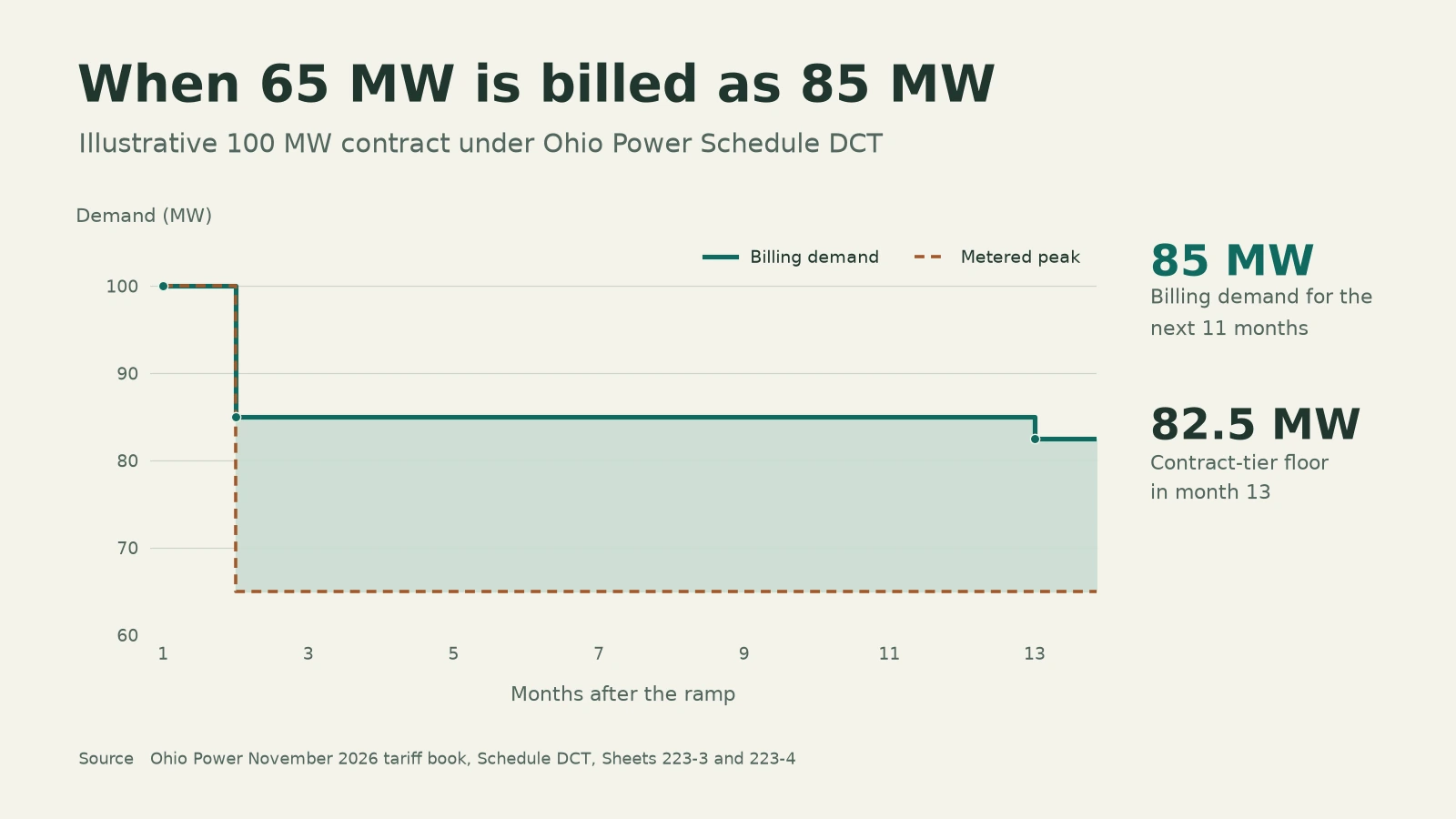
Under Ohio Power’s data center tariff, a single 100 MW New Load contract has an 82.5 MW demand floor after the ramp. A 100 MW billed peak can raise the floor to 85 MW for the next 11 months, even while the current meter peak is 65 MW. During the ramp, the billing floor is 85% of the agreed ramp capacity for the month.
Before you start
- Use the scheduled ramp capacity to calculate the first bills. Use the full contract and prior billed demand to calculate the bills after ramp.
- Keep the measured peak, billed demand and electricity use in separate fields.
- Ask Ohio Power for the eligibility, service voltage, applicable riders, collateral and dates that govern your site.
Which data centers are covered by Schedule DCT?
Schedule DCT applies in Ohio Power’s service territory. The schedule tests for demand above 25,000 kW at a single location or qualifying contract capacity aggregated within the service territory. The example here assumes one energized New Load contract with no affiliated load. The tariff treats existing load and expansions separately.Ramp capacity definitionTariff applicabilityMinimum demand and lookbackUtility customer guidance
Contract capacity is the agreed amount at the meter. Billing demand is the kW quantity used to calculate applicable demand charges. Energy use is measured in kWh. For the model below, the metered demand is the highest 30-minute integrated demand during the billing month.Ramp capacity definitionPrimary rates and metered demand
How does the load ramp change minimum billing demand?
Ohio Power and the customer agree to the monthly ramp capacity. A ramp can last up to four years. The tariff sets the lowest ramp capacity allowed in each year, and the billing floor is 85% of the agreed ramp capacity. The table assumes the parties select the lowest permitted ramp capacity for a 100 MW contract.Ramp capacity definitionTariff applicabilityMinimum demand and lookback
| Ramp year | Lowest permitted agreed ramp capacity | Billing floor at that capacity |
|---|---|---|
| Year 1 | 50 MW | 42.5 MWRamp capacity definitionMinimum demand and lookback |
| Year 2 | 65 MW | 55.25 MWRamp capacity definitionMinimum demand and lookback |
| Year 3 | 80 MW | 68 MWRamp capacity definitionMinimum demand and lookback |
| Year 4 | 90 MW | 76.5 MWRamp capacity definitionMinimum demand and lookback |
At a 35 MW metered peak in the first year of this example, Ohio Power would use 42.5 MW to calculate demand charges. At the listed primary-voltage base rate, 42,500 kW × $8.08 plus the $186.30 monthly customer charge equals $343,586.30. Budget separately for riders, energy supply, reactive demand charges and taxes.Primary rates and metered demandMinimum demand and lookback
How do the contract floor and the 11-month ratchet work?
After the ramp, use the greatest of the current metered peak, the contract-tier minimum or 85% of the highest monthly billing demand during the preceding 11 months. The lookback uses billing demand, which may already include a floor. It can therefore differ from a lookback calculated from meter peaks alone.Primary rates and metered demandMinimum demand and lookback
| Full contract capacity | Contract-tier minimum after ramp | Calculation |
|---|---|---|
| 30 MW | 19.25 MW | 15 MW plus 85% of 5 MWMinimum demand and lookback |
| 50 MW | 36.25 MW | 15 MW plus 85% of 25 MWMinimum demand and lookback |
| 75 MW | 57.5 MW | 15 MW plus 85% of 50 MWMinimum demand and lookback |
| 100 MW | 82.5 MW | 57.5 MW plus 25 MWMinimum demand and lookback |
| 120 MW | 102 MW | 57.5 MW plus 45 MW, capped at 85% of 120 MWMinimum demand and lookback |
From 25,001 through 75,000 kW, the schedule starts at 15,000 kW and adds 85% of capacity above 25,000 kW. Above 75,000 kW, start at 57,500 kW and add all capacity above 75,000 kW, then apply the 85% cap to the contract-tier floor. The actual monthly billing demand can still be higher.Minimum demand and lookback
Replay the thirteen illustrative billing months with the same tariff and editable inputs. The base distribution plus customer subtotal is $9,031,821.90. Of that, $1,919,000 is the additional base distribution charge above using each month’s metered peak alone. Those figures hold the filed rates fixed and exclude the rest of the electricity bill.Primary rates and metered demandMinimum demand and lookbackDownload the versioned replay and checksums
Download monthly demand and base charges CSVDownload the editable example inputs JSONDownload the offline replay script PythonWorked example for a 100 MW contract after the ramp
Assume a 100 MW metered peak in the first month after the ramp, with a 65 MW peak in each of the next 12 months. The contract-tier minimum stays at 82.5 MW. The 100 MW billed peak raises the next 11 months to 85 MW. By month 13, 85 MW is the highest billed demand still in the lookback, making the ratchet 72.25 MW. The 82.5 MW contract floor then determines the billing demand.Primary rates and metered demandMinimum demand and lookback
| Month after ramp | Metered peak | Billed demand | Primary base charge |
|---|---|---|---|
| 1 | 100 MW | 100 MW | $808,186.30Primary rates and metered demandMinimum demand and lookback |
| 2 through 12 | 65 MW | 85 MW | $686,986.30 per monthPrimary rates and metered demandMinimum demand and lookback |
| 13 | 65 MW | 82.5 MW | $666,786.30Primary rates and metered demandMinimum demand and lookback |
At the listed rate, the base charge falls by $20,200 when the 100 MW month leaves the lookback. The table includes the primary distribution demand rate and customer charge. A utility bill can also include transmission and other riders, energy supply, applicable reactive charges and taxes.Primary rates and metered demandMinimum demand and lookbackInitial contract term
Ohio Power data center demand floors and a 100 MW billing example
Download the tariff inputs and 13-month calculation JSONCite dataset
Invariant (2026). Ohio Power data center demand floors and a 100 MW billing example [Data set]. https://invariant-ai.com/blog/aep-ohio-data-center-tariff-minimum-demand#dataset
Archived release v1.0.0 · 2026-11-26
What should a buyer ask Ohio Power before signing?
Request a billing example using your service voltage and the actual dates of the utility work, commissioning and tenant ramp. Ask the utility to identify other loads it aggregates with your contract and the monthly billed demand history it uses. Review the signed electric service agreement and any separate construction or delay obligations.Tariff applicabilityMinimum demand and lookbackExit and collateral termsUtility customer guidance
The tariff sets a minimum initial term of the ramp plus eight years. Check the exit rights and the 36 months of minimum charges specified for qualifying early termination. New Load customers that fall short of the tariff’s credit and liquidity tests must provide the applicable guarantee or collateral, based on 50% of total minimum charges for the term. Use the utility’s calculation for those amounts.Initial contract termExit and collateral terms
Ask the utility to state what happens if the planned service never energizes. Sheet 223-4 uses full contract capacity during the initial term when a customer fails to energize, unless the parties agree otherwise. Sheet 223-5 separately allows a customer to petition the commission for a contract-term adjustment when the electric infrastructure is missing at the estimated in-service date.Minimum demand and lookbackInitial contract term
Questions that come up.
Does the 85% cap limit every monthly demand bill?
The cap applies to the contract-tier minimum for capacities above 75 MW. The monthly billed demand can be higher because the utility also considers the current metered peak and the prior 11 months of billed demand. In the 100 MW example, month one is billed at 100 MW.Primary rates and metered demandMinimum demand and lookback
How does the tariff treat two affiliated data center projects?
Ohio Power aggregates qualifying affiliated New Load in its service territory to calculate the contract-tier minimum. The tariff stacks the loads in energization order when it applies the minimum across contracts. Ask the utility for the breakdown by account and service date.Minimum demand and lookback
Sources and references.
Primary sources checked for this guide on . The location, equipment, and operating plan determine which requirements apply to a project.
- Ohio Power CompanyNovember 2026 tariff book, first revised Sheet 223-1, load ramp definition ↗
- Ohio Power CompanyNovember 2026 tariff book, first revised Sheet 223-2, applicability and ramp duration ↗
- Ohio Power CompanyNovember 2026 tariff book, first revised Sheet 223-3, primary service charges and metered demand ↗
- Ohio Power CompanyNovember 2026 tariff book, first revised Sheet 223-4, billing floors and prior demand ↗
- Ohio Power CompanyNovember 2026 tariff book, first revised Sheet 223-5, initial contract term ↗
- Ohio Power CompanyNovember 2026 tariff book, first revised Sheet 223-6, exit and collateral terms ↗
- Ohio Power CompanyData center tariff customer process and common questions ↗
- InvariantSchedule DCT billing demand replay v1.0.0 ↗