

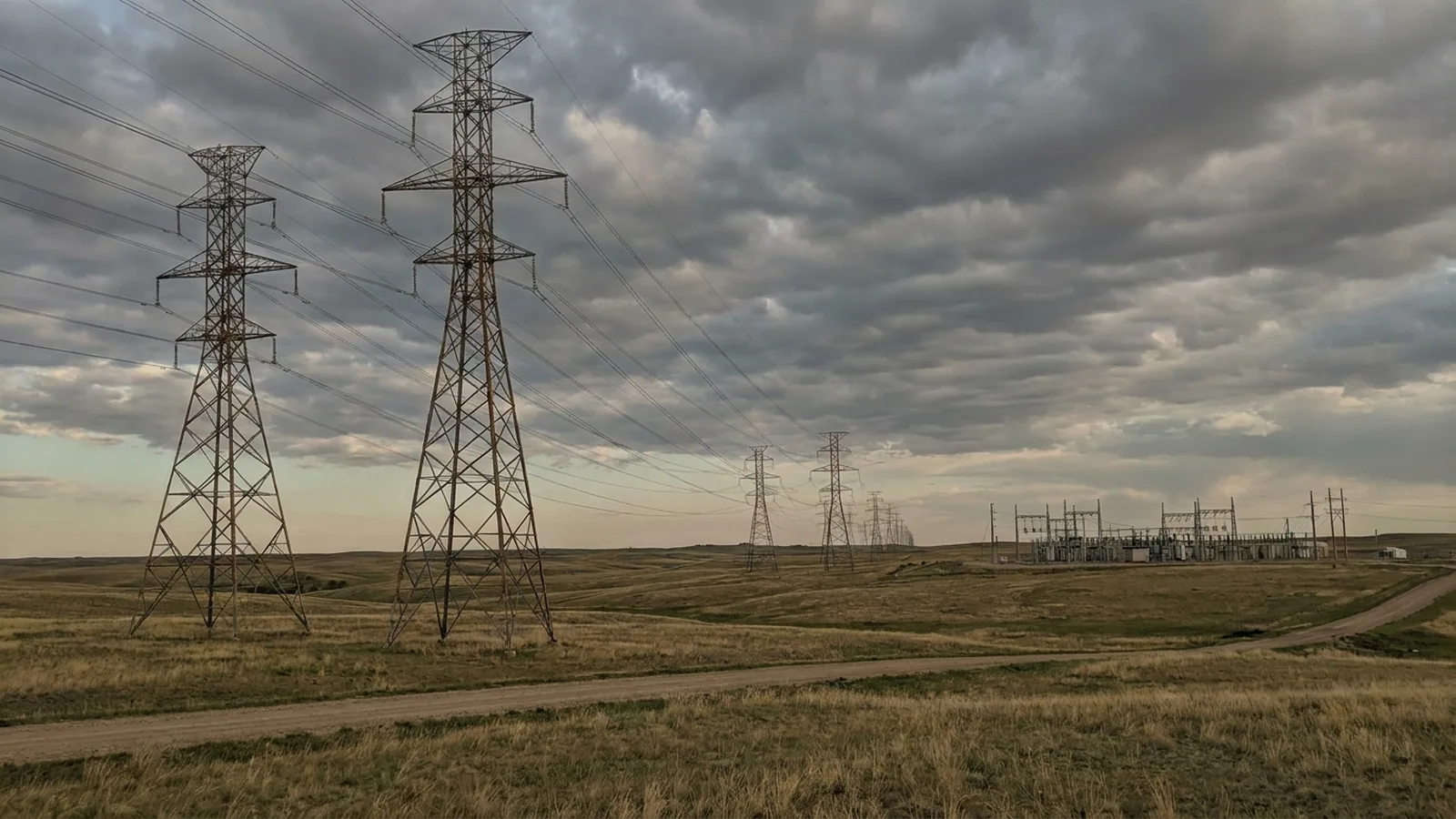
A power flow study, also called a load flow study, solves the voltages and the flow on every line and transformer in a network for a given pattern of load and generation. For a data center it answers one question: if this much load connects here, does any element go over its rating or any voltage go out of range, with everything in service and with any one element out? The MW at which the first limit is crossed is the site’s headroom at that point.
Before you start
- A power flow is a snapshot. Planners run several: summer and winter peak, light load, and more than one study year.
- The answer depends on the connection point. Two substations a mile apart can differ by hundreds of MW.
- The binding element is often not the nearest one. It can be a transformer two stations away.
- Utilities study in tools such as Siemens PSS/E on their planning cases, which are protected as CEII.
What a power flow solves
Give the solver the network (buses, lines, transformers, their impedances and ratings), the generation dispatch and the loads, and it finds a consistent set of voltages and flows. An AC power flow includes reactive power and voltage. A DC power flow is a fast linear version used to screen many cases.
Utility planners run these on base cases built for each season and study year. The cases are protected as critical energy infrastructure information, so access needs an agreement with the ISO or FERC.PJMLegal Information Institute, Cornell Law School
Inputs for a data center study
- The site location and each candidate point of interconnection, including a new switching station on a passing line.
- The load in MW for each phase and year, and its power factor.
- The study years that match your ramp.
- Planned grid changes in service by each year: new lines, upgrades, generator retirements.
- Other large loads likely to connect nearby, because they use the same headroom.
What the results look like
| Connection point | Year | MW, no upgrades | Binding element | Fix | MW after fix |
|---|---|---|---|---|---|
| Substation A, 345 kV | Year 1 | Example: 300 | 345/138 kV transformer at a neighbouring station, N-1 | Second transformer | Example: 520 |
| Substation B, 138 kV | Year 1 | Example: 40 | 138 kV line out of B, N-1 | Reconductor 6 miles | Example: 110 |
| New switching station on line C, 345 kV | Year 3 | Example: 600 | Voltage at the new bus after loss of the parallel circuit | Capacitor bank | Example: 740 |
The table above shows the format, not a real site. Read it by connection point and year. A high number in year three with a low number in year one tells you to phase the load or wait for a planned upgrade.
Common mistakes in reading a power flow
Taking one season as the answer is the usual one. A site can be fine at summer peak and fail at light load when local generation is off. Another: ignoring the load queue. If two other data centers are filing at the same substation, the headroom you found is shared.
And a study that does not name its binding element is not worth much. You need the element to judge the fix and to ask the utility the right question.
More due diligence guides
Questions that come up.
What is the difference between a power flow study and a load flow study?
They are the same thing. Both solve voltages and flows in a network for a given load and generation pattern.
What software is used for power flow studies?
Utilities and ISOs mostly use Siemens PSS/E and PowerWorld on their planning cases. Facility design tools such as ETAP are used inside the fence, not for transmission planning.Siemens
Does a power flow study include contingencies?
A planning study does. It solves the base case and then each single-element outage (N-1) and selected multi-element events under NERC TPL-001.NERC
Who can run a power flow study for my data center site?
Invariant runs utility-grade power studies on US sites, usually within 48 hours. Email pranav@invariant-ai.com with the coordinate and MW.
Sources and references.
Primary sources checked for this guide on . The location, equipment, and operating plan determine which requirements apply to a project.
- NERCTPL-001-5.1: Transmission system planning performance requirements ↗
- PJMPower flow cases ↗
- Legal Information Institute, Cornell Law School18 CFR 388.113: Critical energy and electric infrastructure information ↗
- U.S. Energy Information AdministrationPreliminary monthly electric generator inventory (EIA-860M) ↗
- SiemensPSS/E transmission planning software ↗