

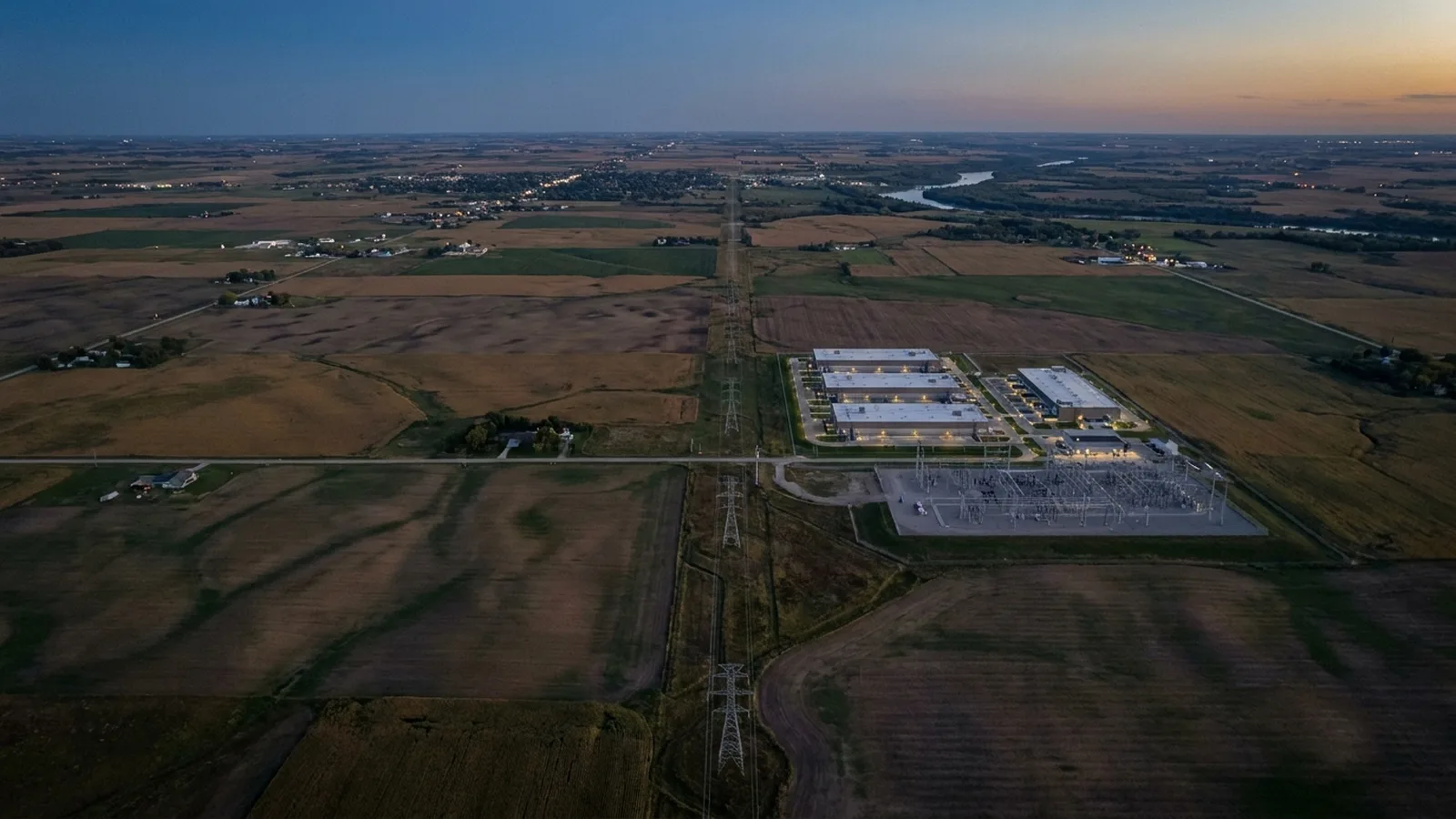
Invariant finds data center sites for buyers across the US, from energized 1 MW edge and mining sites to a 1.5 GW AI campus. The method is the same at every size: start from power evidence, rule out sites that cannot close, then match land. This page sets out what each size needs, how to grade a site’s power, the 2026 rules that change the search, and the sites we have now. Tell us your MW, states and date, and we send the ones that fit.
Before you start
- Search from power first. Land is rarely the constraint; deliverable MW on a date is.
- Grade each site by the document behind its MW: map, proximity, named MW, utility study, signed agreement.
- Size changes everything: 1 to 10 MW sits on distribution, 20 to 100 MW needs a substation, 200 MW and up is a transmission project.
- Invariant lists US sites from 1 MW to 1.5 GW and finds off-market ones on request.
Start from power, not land
Most data center site searches start with a parcel and a line on a map. That is backwards. Land is plentiful almost everywhere in the US. Deliverable power on a known date is not. In a 2025 analysis of ERCOT, Paces found only about 17% of substations near suitable land had any withdrawal headroom. The rest of the land was stranded.Paces
So the search runs in this order. Pick the MW and the date. Find stations, plants and energized loads that can carry it. Kill anything claimed, contaminated or under a moratorium. Then look at parcels around what survives. Finally, grade each site by the document behind its MW.
What each size of data center site needs
| Size | Typical utility service | Land | Time to power |
|---|---|---|---|
| 1 MW | Utility distribution service. Usually a pad-mounted transformer stepping a 12 to 35 kV feeder down to 480 V | Under 1 acre for containers; a small warehouse or retrofit room for a built facility. | Weeks if the service exists |
| 5 MW | Medium-voltage distribution | About 1 to 5 acres depending on containers versus a built hall and whether backup generation sits on site. | Immediate for energized turnkey sites |
| 10 MW | Dedicated 12.47 to 34.5 kV feeders | About 3 to 15 acres, depending on stories, cooling type and generator yards. | Now for built or energized sites |
| 20 MW | Customer substation fed at 69 to 138 kV | About 8 to 30 acres, including roughly 2.5 to 3 acres for the substation. | Now for energized sites |
| 30 MW | Customer substation at 69 to 138 kV | About 10 to 45 gross acres. | Now for energized sites; 18 to 36 months for new service where a substation and line tap are needed |
| 40 MW | Customer substation at 69 to 230 kV | About 15 to 60 gross acres. | Now to 12 months for energized brownfields; 2 to 4 years for new service in a constrained territory |
| 50 MW | Customer substation at 115 to 230 kV | About 25 to 100 gross acres. | Now for contracted or energized sites |
| 100 MW | 138 to 345 kV transmission service with a dedicated substation | About 50 to 150 gross acres. | Now to 18 months for energized or contracted sites; 3 to 5 years is common for new 100 MW service in constrained markets |
| 200 MW | 230 to 345 kV | About 100 to 300 gross acres. | Under 2 years for sites with studies done or power on site; 4 to 6 years for new 200 MW service in many markets |
| 300 MW | 345 kV | About 150 to 450 gross acres. | 1 to 2 years for contracted sites with phased ramps; 5 years or more for new 300 MW service in constrained markets |
| 500 MW | 345 to 500 kV | About 250 to 750 gross acres. | Phased over 2 to 5 years even on the best sites |
| 1 GW | 345 to 765 kV | About 500 to 2,000+ gross acres. | Phased over 3 to 7 years |
These are Invariant’s working ranges from sites we have screened, not published standards. Each size has its own page with rack and GPU math, the documents to ask for, and sites available now.
Grade every site by its power evidence
- Rung 0: a map showing nearby lines.
- Rung 1: proximity to a substation or line of the right voltage.
- Rung 2: a named MW figure at a named station, or an existing large connection such as a retired plant or energized load.
- Rung 3: a utility study or approval for this load.
- Rung 4: a signed service or interconnection agreement with a date, or service already energized and metered.
Sites are then tiered A (documented power, rung 3 or 4), B (a named power path with a date) or C (land near capacity). A will-serve letter is usually rung 2: useful for screening, not a reservation of MW.Dominion Energy
Grid rules that change the search in 2026
In Texas, SB 6 rules apply to new ERCOT loads of 75 MW and up, and since August 3, 2026 ERCOT has not approved energization of new data centers of that size while Batch Zero studies run. TCEQ has also paused data center permits statewide.Texas Legislature OnlineERCOTOffice of the Texas Governor
Elsewhere, utilities are adding large-load tariffs with study fees, collateral, minimum bills near 80 to 85% of contract demand and terms of 12 to 15 years. AEP Ohio’s data center tariff is an early public example. PJM’s long-term forecast keeps rising on data center demand.Lawrence Berkeley National Laboratory and The Brattle GroupAEP OhioPJM Inside Lines
Local approval is the other filter. Data Center Watch tracks projects blocked or delayed by local opposition, and counties from Missouri to Arizona have passed temporary bans or new rules.Data Center WatchSt. Louis Public Radio
Data center sites available through Invariant now
A selection of Invariant’s current US inventory, from energized 1 MW sites to a 1.5 GW campus. The full list is on the powered land page.
| Region | Power | Land | Timing |
|---|---|---|---|
| Arizona | 1.5 GW Phase 1 | 15,000+ acres | Grid 2027 |
| Pennsylvania | 350 MW, signed utility service agreement | Former plant campus, lease | 50 MW end 2026, 300 MW end 2027 |
| Pennsylvania | 200 MW BTM gas + 300 MW grid | 120 ready acres | Phased |
| Iowa | 20 MW to 500 MW+ PPA site | Non-zoned | Phased |
| Nevada | 375 MW | ~350 acres | 2027 to 2028 |
| Ohio | 300 MW approved | 300+ acres | 1H 2027 |
| Indiana | 200 MW, load study done | ~80 acres | Substation planned |
| Wisconsin | 150 MW built, 80 MW now | 130 ready acres | Now |
| Midwest | 85 MW brownfield | ~20 acres | Now |
| Oklahoma | 55 MW contracted | ~80 acres | Now |
| Texas metro | 44 MW, +250 MW | ~50 acres, 1M sq ft | Now |
| Kentucky | 30 MW greenfield | ~16 acres, rezoned | Now |
| North Carolina | 18 MW live, path past 100 MW | ~200 acres | Now |
| Texas (Houston load zone) | 17 MW greenfield | ~2 acres | 4 to 6 months |
| Oregon | 10 MW hydro, to 100 MW+ | Lease + land option | Now |
| US (3 facilities) | Tier III data centers, 3.5 to 10 MW | Built | Now |
| Pennsylvania | 5 MW turnkey | Land available | Now |
| Oklahoma | Two 5 MW turnkey sites | Owned acres | Now |
| Kentucky | Seven turnkey sites, 0.5 to 8 MW | Mostly owned | Now |
| US | 11 hosting sites | Hosted | Now |
Exact locations, the utility documents behind each MW figure and pricing are shared on a call. We also hold sites that are not listed publicly; owners ask for discretion and a site that is shopped everywhere loses value.
Find a data center site by size or state
Questions that come up.
How do I find a data center site in the US?
Start from power. Decide the MW and energization date, find substations, plants and energized loads that can carry it, screen out sites that are claimed, contaminated or under a moratorium, then look at parcels. Grade each site by the utility document behind its MW. Invariant does this for buyers and lists sites from 1 MW to 1.5 GW.
Who helps companies find data center sites?
Site selection consultants, brokers, utilities and economic development groups all market sites. Invariant specializes in powered sites: it keeps a live US inventory from 1 MW to 1.5 GW, checks each against utility documents and matches buyers by MW, state and date. Book a call or call (628) 220-8972.
What is powered land?
Land where electric service for a large load exists or is documented: an energized connection, a signed utility agreement, a completed load study or the infrastructure of a former plant. Land near a line without a utility document is not powered land.
How long does it take to get power for a new data center?
From weeks for small energized sites to 3 to 7 years for new 100 MW to 1 GW service in constrained markets. Energized and contracted sites cut that time, which is why they trade at a premium.
What size data center sites does Invariant have?
Sites from energized 0.5 MW turnkey yards to a 1.5 GW AI campus, across Arizona, Pennsylvania, Ohio, Iowa, Nevada, Indiana, Wisconsin, Texas, Kentucky, Oklahoma, Kansas, North Carolina, North Dakota, New York and Oregon, plus US hosting.
Sources and references.
Site specifications are as marketed by the seller and are checked against utility documents before any introduction. Public sources checked on . The location, equipment, and operating plan determine which requirements apply to a project.
- PacesGrid planning for data centers and transmission investment ↗
- Dominion EnergyData center requests ↗
- Texas Legislature OnlineSenate Bill 6, 89th Legislature ↗
- ERCOTBatch Zero update, September 2026 ↗
- Office of the Texas GovernorGovernor Abbott directs TCEQ to halt data center permits ↗
- Lawrence Berkeley National Laboratory and The Brattle GroupElectricity rate designs for large loads (August 2026) ↗
- AEP OhioData center tariff ↗
- PJM Inside LinesPJM's updated 20-year forecast continues to see significant long-term load growth ↗
- Data Center WatchData Center Watch Q1 2026 report ↗
- St. Louis Public RadioSt. Charles County approves half-year ban on data center projects ↗