

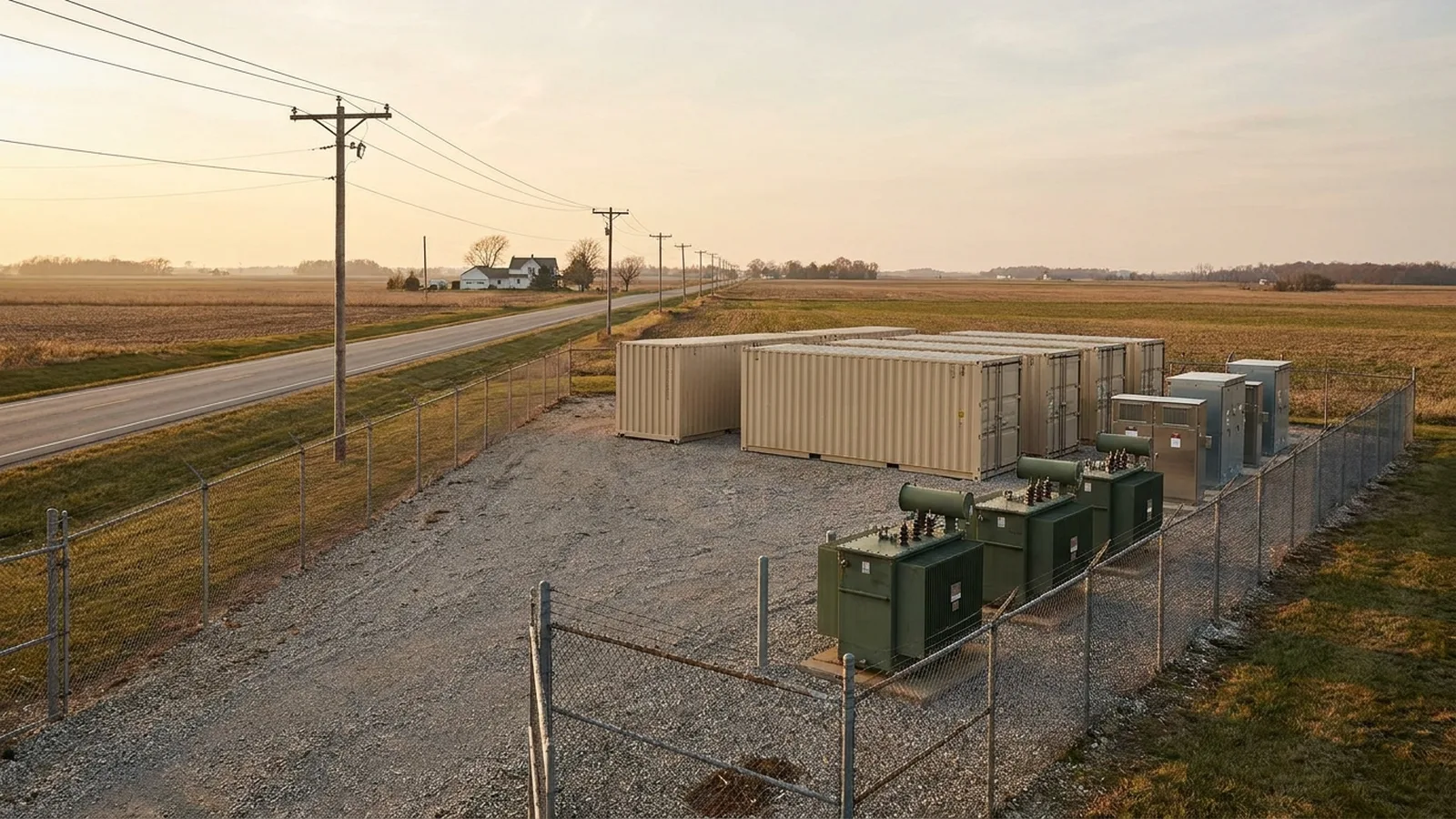
5 MW is where a data center site stops being a building with a big service and starts needing its own utility plan. A 5 MW load is usually still on a distribution feeder, often a dedicated one, and that feeder decides the timeline. Turnkey 5 MW sites with transformers already energized come up regularly in mining markets, and they convert well to inference and edge use if the power is firm. Invariant tracks several of them across the US right now.
Before you start
- 5 MW at the meter is about 3.8 MW of IT at a PUE of 1.3, roughly 32 AI racks at 120 kW, or 2,300 GPUs.
- Expect medium-voltage distribution service, often a dedicated 12 to 35 kV feeder and several pad-mounted transformers.
- Turnkey mining sites at 5 MW can be live immediately. Check whether the rate is interruptible before you plan an uptime promise around it.
- Land: 1 to 5 acres covers most layouts, more if you add generators and cooling yards.
What 5 MW actually fits
Utilities sell facility load. Tenants buy IT load. At a PUE of 1.3, a 5 MW site leaves about 3.8 MW for IT. At about 120 kW per NVIDIA GB200 NVL72 rack, that is roughly 32 racks, or about 2,310 GPUs. Air-cooled designs at 30 to 50 kW per rack fit more racks and fewer GPUs per MW. Typical buyers at this size are an inference cluster, a regional colocation room, an enterprise build or a mining expansion.eeNews EuropeUptime Institute
| 5 MW site | What to expect |
|---|---|
| IT load at PUE 1.3 | About 3.8 MW |
| AI racks at 120 kW | About 32 |
| Utility service | Medium-voltage distribution, typically 12.47 to 34.5 kV, often a dedicated feeder or a large share of one, with several transformers on site. |
| Land | About 1 to 5 acres depending on containers versus a built hall and whether backup generation sits on site. |
| Time to power | Immediate for energized turnkey sites. New service commonly runs 9 to 24 months where a feeder extension or substation bay is needed. |
| Documents to ask for | Contract demand on the bill, the utility one-line diagram, transformer ratings, a written statement of feeder headroom, and the rate schedule (firm or curtailable). |
These ranges are Invariant’s working figures from sites we have screened. They are not published standards, and individual utilities and designs land outside them.
Why 5 MW sites move fast or not at all
A single 12.47 kV distribution feeder carries roughly 8 to 12 MW in normal operation, and utilities rarely give one customer most of it. So a new 5 MW load often means a dedicated feeder from the substation, a new breaker position or a new circuit, and each of those has its own queue and equipment lead time.
That is why energized 5 MW sites trade at a premium. The value is in the transformers and the feeder that are already there, with the utility already billing the account.
Converting a 5 MW mining site to AI or inference
Mining sites at this size have the power and usually the airflow. What they lack is redundancy, backup generation and a building that meets an enterprise tenant’s checklist. Budget for UPS, generators, fire protection and either liquid cooling or a new hall. Keep the utility service and the land; plan to rebuild most of the rest. Our guide on converting mining sites covers this in more detail.
5 MW data center sites available now
These sites from Invariant’s current inventory fit a 5 MW requirement, either at that size today or with a phase that covers it. Specs are as marketed by the owner and are checked against utility documents before any introduction.
| Region | Power | Land | Timing |
|---|---|---|---|
| Pennsylvania | 5 MW turnkey | Land available | Now |
| Oklahoma | Two 5 MW turnkey sites | Owned acres | Now |
| Kentucky | Seven turnkey sites, 0.5 to 8 MW | Mostly owned | Now |
| Iowa | 2 MW turnkey, to 7 MW | Owned acre | Now |
| US (3 facilities) | Tier III data centers, 3.5 to 10 MW | Built | Now |
| US | 20 earlier listings, 0.25 to 30 MW | Various | Status on a call |
Exact locations, the utility documents behind each MW figure and pricing are shared on a call. We also hold sites that are not listed publicly; owners ask for discretion and a site that is shopped everywhere loses value.
How Invariant finds 5 MW sites
We search from power evidence first and land second. For a 5 MW request we start with stations and services that can carry the load, kill anything already claimed, operating for someone else, contaminated or under a moratorium, and only then look at parcels. Each surviving site is graded A (documented power), B (a named power path with a date) or C (land near capacity), with the one document that would move it up a tier.
Tell us the MW, the states you would consider and the date you need power. We send the 5 MW sites that fit, including ones that are not on this page.
Browse data center sites by size and state
Questions that come up.
How many GPUs fit in a 5 MW data center?
At a PUE of 1.3, 5 MW at the meter leaves about 3.8 MW for IT. At about 120 kW per GB200 NVL72 rack, that is roughly 32 racks and 2,300 GPUs. Air-cooled H100-class deployments at 40 to 50 kW per rack would fit 75 to 95 racks.
Is a 5 MW data center on transmission or distribution power?
Usually distribution, at 12.47 to 34.5 kV, often on a dedicated feeder. Some utilities serve 5 MW from a small customer substation tapped off a 69 kV line.
Where can I find a 5 MW data center site for sale?
Invariant currently lists energized 5 MW turnkey sites in Pennsylvania and Oklahoma, plus smaller expandable sites in Kentucky and Iowa and three built Tier III facilities between 3.5 and 10 MW. Locations and terms are shared on a call.
How does Invariant help find a 5 MW data center site?
Invariant keeps a live inventory of US powered sites, screens each one against utility documents, and matches buyers to sites by MW, state and energization date. Book a call or call (628) 220-8972 with your 5 MW requirement and we send matching sites, including off-market ones.
Sources and references.
Site specifications are as marketed by the seller and are checked against utility documents before any introduction. Public sources checked on . The location, equipment, and operating plan determine which requirements apply to a project.