

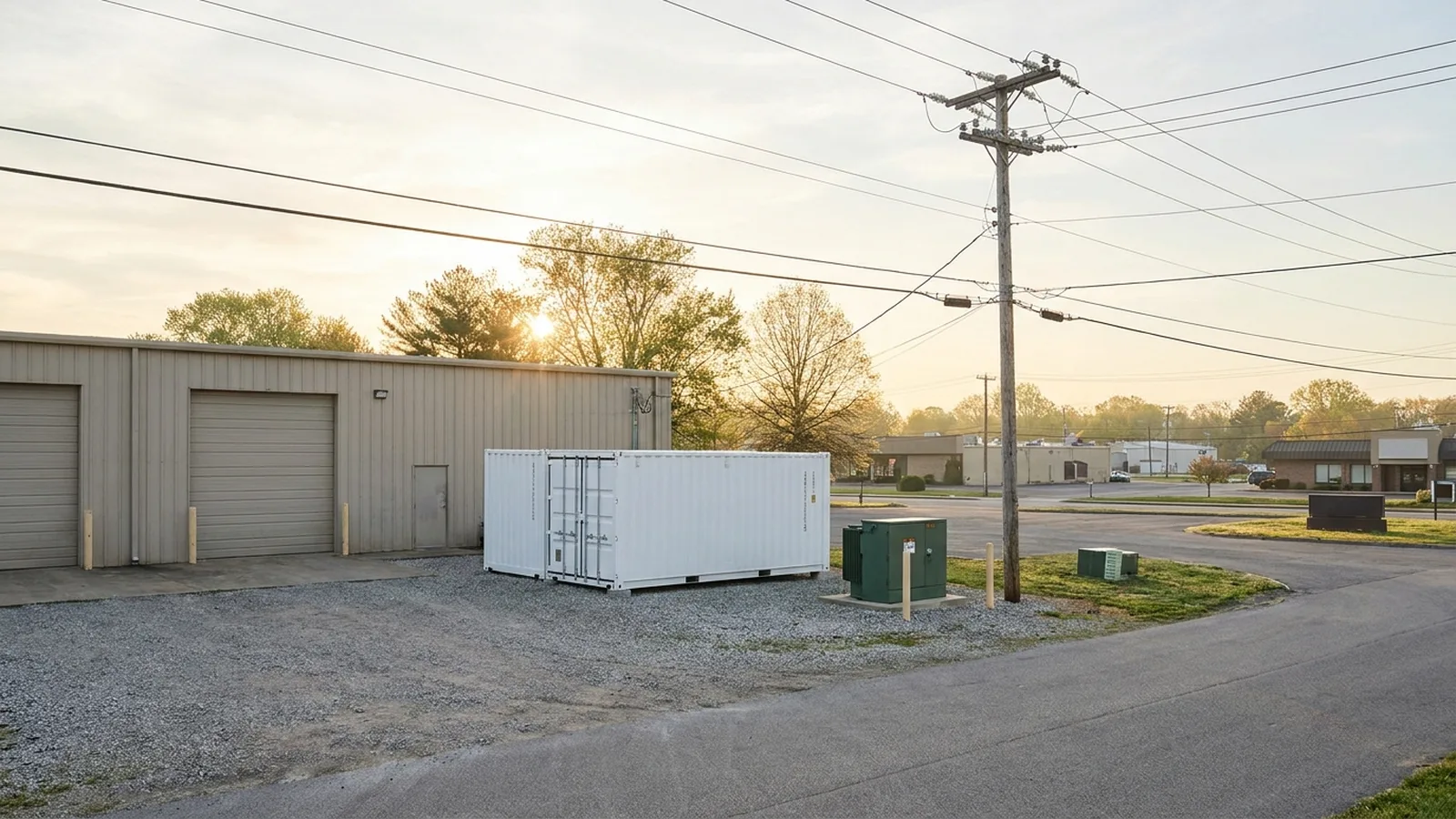
A 1 MW data center site is the easiest size to find and the easiest to get wrong. At this scale you are almost always on the utility distribution system, so the fastest sites are buildings or yards that already have the service in place. A new 1 MW service can take longer than people expect because of transformer lead times and feeder upgrades. Invariant keeps a running list of energized small sites across the US, from 0.5 MW turnkey mining yards to Tier III rooms, and shares the ones that fit on a call.
Before you start
- 1 MW at the meter is about 0.75 MW of IT at a PUE of 1.3. That is roughly six 120 kW AI racks, or a few hundred air-cooled mining machines.
- At this size the question is the existing service: voltage, transformer rating and whether the feeder has room. A site that already has it can be live in weeks.
- Land is rarely the issue. A containerized 1 MW deployment fits on well under an acre.
- Ask for a recent utility bill or a service letter showing the transformer and the contracted capacity, not a map of nearby lines.
What 1 MW actually fits
Utilities sell facility load. Tenants buy IT load. At a PUE of 1.3, a 1 MW site leaves about 0.8 MW for IT. At about 120 kW per NVIDIA GB200 NVL72 rack, that is roughly 6.4 racks, or about 460 GPUs. Air-cooled designs at 30 to 50 kW per rack fit more racks and fewer GPUs per MW. Typical buyers at this size are edge inference, a small GPU pod, enterprise compute or a bitcoin mining deployment.eeNews EuropeUptime Institute
| 1 MW site | What to expect |
|---|---|
| IT load at PUE 1.3 | About 0.8 MW |
| AI racks at 120 kW | About 6.4 |
| Utility service | Utility distribution service. Usually a pad-mounted transformer stepping a 12 to 35 kV feeder down to 480 V, sometimes primary service at the feeder voltage. |
| Land | Under 1 acre for containers; a small warehouse or retrofit room for a built facility. |
| Time to power | Weeks if the service exists. New service can run from a few months to more than a year where transformers or feeder work are on order. |
| Documents to ask for | Recent utility bills, the service agreement or contract demand, the transformer nameplate, and a note from the utility on any headroom above the current load. |
These ranges are Invariant’s working figures from sites we have screened. They are not published standards, and individual utilities and designs land outside them.
Where 1 MW sites come from
Most 1 MW sites we see are one of four things: a light industrial building with a large existing service, a small mining yard with containers already wired, a room inside a colocation facility, or a spot inside the fence of a power plant or industrial user that has spare capacity on its own transformers.
Each has a different catch. Industrial buildings often have the amps but not the cooling. Mining yards have power and airflow but no redundancy. Colocation rooms are fast and expensive per kW. Plant sites can be the cheapest power you will ever see, with the least flexibility on hours and terms.
What to check before you sign
Confirm the contracted capacity on the bill, not the panel rating. A building with a 4,000 A switchboard at 480 V can in theory carry more than 3 MW, yet its utility contract and transformer may cap it far lower.
Ask whether the power is firm or interruptible. Many small mining sites run on curtailable rates. That suits miners and does not suit an inference customer with an uptime promise.
1 MW data center sites available now
These sites from Invariant’s current inventory fit a 1 MW requirement, either at that size today or with a phase that covers it. Specs are as marketed by the owner and are checked against utility documents before any introduction.
| Region | Power | Land | Timing |
|---|---|---|---|
| Kentucky | Seven turnkey sites, 0.5 to 8 MW | Mostly owned | Now |
| Iowa | 2 MW turnkey, to 7 MW | Owned acre | Now |
| Iowa | 2 MW+ edge site | Leased | Now |
| Texas (Houston) | 3 MW ERCOT | Leased | Now |
| US | 11 hosting sites | Hosted | Now |
| US | 20 earlier listings, 0.25 to 30 MW | Various | Status on a call |
Exact locations, the utility documents behind each MW figure and pricing are shared on a call. We also hold sites that are not listed publicly; owners ask for discretion and a site that is shopped everywhere loses value.
How Invariant finds 1 MW sites
We search from power evidence first and land second. For a 1 MW request we start with stations and services that can carry the load, kill anything already claimed, operating for someone else, contaminated or under a moratorium, and only then look at parcels. Each surviving site is graded A (documented power), B (a named power path with a date) or C (land near capacity), with the one document that would move it up a tier.
Tell us the MW, the states you would consider and the date you need power. We send the 1 MW sites that fit, including ones that are not on this page.
Browse data center sites by size and state
Questions that come up.
How much power is 1 MW for a data center?
1 MW at the meter supports about 0.7 to 0.8 MW of IT load at a PUE between 1.25 and 1.4. That is roughly six GB200 NVL72 racks at about 120 kW each, around 430 GPUs, or 20 to 40 standard enterprise racks at 20 to 30 kW.
How fast can I get a 1 MW data center site?
If the building or yard already has a 1 MW service and the utility confirms headroom, you can be live in weeks. New service depends on the utility and transformer supply and can take several months to more than a year.
How much land does a 1 MW data center need?
Very little. Containerized deployments fit on well under an acre. A built facility can sit in an existing industrial building. Setbacks, generator space and noise rules matter more than raw acreage.
How does Invariant help find a 1 MW data center site?
Invariant keeps a live inventory of US powered sites, screens each one against utility documents, and matches buyers to sites by MW, state and energization date. Book a call or call (628) 220-8972 with your 1 MW requirement and we send matching sites, including off-market ones.
Sources and references.
Site specifications are as marketed by the seller and are checked against utility documents before any introduction. Public sources checked on . The location, equipment, and operating plan determine which requirements apply to a project.