

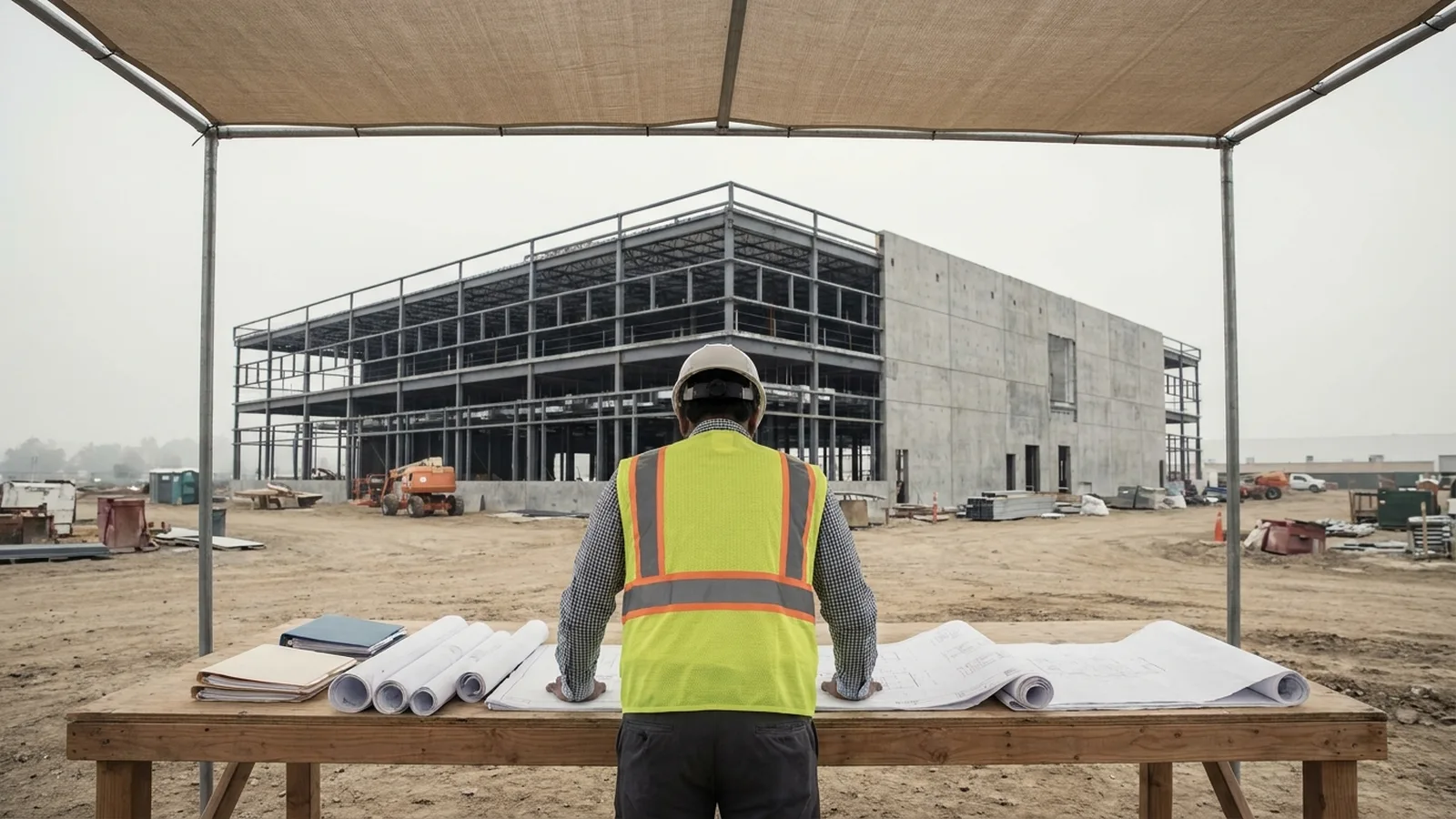
India has no single data centre licence: a project collects separate approvals from several authorities, and environmental clearance under the EIA Notification 2006 applies only if built-up area is 20,000 sq m or more. A data centre in India also needs land allotment and building plan approval from the state or local authority, Consent to Establish and Consent to Operate from the state pollution control board, a groundwater NOC, an airport height clearance, a fire NOC, a licence to store diesel and an electrical inspector’s approval before energisation. Because these sit with so many offices, NITI Aayog’s October 2026 framework asks every state to publish a data centre approval matrix and run a single clearance portal.
Before you start
- Environmental clearance: the environment ministry told the Rajya Sabha on 6 August 2026 that AI data centres do not per se need environmental clearance, only as building projects above 20,000 sq m (item 8(a)) or townships (item 8(b)).
- Pollution board category: CPCB’s January 2025 classification says data centres polluting only through gensets may be classified by genset capacity and fuel: 1 MVA or more on liquid fuel is Orange, on gas Green.
- Diesel: under the Petroleum Rules 2002, Class B petroleum (confirm your fuel’s class with PESO) below 2,500 litres needs no licence, 2,500 to 25,000 litres is licensed by the district authority and more needs a PESO licence.
- Fire: the National Building Code 2016 puts electronic data processing centres in occupancy E-3 and requires automatic fire detection and alarm.
- Single window: NITI Aayog’s October 2026 framework asks each state to publish a data centre approval matrix and run a single clearance portal.
Every approval for a data centre in India, in one table
A colocation or hyperscale campus in India needs the approvals below; each row gives the law behind the approval, who issues it, what triggers it and when it is needed. State rules vary, and the state approval matrix that NITI Aayog has asked for will be the authoritative list once each state publishes it.MediaNama
| Approval | Law or rule | Issued by | Trigger or threshold | When |
|---|---|---|---|---|
| Foreign investment | FDI policy, Press Note 3 (2020) | Automatic route; government approval for investors from land-border countries | 100% under the automatic route for a company doing only data centre business, according to Khaitan & Co | Before land |
| Land allotment or purchase | State industrial development authority rules | For example YEIDA’s Data Centre Park or MIDC data centre parks | Allotment terms set use, FAR and timelines | Before design |
| Change of land use | State rules (vary by state) | State authority (varies by state) | Land not already zoned for industrial or IT use; Anarock says agricultural conversion adds 12 to 18 months in most states | Before building plan |
| Building plan | State building bye-laws and policy relaxations | Development or local authority | Every building; UP 2026 and West Bengal 2021 policies allow FAR 3.0 plus 1.0 purchasable | Before construction |
| Environmental clearance | EIA Notification 2006, item 8(a) or 8(b) | State Environment Impact Assessment Authority, through PARIVESH | Built-up area of 20,000 sq m or more (8(a)); 50 ha or 1,50,000 sq m (8(b)) | Before construction |
| Consent to Establish | Water Act 1974, Air Act 1981 | State pollution control board | Category set by genset capacity and fuel and by built-up area | Before construction |
| Groundwater NOC | CGWA guidelines, S.O. 3289(E), 24 September 2020 | CGWA or the state groundwater authority | Any groundwater abstraction unless exempt | Before abstraction |
| Height clearance | G.S.R. 751(E), 30 September 2015 | Airports Authority of India, through NOCAS | Within 20 km of a VFR airport or 56 km of an IFR airport | Before construction |
| Diesel storage licence | Petroleum Rules 2002 | District authority or PESO | Class B fuel: 2,500 to 25,000 litres district; above that PESO | Before filling tanks |
| Genset type approval | G.S.R. 804(E) of 3 November 2022 | Regulated at the manufacturing stage under a CPCB procedure | Engines up to 800 kW; engines above 800 kW fall under G.S.R. 489(E) of 2002, regulated by state boards | At procurement |
| Fire NOC | National Building Code 2016, Part 4 | State fire department | Occupancy E-3 | Before occupation |
| Electrical inspection | CEA (Measures relating to Safety and Electric Supply) Regulations 2023 | State electrical inspector | Installations above the state’s notified voltage; generating units | Before energisation |
| Consent to Operate | Water Act 1974, Air Act 1981 | State pollution control board | Same category as consent to establish | Before operation |
Environmental clearance for data centres in India
In a Rajya Sabha reply on 6 August 2026, the environment ministry said AI data centres do not per se require environmental clearance but do when proposed as part of a project under item 8(a) or 8(b) of the EIA Notification 2006, and that SEIAA grants clearance for such building projects. Item 8(a) covers building and construction projects of 20,000 sq m or more and below 1,50,000 sq m of built-up area; item 8(b) covers townships and area development projects of 50 ha or more or 1,50,000 sq m or more.Ministry of Environment and ForestsMinistry of Environment, Forest and Climate Change (Rajya Sabha)
SEIAA Maharashtra granted clearance under item 8(a) on 21 November 2025 for Nxtra’s expansion at Mahape, Navi Mumbai: two data centre buildings, two DG buildings and a substation building, 76,930 sq m built-up in total after expansion. STT GDC received an 8(a) clearance from SEIAA Maharashtra in April 2022. In August 2025 the Supreme Court struck down the part of a January 2025 notification that had exempted industrial sheds, schools, colleges and hostels from prior clearance under 8(a).SEIAA MaharashtraSEIAA MaharashtraBusiness Standard
CTE, CTO and the pollution category of a data centre
Consent to Establish (CTE) is the state pollution control board’s permission to build; Consent to Operate (CTO) is its permission to run. Both are issued under the Water Act 1974 and the Air Act 1981, and the conditions follow the sector’s category.
| CPCB entry (January 2025) | Category | Pollution index |
|---|---|---|
| Standalone gensets totalling less than 1,000 kVA | May not require additional classification | Not stated |
| Gensets totalling 1 MVA or more on liquid fuel | Orange | 60.0 |
| Gensets totalling 1 MVA or more on cleaner or gaseous fuel | Green | 50.5 |
| Building construction, built-up area of 20,000 sq m or more | Orange | 61.3 |
CPCB notes that data centres whose pollution potential comes only from gensets may be classified by genset capacity and fuel, so a campus with diesel gensets of 1 MVA or more falls in Orange, for which boards may grant CTO for up to 10 years, against 15 years for Green. Confirm the category with the state board for the specific site.Central Pollution Control Board
Diesel storage licence and genset emission rules
Under the Petroleum Rules 2002, Class B petroleum stored below 2,500 litres needs no PESO licence, the district authority licenses more than 2,500 and up to 25,000 litres, and larger quantities need a PESO licence. The rules split fuels by flash point (Class B is 23°C to below 65°C), and PESO lists diesel (HSD) among products that need a licence; PESO’s FAQ says applicants register on the National Single Window System first. Confirm the class of the fuel you store with PESO; at data centre volumes it decides which licence you need.Petroleum and Explosives Safety OrganisationPetroleum and Explosives Safety OrganisationGovernment of India
CPCB told the National Green Tribunal that revised emission standards for genset engines up to 800 kW were notified by G.S.R. 804(E) of 3 November 2022 and are regulated at the manufacturing stage, while diesel engines above 800 kW fall under G.S.R. 489(E) of 9 July 2002 and are regulated by the state pollution control boards.Central Pollution Control Board (filed before the National Green Tribunal)
Fire NOC and electrical inspection
The National Building Code 2016, Part 4, puts electronic data processing centres and computer installations in occupancy E-3. For E-3 it requires an automatic fire detection and alarm system, allows clean agents, mist technologies or hypoxic air for protection, and allows CO2 or inert gas flooding for electrical panels. Anarock lists the fire NOC as issued by the state fire department.Bureau of Indian Standards (copy hosted by Nagpur Municipal Corporation)Anarock
Under the CEA safety regulations of 2023, each state notifies the voltage up to which owners may self-certify. Andhra Pradesh’s order of 11 March 2026 sets 33 kV: installations above it are inspected by the electrical inspector, and generating units above 10 kW are inspected before commissioning. In Andhra Pradesh, then, a campus with a 66, 110 or 220 kV substation and diesel gensets needs the inspector before energisation.Central Electricity AuthorityGovernment of Andhra Pradesh
Obligations that start once the data centre runs
- CERT-In directions of 28 April 2022: report listed cyber incidents within 6 hours, keep ICT logs for 180 days in India, and keep validated subscriber records for 5 years.
- Battery Waste Management Rules 2022: producers carry extended producer responsibility under the CPCB EPR system; confirm how waste UPS batteries must be handed over.
- Energy codes: BEE has notified ECBC 2017 and ECSBC 2024, which include provisions relevant to data centre infrastructure.
- Refrigerants: India’s HFC production and consumption freeze starts on 1 January 2028, with an 85% cut by 2047, which affects chiller refrigerant choice.
How Invariant helps
Invariant maps the central and state approvals for a specific site and load: which ones apply, who issues each, what triggers it and what evidence the application needs, alongside a check of how the site gets power and a screen of seismic, flood, groundwater and airport height risk. Send the state, the MW and the date you need power.
More on data centres in India
Questions that come up.
What approvals are needed to set up a data centre in India?
A data centre in India needs land, building, environmental, pollution board, groundwater, airport height, diesel, fire and electrical approvals from separate authorities: land allotment or purchase and any change of land use, building plan approval, environmental clearance if built-up area is 20,000 sq m or more, Consent to Establish and Consent to Operate from the state pollution control board, a groundwater NOC, an AAI height clearance near airports, a diesel storage licence, a fire NOC and electrical inspection before energisation.Ministry of Environment and ForestsCentral Pollution Control BoardMinistry of Jal Shakti, Central Ground Water AuthorityAirports Authority of IndiaPetroleum and Explosives Safety OrganisationAnarockCentral Electricity Authority
Is there a data center licence in India?
No. India has no single data centre licence; a project collects approvals from several authorities. NITI Aayog’s October 2026 framework asks each state to publish a data centre approval matrix and run a single clearance portal.MediaNama
Does a data centre need environmental clearance in India?
Not as a category of its own. The environment ministry told the Rajya Sabha on 6 August 2026 that AI data centres do not per se require environmental clearance, but do when proposed as a building project above 20,000 sq m (item 8(a) of the EIA Notification 2006) or a township of 50 ha or 1,50,000 sq m or more (item 8(b)).Ministry of Environment and ForestsMinistry of Environment, Forest and Climate Change (Rajya Sabha)
What is CTE and CTO for a data centre?
Consent to Establish and Consent to Operate are the state pollution control board’s permissions to build and to run, under the Water Act 1974 and the Air Act 1981. Under CPCB’s January 2025 classification a data centre polluting only through gensets may be classified by its gensets: 1 MVA or more on liquid fuel is Orange.Central Pollution Control Board
Which pollution category is a data centre in India?
Under CPCB’s January 2025 classification, a data centre polluting only through gensets may be classified by genset capacity and fuel: Orange for 1 MVA or more on liquid fuel, Green on cleaner or gaseous fuel. A building construction project of 20,000 sq m or more is separately Orange.Central Pollution Control Board
Do I need a licence to store diesel at a data centre?
Under the Petroleum Rules 2002, Class B fuel below 2,500 litres needs no licence, 2,500 to 25,000 litres needs a district licence and more needs a PESO licence. PESO lists diesel (HSD) as a product requiring a licence; confirm its class for your fuel with PESO.Petroleum and Explosives Safety OrganisationPetroleum and Explosives Safety Organisation
Do data centres in India need a fire NOC?
Yes. Anarock lists the fire NOC as issued by the state fire department, and the National Building Code 2016 puts electronic data processing centres in occupancy E-3, which requires automatic fire detection and alarm.AnarockBureau of Indian Standards (copy hosted by Nagpur Municipal Corporation)
Sources and references.
Primary sources checked for this guide on . The location, equipment, and operating plan determine which requirements apply to a project.
- MediaNamaNITI Aayog and MeitY data centre evaluation framework ↗
- Khaitan & CoData centres in India: a legal outlook for an emerging asset ↗
- PIB, Ministry of Commerce and IndustryReview of FDI policy for curbing opportunistic takeovers of Indian companies (Press Note 3, 2020) ↗
- Yamuna Expressway Industrial Development AuthorityIndustrial property and Data Centre Park, Sector 28 ↗
- S&R AssociatesIncentives and laws for data centers in Maharashtra (IT/ITeS Policy 2023) ↗
- Government of Uttar PradeshUttar Pradesh Data Center Policy 2026 (G.O. dated 9 July 2026) ↗
- Government of West Bengal (via wbxpress)West Bengal Data Centre Policy 2021 (notification of 6 September 2021) ↗
- Ministry of Environment and ForestsEIA Notification 2006 ↗
- Ministry of Environment, Forest and Climate Change (Rajya Sabha)Rajya Sabha unstarred question 2136 on water use in AI data centres, answered 6 August 2026 ↗
- SEIAA MaharashtraEnvironmental clearance, STT GDC Mumbai data centre ↗
- Central Pollution Control BoardClassification of sectors into Red, Orange, Green, White and Blue categories (January 2025) ↗
- Ministry of Jal Shakti, Central Ground Water AuthorityGuidelines to regulate and control ground water extraction, S.O. 3289(E) of 24 September 2020 ↗
- Airports Authority of IndiaNOCAS frequently asked questions (height clearance) ↗
- Petroleum and Explosives Safety OrganisationRevised FAQs on the Petroleum Rules 2002 ↗
- Central Pollution Control Board (filed before the National Green Tribunal)Reply of CPCB in O.A. No. 478 of 2025 on genset emission standards ↗
- Bureau of Indian Standards (copy hosted by Nagpur Municipal Corporation)National Building Code 2016, Part 4: Fire and Life Safety ↗
- AnarockData Centre: The Blueprint of the Digital Fortress in India (2026) ↗
- Central Electricity AuthorityCEA (Measures relating to Safety and Electric Supply) Regulations 2023 (gazette text, copy hosted by KSEB) ↗
- SEIAA MaharashtraEnvironmental clearance, Nxtra Mahape data centre (21 November 2025) ↗
- Business StandardSupreme Court strikes down EIA exemption notification for educational buildings and industrial sheds ↗
- Petroleum and Explosives Safety OrganisationList of petroleum products requiring a licence ↗
- Government of IndiaNational Single Window System ↗
- Government of Andhra PradeshG.O.Ms.No.17 (Energy), implementation of the CEA safety regulations 2023 (11 March 2026) ↗
- CERT-InDirections under section 70B(6) of the IT Act (28 April 2022) ↗
- Central Pollution Control BoardEPR portal, Battery Waste Management Rules 2022 ↗
- PIBData centres in India (explainer, 14 September 2026) ↗
- Ministry of Environment, Forest and Climate ChangeOffice memorandum on HFC phase-down under the Kigali Amendment (1 April 2026) ↗