

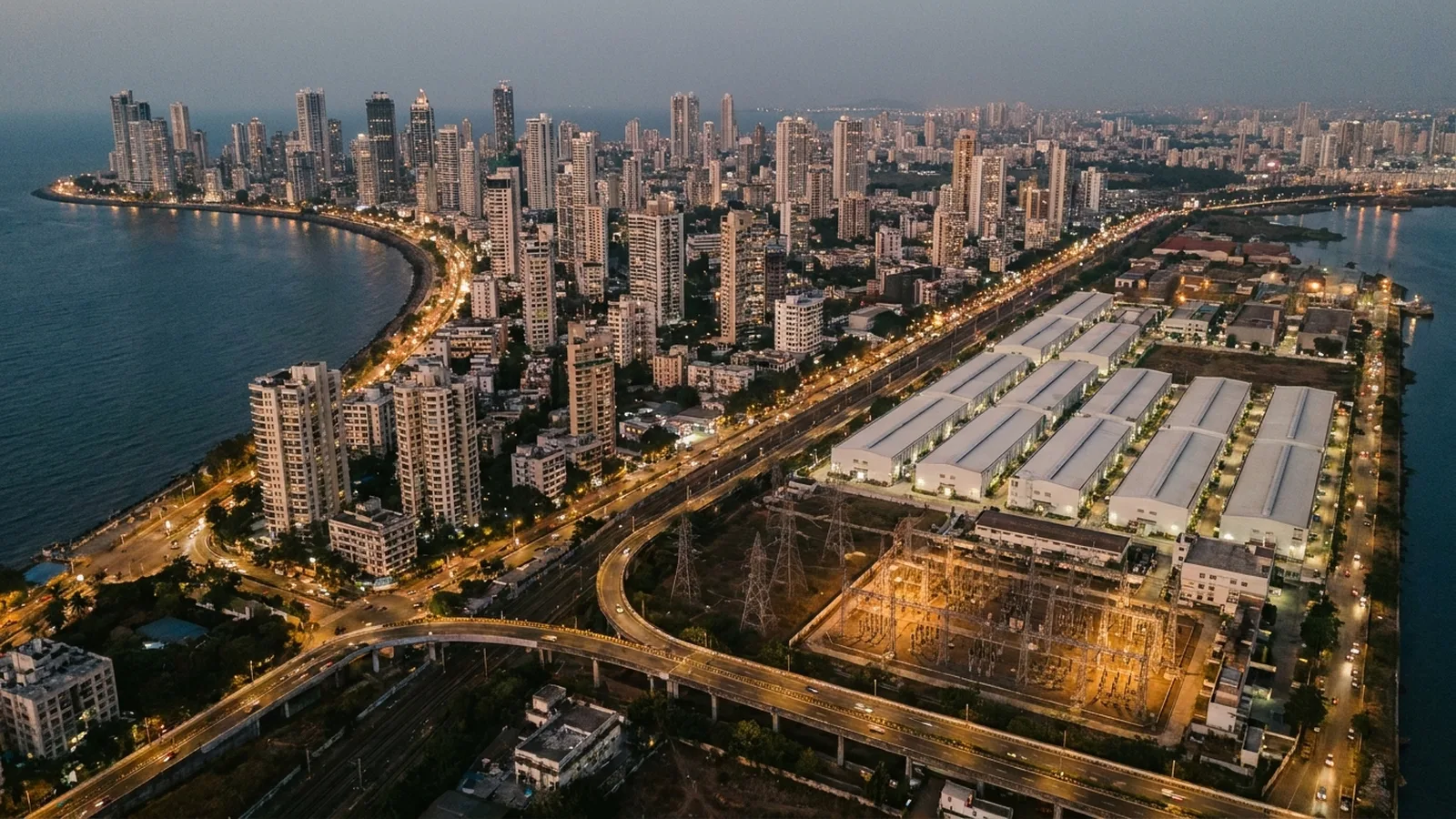
Mumbai had 890 MW of operational data centre capacity in H1 2026, against 214 MW in Chennai and 151 MW in Hyderabad, according to Cushman & Wakefield, and each city wins on a different test: Mumbai on interconnection, Chennai on colocation space available now, and Hyderabad on power headroom relative to city demand and a lower seismic zone. Mumbai has 13 cable landing stations and the lowest vacancy of the three, but Structure Research reports that committed capacity is approaching its Navi Mumbai grid allocation. Chennai has seven landing stations and 26.7% colocation vacancy, but carries flood risk, and its 2021 state policy covers data centres incorporated by 31 March 2026. Hyderabad has the second largest pipeline, Microsoft and AWS regions and Seismic Zone II, but no cable landings, as it is inland.
Before you start
- Mumbai suits interconnection, with 13 cable landing stations and 7.9% colocation vacancy (Cushman & Wakefield, H1 2026); power evidence is the hardest part, as committed capacity approaches MSEDCL’s Navi Mumbai allocation (Structure Research).
- Chennai suits buyers who need a hall now, with 26.7% colocation vacancy (Cushman & Wakefield, H1 2026) and east-coast cables; check flood exposure at plot level.
- Hyderabad holds 18% of India’s upcoming supply (Cushman & Wakefield), and Crisil’s ratio of data centre capacity to city peak demand by FY2030 is about 20% there against about 60% in Mumbai, suggesting more power headroom relative to city demand; it has no local cable landing.
- Colocation rents for 5 MW+ deals ran from Rs 6,000 to 7,500 per kW per month across the three cities in H1 2025 (Cushman & Wakefield); land and power date differ far more.
Mumbai, Chennai and Hyderabad compared (H1 2026 unless stated)
Mumbai has more operational capacity and cable landings than Chennai and Hyderabad and the lowest colocation vacancy of the three, while Hyderabad has more planned capacity than Chennai, 668 MW against 313 MW, on Cushman & Wakefield’s H1 2026 figures.Cushman & Wakefield
| Measure | Mumbai | Chennai | Hyderabad |
|---|---|---|---|
| Operational capacity (Cushman & Wakefield) | 890 MW | 214 MW | 151 MW |
| Under construction | 281 MW | 55 MW | 42 MW |
| Planned | 1,445 MW | 313 MW | 668 MW |
| Share of India upcoming supply to 2030 | 45% | 9% | 18% |
| Colocation vacancy | 7.9% | 26.7% | 28.0% |
| Cable landing stations | 13, plus 2 due in 2026 | 7, plus 2 under construction | None (inland city) |
| Data centres as share of current city peak demand by FY2030 (Crisil) | About 60% | Not published | About 20% |
| Seismic zone (IS 1893 (Part 1):2002 town list) | III | III | II |
| Signature hazard event | 944 mm of rain on 26 July 2005 (NOAA) | 1,178.3 mm in November 2015 at Meenambakkam, the highest November total on record (IMD) | Record rains and deadly flooding, October 2020 |
Power supply and state data centre policy in each city
| Measure | Mumbai (Maharashtra) | Chennai (Tamil Nadu) | Hyderabad (Telangana) |
|---|---|---|---|
| Grid note | About 6 GW allocated by MSEDCL to Navi Mumbai data centres, with committed capacity approaching it (Structure Research) | Dual power from two grids for data centres with sanctioned load of 50 MW or more (2021 policy) | Not found in sources reviewed |
| State policy | IT/ITES Policy 2023; Integrated Green Data Centre Parks, up to 20 parks statewide after a June 2026 amendment | Data Centre Policy 2021, for data centres incorporated from 1 April 2021 to 31 March 2026 | Dedicated data centre policy since 2016, the first in India (Cushman & Wakefield) |
| Power incentive | Re 1 per unit for 10 years (Rs 30,000 crore investment) or 20 years (Rs 60,000 crore or more) in green parks, which must use at least 51% green power for core operations | Open access charges at 50% of conventional charges; concessional cross subsidy surcharge (2021 policy) | Not found in sources reviewed |
| Voltage for large loads | Extra high voltage above 10,000 kVA contract demand (20,000 kVA in a Metropolitan Area or on an express feeder) | 110 kV for 10 to 50 MVA; 230 kV above 50 MVA | 132 kV or above for contracted demand above 10,000 kVA on a common feeder or above 20,000 kVA on a dedicated feeder, through a dedicated feeder or LILO |
| HT industrial tariff | MERC classifies data centres under the Industrial category (Case 217 of 2024) | Data centres buy at industrial tariff (2021 policy); HT-I Industries, Factories, IT services: Rs 7.50 per kWh plus Rs 608 per kVA per month from 1 July 2025 | HT-I(A) Industry General at 132 kV and above: Rs 6.65 per kVAh plus Rs 500 per kVA per month (FY 2024-25; reported unchanged for 2026-27) |
Structure Research describes Mumbai’s constraint as grid allocation: new campuses are going to Panvel, Taloja and Rasayani, where separate substation infrastructure can be commissioned. Crisil’s ratio of data centre capacity to current peak demand by FY2030 is about 20% for Hyderabad against about 60% for Mumbai. In Chennai, check whether any incentive applies to a project incorporated after March 2026.Structure ResearchDeccan HeraldGovernment of Tamil Nadu (via National Single Window System)
Colocation rents and land prices in Mumbai, Chennai and Hyderabad
| Measure | Mumbai | Chennai | Hyderabad |
|---|---|---|---|
| Colocation rent, 5 MW+ deals (Rs per kW per month, H1 2025) | 6,000 to 7,500 | 6,000 to 7,000 | 6,000 to 7,000 |
| Colocation rent, under 250 kW (Rs per kW per month, H1 2025) | 8,000 to 12,000 | 8,000 to 9,000 | 7,500 to 9,500 |
Colocation rents in the three cities are close; Cushman & Wakefield’s latest rent table is from H1 2025, as its H1 2026 report has none. Land prices vary more. Anarock puts small suburban Mumbai parcels at Rs 35 to 60 crore per acre and large park land, including Navi Mumbai and outer Chennai, at Rs 3 to 10 crore per acre.Cushman & WakefieldAnarock
Which city suits which data centre project
- Interconnection, cloud on-ramps and financial services: Mumbai, where Cushman & Wakefield’s main clusters are Thane-Belapur Road and Powai.
- A hall in 2026 or 2027 at a few MW: Chennai or Hyderabad, where colocation vacancy is highest of the three.
- A 100 MW+ hyperscale or AI campus: South Hyderabad (634 MW planned), Mumbai’s outer belt (Panvel, Taloja) if a substation date is firm, or Visakhapatnam.
- Lowest seismic zone of the three: Hyderabad (Zone II).
Invariant runs the same screen on candidate sites in all three cities, so the comparison is on evidence: the power route and its date, the hazard profile at the plot, groundwater, airport height limits, and the approvals each state requires.
More on data centres in India
Questions that come up.
Is Mumbai or Chennai better for a data centre?
It depends on the project: Mumbai has more capacity, more cable landing stations and lower vacancy, while Chennai has more vacant colocation space. Chennai also has a record of extreme rainfall, with 1,178.3 mm at Meenambakkam in November 2015, and power availability in Navi Mumbai is the main Mumbai check.Cushman & WakefieldStructure ResearchIndia Meteorological Department, RMC Chennai
Why is Hyderabad growing as a data center market?
Hyderabad is growing on hyperscale demand: AWS and Microsoft run cloud regions there. It holds 18% of India’s upcoming supply on Cushman & Wakefield’s count and sits in Seismic Zone II, the lowest of the three cities.Cushman & WakefieldAmazonMicrosoftBureau of Indian Standards
Which city has the most data centres in India?
Mumbai has the most, with 890 MW operational in H1 2026, about half of the top seven cities, per Cushman & Wakefield.Cushman & Wakefield
How do colocation rents compare in Mumbai, Chennai and Hyderabad?
For deals above 5 MW, Cushman & Wakefield’s H1 2025 table shows Rs 6,000 to 7,500 per kW per month in Mumbai and Rs 6,000 to 7,000 in Chennai and Hyderabad.Cushman & Wakefield
Is there enough grid power for new data centres in Mumbai?
Grid allocation is the main constraint in Navi Mumbai. Structure Research reports that MSEDCL has allocated about 6 GW to data centres there and that committed capacity is approaching it, pushing new campuses to Panvel, Taloja and Rasayani.Structure Research
Sources and references.
Primary sources checked for this guide on . The location, equipment, and operating plan determine which requirements apply to a project.
- Cushman & WakefieldIndia Data Centre Market Overview H1 2026 ↗
- Deccan HeraldIndia set for five times surge in its data centre capacity by 2030 (Crisil Ratings) ↗
- Bureau of Indian StandardsIS 1893 (Part 1):2002, Annex E zone factors ↗
- NOAA National Centers for Environmental InformationGlobal hazards, July 2005 ↗
- India Meteorological Department, RMC ChennaiMeenambakkam climate extremes ↗
- Al JazeeraMany dead as record rains lash India’s Hyderabad and nearby areas ↗
- Structure ResearchMumbai and Pune data centre report 2026 ↗
- International Bar AssociationGreen data centres in India: policy meets practice ↗
- Government of Tamil Nadu (via National Single Window System)Tamil Nadu Data Centre Policy 2021 ↗
- Maharashtra Electricity Regulatory Commission (via MSEDCL)MERC Electricity Supply Code and Standards of Performance Regulations 2021 ↗
- Maharashtra Electricity Regulatory CommissionMERC MYT Order for MSEDCL, Case 217 of 2024 (28 March 2025) ↗
- TNPDCLNew service connection: categories of supply (Tamil Nadu Electricity Supply Code) ↗
- Tamil Nadu Electricity Regulatory CommissionTNERC Suo-motu Tariff Order 6 of 2025 (30 June 2025) ↗
- Telangana Electricity Regulatory CommissionGTCS amendment: voltage of supply by contracted demand (19 October 2022) ↗
- Telangana Electricity Regulatory CommissionRetail supply tariff order FY 2024-25 (28 October 2024) ↗
- The Hans IndiaNo power tariff hike for 2026-27: TGERC ↗
- Cushman & WakefieldIndia Data Center Market Overview H1 2025 (rental tables) ↗
- AnarockData Centre: The Blueprint of the Digital Fortress in India (2026) ↗
- AmazonAWS to invest INR 1,05,600 crore (US$12.7 billion) into cloud infrastructure in India ↗
- MicrosoftMicrosoft establishes India South Central region as a strategic hub ↗