

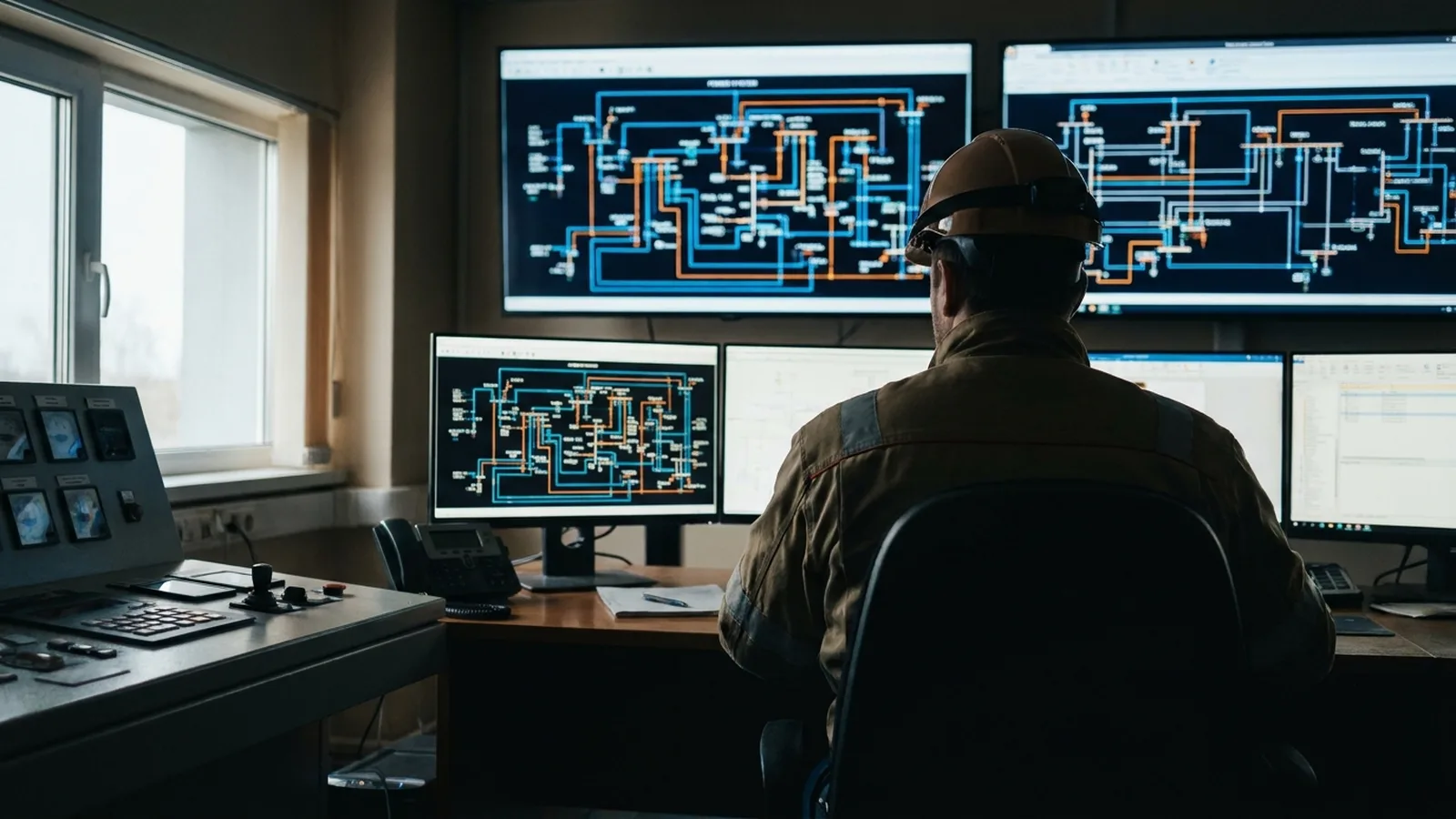
A power study for a data centre site in India estimates how many MW each nearby substation can take, at which voltage, and what limits it, by testing the surrounding network at N-0 and N-1 against the state grid code. The model spans the discom, state transmission (STU) and, for 50 MW and above, inter-state (CTU) networks. Maharashtra’s grid code, for instance, requires the system to withstand the loss of a 220 kV double-circuit line or a single interconnecting transformer, among other outages, without load curtailment. A screening study shows where to apply, how much to ask for and which upgrades to expect; only the discom’s sanction, or the nodal agency’s grant of inter-state access, makes the number firm.
Before you start
- A data centre power study in India follows the connection hierarchy: 33 kV discom supply for small halls, 110 to 230 kV STU substations above about 10 MVA, and inter-state access for 50 MW and above.
- State grid codes set the N-1 tests and substation limits; Maharashtra’s State Grid Code 2020 says a single 220 kV substation should not normally exceed 500 MVA, or a 400 kV substation 2,000 MVA.
- Public network data in India is thinner than the planning question needs; we found no CTUIL plan naming transmission schemes for the main data centre clusters.
- The MW and the date become firm only when the discom sanctions the load and the STU approves the works, or, for inter-state access, when the nodal agency grants GNA under CERC’s regulations.
What a data centre power study in India covers
| Part | What it covers in India |
|---|---|
| Network model | Discom 33 kV and STU 66 to 400 kV substations, lines and transformers around the site for each study year, with inter-state elements where the load may connect at 400 kV |
| Connection options | Each substation that could supply the load at the voltage its contract demand falls under in the state supply code, plus line-in line-out options |
| Cases | Peak and light-load conditions, near-term and later years, with other announced data centre and industrial loads in and out |
| Contingencies | AC load flow at N-0 and N-1 to the state grid code criteria, for example loss of a 220 kV double-circuit line or an interconnecting transformer |
| Limits | Thermal and voltage limits, the element that binds first and at what MW, and substation capacity limits in the grid code |
| Upgrades and date | The augmentation that lifts each limit, an indicative cost range and an energisation range, with the approvals each depends on |
The method is the same as a US utility-grade study; what changes is the hierarchy of who studies and approves the connection, and the planning criteria each state sets.
Grid code planning tests a new data centre load must pass
Maharashtra’s State Grid Code 2020 requires the intra-state transmission system to withstand, without load curtailment, the outage of a 132 kV double-circuit line, a 220 kV double-circuit line, a 400 kV single-circuit line or a single interconnecting transformer. The outage of one transformer at a 66 kV or higher substation must not overload the rest, and new substations can be proposed when urban transformers exceed 70% loading. A single substation should not normally exceed 250 MVA at 132 kV, 500 MVA at 220 kV or 2,000 MVA at 400 kV.Maharashtra Electricity Regulatory Commission
For inter-state access, bulk consumers of 50 MW or more apply for GNA to the nodal agency, the Central Transmission Utility, under CERC’s GNA regulations. CERC’s June 2026 draft amendment would grant GNA to entities seeking dual connectivity, such as data centres, only after the nodal agency carries out technical studies.Central Electricity Regulatory CommissionCentral Electricity Regulatory CommissionPIB, Ministry of New and Renewable Energy
Which grid data is public in India, and which is not
- Public: state supply codes and grid codes, tariff orders, CERC regulations and drafts, and the transmission utilities’ published plans.
- Thin: the CTUIL rolling plan study report we retrieved for 2026-27 does not mention data centres, and we found no CTUIL or Grid-India document naming schemes for the Navi Mumbai, Chennai, Hyderabad or Visakhapatnam clusters.
- Moving: CEA set up a committee on data centres and grid stability in 2026, and NITI Aayog has asked states to verify power and water capacity before clearing projects.
That gap is why a screening study in India leans on the substation and line data that can be assembled, the announced loads competing for the same substation, and direct questions to the discom and STU.
Why AI data centre loads change the power study
S.K. Soonee, founding CEO of POSOCO, and Parikshit Pareek of IIT Roorkee have written that a voltage disturbance can trigger data centre protection that shifts load to backup, and that such silent exits can remove gigawatts of load in seconds, producing frequency overshoot. They argue that data centre load characteristics, such as planned IT load, PUE, UPS configuration, backup mode and commissioning timelines, should be integrated into CEA’s transmission and distribution planning criteria, and that interconnection standards should require voltage ride-through. A draft CEA connectivity standard of July 2026 would bring bulk consumers at 33 kV and above under common technical standards.Power LineIndian Infrastructure
What makes the MW and the date firm
A screening power study does not commit a discom or transmission utility to anything. The number becomes firm when the discom sanctions the load and the STU approves the substation and bay works, or, for inter-state access, when the nodal agency grants GNA. The study’s value is that the application goes in with the right connection point, MW and questions.Central Electricity Regulatory Commission
How Invariant helps
For a site or shortlist in India, Invariant checks how the site gets power: the discom or transmission connection, the voltage the load falls under, the nearest substations, the open access or captive route and the document behind the MW. We also screen seismic zone, flood history, groundwater status and airport height limits, and map the central and state approvals with the authority behind each. Send the state, the MW and the date you need power.
More on data centres in India
Questions that come up.
What is a power study for a data centre?
A load flow study of the network around a site that estimates how many MW each nearby substation can supply at N-0 and N-1. It also identifies the element that limits it, the upgrade that lifts it and roughly when power could be available.Maharashtra Electricity Regulatory Commission
What N-1 criteria apply to a data centre connection in India?
Each state grid code sets them. Maharashtra’s requires the system to withstand loss of a 132 kV or 220 kV double-circuit line, a 400 kV single-circuit line or a single interconnecting transformer without load curtailment.Maharashtra Electricity Regulatory Commission
Who studies a data centre grid connection in India?
The discom and state transmission utility, for supply at up to 220 kV through the state network. For bulk consumers of 50 MW or more applying for inter-state access, the nodal agency (the Central Transmission Utility) decides the GNA application under CERC’s regulations, and a June 2026 draft would require it to carry out technical studies for dual-connected entities.Central Electricity Regulatory CommissionCentral Electricity Regulatory CommissionPIB, Ministry of New and Renewable Energy
Can a power study guarantee a data centre connection date?
No. Only the discom’s sanction and the transmission utility’s approval of the works, or a GNA grant for inter-state access, make the MW and date firm. A study tells you where and how much to apply for.Central Electricity Regulatory Commission
Is transmission data for Indian data centre clusters public?
Partly. Grid codes, supply codes, tariff orders and CERC documents are public, but we found no CTUIL or Grid-India plan naming transmission schemes for the main data centre clusters.CTUIL
Sources and references.
Primary sources checked for this guide on . The location, equipment, and operating plan determine which requirements apply to a project.
- Maharashtra Electricity Regulatory CommissionMERC Electricity Supply Code and Standards of Performance Regulations 2021 ↗
- Maharashtra Electricity Regulatory CommissionMERC State Grid Code Regulations 2020 ↗
- Central Electricity Regulatory CommissionCERC (Connectivity and General Network Access to the inter-State Transmission System) Regulations 2022 ↗
- Central Electricity Regulatory CommissionDraft GNA Fourth Amendment, explanatory memorandum (16 June 2026) ↗
- PIB, Ministry of New and Renewable EnergyWaiver of ISTS charges for renewable energy projects (Rajya Sabha reply, 17 March 2026) ↗
- CTUILISTS rolling plan study report 2026-27 ↗
- KNN IndiaCEA sets up committee to assess data centres’ impact on power grid stability ↗
- ThePrintNITI Aayog asks states to verify power and water capacity before clearing data centre projects ↗
- Power LinePowering the AI era: preparing the grid for the data centre boom ↗
- Indian InfrastructureCEA issues draft Technical Standards for Connectivity to the Grid Regulations 2026 ↗