

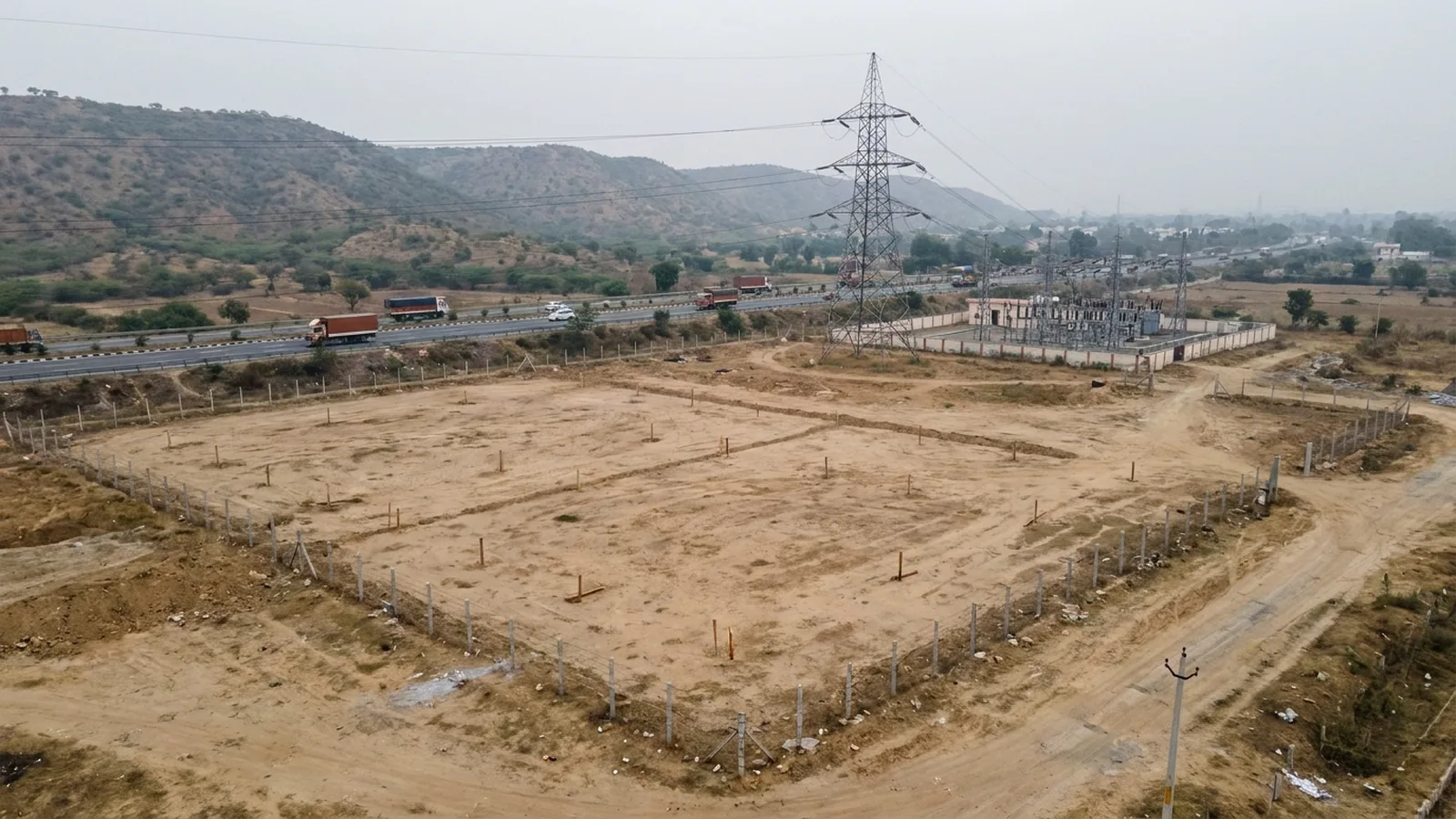
The best location for a data centre in India is a site that can show a dated power connection for its full load, not the one nearest a substation. Mumbai had 890 MW of operational capacity in H1 2026, half of India’s total, and 13 cable landing stations, according to Cushman & Wakefield, but Structure Research reports that the roughly 6 GW of grid capacity allocated to Navi Mumbai data centres is close to fully committed. Chennai and Hyderabad had colocation vacancy of 26.7% and 28.0% in H1 2026, and Invest India and Cushman & Wakefield count more than 4 GW announced in Visakhapatnam. After power, screen fibre, land, water, physical risk and state policy.
Before you start
- Rank sites by the document behind the MW (a connection offer, sanctioned load or signed agreement), not by distance to a line; NITI Aayog’s October 2026 framework asks states to verify power and water capacity before clearing data centre projects.
- Mumbai (13 cable landing stations) and Chennai (7) hold India’s cable landings, according to Cushman & Wakefield; Hyderabad, Noida and Pune are inland markets that depend on terrestrial fibre.
- Seismic zones in the IS 1893 (Part 1):2002 town list: Delhi IV; Mumbai, Chennai, Pune, Kolkata and Ahmedabad III; Bengaluru, Hyderabad and Visakhapatnam II.
- Tamil Nadu’s 2021 policy covered data centres incorporated until 31 March 2026 and Uttar Pradesh replaced its 2021 policy in July 2026, so check which incentives are open on the date you apply.
The order to screen a data centre site in India
Power is the first check on an Indian data centre site because it is the cheapest check that can rule a site out: a large load needs a dedicated connection from the discom or the state transmission utility, and the date on that connection usually sets the project schedule. Every later check in the table can also kill a site. NITI Aayog’s October 2026 framework now asks states to verify power and water capacity before clearing data centre projects.ThePrint
| Step | What to establish | What counts as evidence |
|---|---|---|
| 1. Power | Who serves the load, at what voltage, how many MW and by when | A connection offer or sanctioned load in writing, and the substation and line it depends on |
| 2. Fibre and cable landings | Route diversity to at least two carriers and distance to landing stations | Carrier route maps; landing station locations |
| 3. Land and zoning | Clean title, permitted use, FAR and ground coverage | Title chain, land use, allotment terms from the development authority |
| 4. Water | Source for cooling and whether groundwater is allowed | Groundwater assessment unit status; supplier or treated water commitment |
| 5. Physical risk | Seismic zone, flood and cyclone history, airport height limits | IS 1893 zone, IMD records, AAI height clearance map |
| 6. Policy | Which state incentives are open and what they require | The notified policy text and its validity date |
Best cities for a data centre in India, compared
No Indian city leads on every measure a site buyer compares. Mumbai and Navi Mumbai have the most operational capacity and the lowest colocation vacancy (7.9%); Bengaluru and Hyderabad have the most spare colocation (28.0%) and sit in seismic zone II. Operational capacity and vacancy are Cushman & Wakefield’s H1 2026 figures; seismic zones are from IS 1893 (Part 1):2002, Annex E.Cushman & WakefieldBureau of Indian Standards
| City | Operational MW (H1 2026) | Colocation vacancy | Seismic zone | Cable landings | Note for site selection |
|---|---|---|---|---|---|
| Mumbai and Navi Mumbai | 890 | 7.9% | III | 13, two more due in 2026 | Grid allocation for Navi Mumbai data centres reported close to fully committed |
| Chennai | 214 | 26.7% | III | 7, two under construction | East coast cyclone and monsoon flood exposure |
| Delhi NCR | 183 | 10.9% | IV (Delhi) | Inland | Noida airport height clearance zone of 20 km |
| Bengaluru | 162 | 28.0% | II | Inland | All 10 groundwater assessment units in Bengaluru Urban and Rural over-exploited, per CGWB data reported by Citizen Matters |
| Hyderabad | 151 | 28.0% | II | Inland | Second-largest pipeline after Mumbai (18% of upcoming) |
| Pune | 133 | 22.1% | III | Inland | Same state grid and policy as Mumbai |
| Kolkata | 22 | 19.4% | III | Tajpur station under construction | Small market, government and SME demand |
| Visakhapatnam | Early stage, 4 GW+ announced | Not published | II | New gateway announced under Google’s America-India Connect | Hudhud (2014) made landfall over the city |
Power: the check that sets the schedule
Structure Research reports that MSEDCL allocated about 6 GW of grid capacity to Navi Mumbai data centres and that committed and under-construction capacity is approaching it, which is pushing new builds to Panvel, Taloja and Rasayani where new substations can be built. Crisil estimates that by FY2030 data centre capacity could equal about 60% of Mumbai’s current peak demand and about 80% of Visakhapatnam’s.Structure ResearchDeccan Herald
Some state policies write the connection terms down: Tamil Nadu’s 2021 policy offered dual grid supply for a sanctioned load of 50 MW or more and an additional feeder above 100 MW, and West Bengal’s 2021 policy said the government would establish dual power grid networks. Treat these as eligibility for a connection, not as capacity on a given date.Government of Tamil Nadu (via National Single Window System)Government of West Bengal (via wbxpress)
Fibre and cable landing stations in India
Tele.net reports that the Mumbai region handles about 95% of India’s international bandwidth. Mumbai has 13 cable landing stations with two more due in 2026, and Chennai has 7 with two under construction. Visakhapatnam is being built as an east coast gateway: Google’s America-India Connect, announced on 18 February 2026, includes a subsea path from Visakhapatnam and Chennai to South Africa and one from Visakhapatnam to Singapore.Tele.netCushman & WakefieldGoogle
For an AI training campus, latency to a landing station matters less than power and land; for interconnection and cloud regions it matters more. Decide which you are building before weighting this step.
Land, water and physical risk at Indian sites
Anarock prices land for 100 to 500 MW parks at ₹3 to 10 crore per acre and for small suburban Mumbai sites at ₹35 to 60 crore, and advises buying 30 to 50% more land than phase 1 needs. Groundwater cannot be assumed: under the CGWA guidelines of September 2020, new industries other than MSMEs get no groundwater NOC in over-exploited assessment units, and SBI names Bengaluru, Chennai and Gurugram as water-stressed data centre metros.AnarockMinistry of Jal Shakti, Central Ground Water AuthoritySBI CHAKRA
Physical risk at Indian sites is mostly on record in advance: 944 mm of rain fell on Mumbai on 26 July 2005, a 24-hour record for the city, Chennai’s Meenambakkam station recorded 1,178.3 mm in November 2015, and Cyclone Hudhud crossed the coast over Visakhapatnam in October 2014. AAI height clearance is needed within 20 km of an airport operating under visual flight rules and 56 km of one under instrument flight rules, and new airports began commercial flights at Navi Mumbai in December 2025 and at Noida in June 2026.NOAA National Centers for Environmental InformationIndia Meteorological Department, RMC ChennaiIndia Meteorological DepartmentAirports Authority of IndiaBusiness StandardBusiness Standard
How Invariant helps
For a site or a shortlist in India, Invariant checks how the site gets power (the discom or transmission connection, the open access route and the nearest substations), screens seismic zone, flood history, groundwater status and airport height limits, and maps the central and state approvals the project needs with the authority behind each one. Send the state, the MW and the date you need power.
More on data centres in India
Questions that come up.
What is the best location for a data centre in India?
The best location is whichever site can show a dated power connection for its full load; the right city depends on what you are building. Mumbai has the cable landings and half of operational capacity but a tight grid in Navi Mumbai; Chennai has landings and 26.7% colocation vacancy; Hyderabad has the second-largest pipeline and seismic zone II; Visakhapatnam has more than 4 GW announced.Cushman & WakefieldStructure ResearchInvest India and Cushman & WakefieldBureau of Indian Standards
How do I choose a site for a data center in India?
Start with written power evidence for the full load, then check the rest in order: fibre and cable landings, land title and zoning, water, seismic, flood and airport height limits, and the state policy that applies on the date you apply.
Which Indian cities have cable landing stations for data centres?
Mumbai (13 stations, two more due in 2026) and Chennai (7, two under construction) are the main ones. Google has announced a new international subsea gateway at Visakhapatnam, and a station at Tajpur near Kolkata is under construction.Cushman & WakefieldGoogle
Is Navi Mumbai running out of power for data centres?
Structure Research reports that the roughly 6 GW of grid capacity MSEDCL allocated to Navi Mumbai data centres is close to fully committed. New builds are moving to Panvel, Taloja and Rasayani, where new substations can be built.Structure Research
Which seismic zone are India’s data centre cities in?
Under the IS 1893 (Part 1):2002 town list: Delhi is zone IV; Mumbai, Thane, Chennai, Pune, Kolkata and Ahmedabad are zone III; Bengaluru, Hyderabad and Visakhapatnam are zone II.Bureau of Indian Standards
Sources and references.
Primary sources checked for this guide on . The location, equipment, and operating plan determine which requirements apply to a project.
- ThePrintNITI Aayog asks states to verify power, water capacity before clearing data centre projects ↗
- Cushman & WakefieldIndia Data Centre Market Overview H1 2026 ↗
- Bureau of Indian StandardsIS 1893 (Part 1):2002, criteria for earthquake resistant design, Annex E ↗
- Invest India and Cushman & WakefieldIndia's Data Centre Growth Story (October 2026) ↗
- Structure ResearchMumbai and Pune data centre report 2026 ↗
- ThePrint (PTI)Height restrictions put in place within 20 km radius of Noida airport (PTI, 12 July 2025) ↗
- Citizen MattersWhy Bengaluru needs effective groundwater monitoring ↗
- GoogleAnnouncing America-India Connect and new investments to advance global AI access (18 February 2026) ↗
- India Meteorological DepartmentVery severe cyclonic storm Hudhud: a report ↗
- Deccan HeraldIndia set for five times surge in its data centre capacity by 2030 (Crisil Ratings, 3 November 2026) ↗
- Government of Tamil Nadu (via National Single Window System)Tamil Nadu Data Centre Policy 2021 ↗
- Government of West Bengal (via wbxpress)West Bengal Data Centre Policy 2021 (notification of 6 September 2021) ↗
- Tele.netIndia's subsea cable expansion outpaces its supporting infrastructure ↗
- AnarockData Centre: The Blueprint of the Digital Fortress in India (2026) ↗
- Ministry of Jal Shakti, Central Ground Water AuthorityGuidelines to regulate and control ground water extraction, S.O. 3289(E) of 24 September 2020 ↗
- SBI CHAKRAData Centres in India, sector report (April 2026) ↗
- NOAA National Centers for Environmental InformationGlobal hazards and significant events, July 2005 (archived copy) ↗
- India Meteorological Department, RMC ChennaiMeenambakkam extremes and normals ↗
- Airports Authority of IndiaNOCAS frequently asked questions (height clearance) ↗
- Business StandardNavi Mumbai airport begins commercial flight operations (25 December 2025) ↗
- Business StandardCommercial operations begin at Noida International Airport ↗