

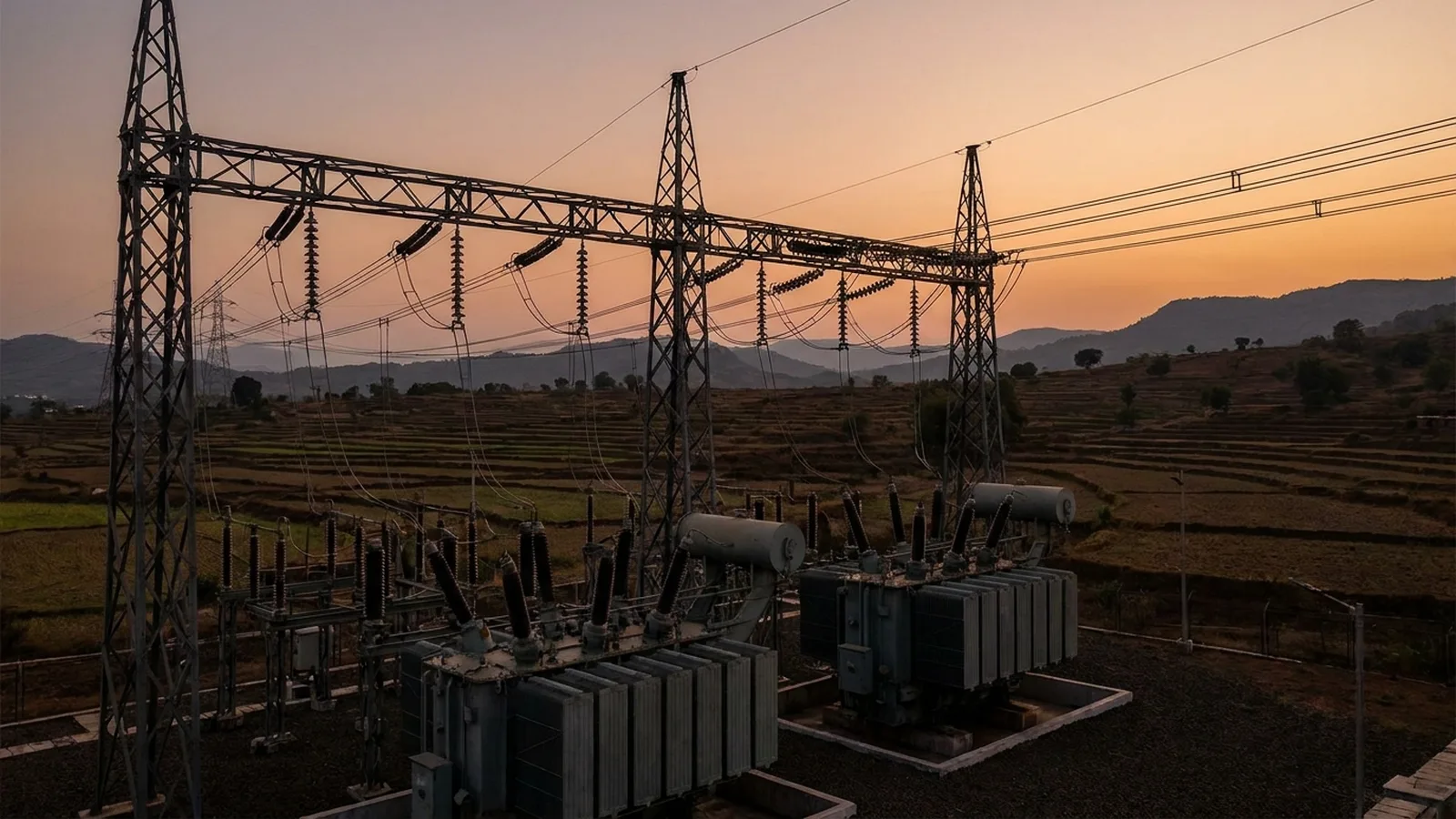
A data centre in India buys power from the state distribution company (discom), and under the state supply codes a load above about 10 MVA connects at 110 kV to 230 kV. Renewable power can be added through green energy open access, from 100 kW, or from captive plants, and a bulk consumer of 50 MW or more can connect directly to the inter-state grid. Tariffs differ by state: Tamil Nadu charged ₹7.50/kWh plus ₹608/kVA a month from July 2025, and Uttar Pradesh ₹6.10 to ₹7.10/kVAh for 2026-27. The binding question for a site is rarely the tariff: it is whether the substation and line can deliver the MW, and by when.
Before you start
- A data centre in India has three power routes: discom supply at high or extra high voltage, green energy open access from 100 kW under the 2022 rules, and captive or group captive generation with 26% ownership and 51% consumption.
- Maharashtra’s MERC tariff order names data centres as industrial; Tamil Nadu bills them as IT services under HT-I; Uttar Pradesh covers notified IT units under HV-2.
- Under each state’s supply code, load above 10 MVA usually moves to 110 kV, 132 kV or 220 kV supply from a transmission substation.
- TNERC’s order T.O. 6 of 2025 set ₹7.50/kWh plus ₹608/kVA a month for Tamil Nadu’s HT-I category, which covers data centres, from 1 July 2025.
- The Central Electricity Authority estimates data centre demand of about 17 GW by 2031-32, according to the government’s reply to the Rajya Sabha.
The three ways a data centre in India buys power
| Route | What it is | Main rule | What it adds to cost |
|---|---|---|---|
| Discom supply | Supply from the state distribution licensee at HT or EHV | State supply code and the commission’s tariff order | Demand charge per kVA plus energy charge per kWh or kVAh, electricity duty, fuel adjustment |
| Green energy open access | Renewable power bought from a generator or trader and wheeled over the grid | Green Energy Open Access Rules 2022: from 100 kW contracted demand | Transmission, wheeling, cross subsidy surcharge, standby and banking charges |
| Captive or group captive | Generation the consumer part-owns | Electricity Rules 2005, Rule 3, as amended in March 2026: at least 26% ownership and 51% consumption | No cross subsidy or additional surcharge if the tests are met |
Most campuses combine the first route with one of the others: the discom supplies the connection, standby and balance, while open access or captive plants provide renewable energy. A bulk consumer of 50 MW or more may instead connect directly to the inter-state transmission system under CERC’s General Network Access regulations.Central Electricity Regulatory Commission
Data centre connection voltage by state
Each Indian state’s supply code ties a data centre’s connection voltage to its contract demand, so a 20 MW hall and a 200 MW campus connect at different voltages.
| State | Up to about 10 MVA | Above 10 MVA | Largest loads |
|---|---|---|---|
| Maharashtra | 11 kV to 3 MVA, 22 kV to 7.5 MVA, 33 kV to 10 MVA (higher limits in metro areas) | Extra high voltage above the 22 and 33 kV limits | EHV from a transmission substation |
| Tamil Nadu | 11 or 22 kV to 3 or 5 MVA; 33 kV to 10 MVA | 110 kV from 10 to 50 MVA | 230 kV above 50 MVA |
| Telangana | 11 kV or 33 kV by feeder type (132 kV also allowed from 5 MVA on a common feeder) | 132 kV or above beyond 10 MVA on a common feeder or 20 MVA on a dedicated one | 132 kV or above, dedicated feeder or LILO |
| Uttar Pradesh | 11 kV to 3 MVA; 33 kV to 10 MVA | 132 or 220 kV above 10 MVA | 220 kV feeder from a 220 or 400 kV substation on request, if the licensee considers it essential |
Electricity tariffs for data centres by state
Each state commission sets data centre tariffs in its retail supply tariff order; the table gives the published rates for the category each state uses for data centres, before fuel adjustment, electricity duty, time-of-day terms and taxes. Units follow each order: some bill energy per kWh, others per kVAh.
| State | Category for data centres | Demand charge | Energy charge | Order |
|---|---|---|---|---|
| Tamil Nadu (TNPDCL) | HT-I, which covers IT services including data centres | ₹608/kVA a month | ₹7.50/kWh | TNERC T.O. 6 of 2025, from 1 July 2025 |
| Uttar Pradesh (UPPCL discoms) | HV-2 Large and Heavy Power, for IT units notified by the state | Urban ₹300 (up to 11 kV) to ₹270 (above 66 kV) per kVA a month | ₹7.10 (up to 11 kV), ₹6.80, ₹6.40, ₹6.10/kVAh (above 132 kV) | UPERC order FY 2026-27, 2 July 2026 |
| Telangana (TGSPDCL, TGNPDCL) | HT-I(A) Industry (General); we did not confirm that data centres are billed in it | ₹500/kVA a month | ₹7.65 (11 kV), ₹7.15 (33 kV), ₹6.65/kVAh (132 kV and above) | TGERC order FY 2024-25 (28 October 2024); no tariff hike announced for FY 2026-27, per The Hans India |
| Maharashtra (MSEDCL) | HT I(A) Industry, which names data centres | ₹555/kVA a month in the March 2025 multi-year order, since revised | ₹7.48/kVAh at EHV in the March 2025 multi-year order, since revised | MERC Case 217 of 2024, then review orders; rate in force not confirmed |
| Gujarat (one licensee) | HTP-I, for HT purposes not covered by another HT category | ₹150 to ₹475/kVA a month by slab | 400 to 430 paise per unit by demand slab, plus fuel adjustment | GERC order for AspenPark Infra Vadodara, 25 March 2026 |
MERC revised Maharashtra’s rates in a review order of 25 June 2025, to ₹600/kVA and ₹8.68/kVAh at EHV from 1 July 2025. We have not confirmed whether later orders changed these rates, so check the rate in force with MSEDCL before using any of these figures. The Gujarat row is from one small licensee’s order; we did not confirm that the state discoms use the same schedule.Maharashtra Electricity Regulatory CommissionGujarat Electricity Regulatory Commission
We have not verified current tariffs for Karnataka, Andhra Pradesh, Haryana or West Bengal for this guide. For those states, the commission’s latest retail supply tariff order is the source.
States that treat data centres as industrial consumers
- Maharashtra: MERC classified data centres and semiconductor units as industrial to attract high, continuous loads; industrial incentives apply, and data centres using 100% green power get a 10% discount on wheeling charges.
- Tamil Nadu: data centres fall under HT-I as IT services, following the state ICT policy definition.
- Uttar Pradesh: the HV-2 industrial category covers IT and ITeS units the state notifies by policy.
State data centre policies add power incentives on top of the tariff category. Odisha’s 2022 policy exempts electricity duty for 10 years up to 5 MVA and subsidises 30% of the power bill for five years, capped at ₹2 crore. Uttar Pradesh’s 2026 policy exempts electricity duty for 10 years. Gujarat’s 2026-29 policy offers a power tariff subsidy of ₹1 per unit for 20 years to eligible projects of 150 MW or more of IT load.Invest OdishaInvest UPCyril Amarchand Mangaldas
Where grid capacity constrains data centres in India
Data centre capacity is still under 1% of India’s installed power capacity, according to the government, but it is concentrated. Structure Research reports that committed and under-construction data centre capacity in Navi Mumbai is approaching the roughly 6 GW of grid capacity MSEDCL allocated there, pushing new builds towards Panvel, Taloja and Rasayani. Crisil Ratings estimates, as reported by Deccan Herald, that by FY2030 data centre capacity could equal about 60% of Mumbai’s current peak demand and about 80% of Visakhapatnam’s.PIB, Ministry of Electronics and ITStructure ResearchDeccan Herald
The Central Electricity Authority has asked states including Maharashtra, Andhra Pradesh, Telangana and Tamil Nadu to enhance resource adequacy for data centre demand, ThePrint reported in April 2026. The head of TGSPDCL, one of Telangana’s two discoms, told ThePrint that data centres need transmission lines of 132 kV and above.ThePrint
How Invariant helps
For a site or shortlist in India, Invariant checks how the site gets power: the discom or transmission connection, the voltage the load falls under, the nearest substations, the open access or captive route and the document behind the MW. We also screen seismic zone, flood history, groundwater status and airport height limits, and map the central and state approvals with the authority behind each. Send the state, the MW and the date you need power.
More on data centres in India
Questions that come up.
How do data centres in India get electricity?
From the state discom, at a voltage the state supply code sets for the contract demand. Renewable power is often added through green energy open access or captive plants, and bulk consumers of 50 MW or more can also connect directly to the inter-state grid under CERC rules.Ministry of Power (gazette copy)Central Electricity Regulatory Commission
How much does electricity cost a data centre in India?
It depends on the state and tariff category: TNERC set ₹7.50/kWh plus ₹608/kVA a month for Tamil Nadu from July 2025. Uttar Pradesh charges ₹6.10 to ₹7.10/kVAh plus ₹270 to ₹300/kVA for 2026-27, and Telangana’s FY 2024-25 order set ₹6.65 to ₹7.65/kVAh plus ₹500/kVA for HT industry. Fuel adjustment, duty and taxes are extra.Tamil Nadu Electricity Regulatory CommissionUttar Pradesh Electricity Regulatory CommissionTelangana Electricity Regulatory Commission
Are data centres industrial consumers for electricity in India?
In Maharashtra, yes: the MERC tariff order names them as industrial. Tamil Nadu bills them under HT-I as IT services, and Uttar Pradesh under the HV-2 industrial category for notified IT units.Maharashtra Electricity Regulatory CommissionTamil Nadu Electricity Regulatory CommissionUttar Pradesh Electricity Regulatory Commission
Can a data center in India buy renewable power directly?
Yes, through green energy open access or a captive plant. The Green Energy Open Access Rules 2022 allow any consumer with 100 kW or more of contracted demand to buy renewable power through open access, and a captive or group captive plant qualifies if the consumer owns at least 26% and uses at least 51% of the output.Ministry of Power (gazette copy)PIB, Ministry of Powerpv magazine India
How much power will data centres in India need?
About 17 GW by 2031-32, according to the Central Electricity Authority. Data centre capacity today is less than 1% of India’s installed power capacity.PIB, Ministry of Electronics and IT
Sources and references.
Primary sources checked for this guide on . The location, equipment, and operating plan determine which requirements apply to a project.
- Ministry of Power (gazette copy)Electricity (Promoting Renewable Energy through Green Energy Open Access) Rules 2022, G.S.R. 418(E) ↗
- Ministry of Power (gazette copy via REC Registry)Electricity (Promoting Renewable Energy Through Green Energy Open Access) Amendment Rules 2023, G.S.R. 59(E), 27 January 2023 ↗
- PIB, Ministry of PowerElectricity (Amendment) Rules 2026 on captive generation ↗
- pv magazine IndiaReforming captive power in India: key changes under the Electricity (Amendment) Rules 2026 ↗
- Central Electricity Regulatory CommissionCERC (Connectivity and General Network Access to the inter-State Transmission System) Regulations 2022 ↗
- Maharashtra Electricity Regulatory CommissionMERC Electricity Supply Code and Standards of Performance Regulations 2021 ↗
- TNPDCLCategories of supply (Tamil Nadu Electricity Supply Code) ↗
- Telangana Electricity Regulatory CommissionGTCS amendment on supply voltage by contracted demand (19 October 2022) ↗
- Dakshinanchal Vidyut Vitran NigamUP Electricity Supply Code 2005, salient features ↗
- Tamil Nadu Electricity Regulatory CommissionTariff Order T.O. 6 of 2025 (30 June 2025) ↗
- Uttar Pradesh Electricity Regulatory CommissionTariff order FY 2026-27 for UPPCL distribution companies (2 July 2026) ↗
- Telangana Electricity Regulatory CommissionRetail supply tariff order FY 2024-25 (28 October 2024) ↗
- The Hans IndiaNo power tariff hike for 2026-27: TGERC ↗
- Maharashtra Electricity Regulatory CommissionMSEDCL multi-year tariff order, Case 217 of 2024 (28 March 2025) ↗
- Maharashtra Electricity Regulatory CommissionReview order, Case 75 of 2025 (25 June 2025) ↗
- Gujarat Electricity Regulatory CommissionTariff order FY 2026-27, AspenPark Infra Vadodara, Case 2591 of 2025 (25 March 2026) ↗
- Invest OdishaOdisha State Data Centre Policy 2022 ↗
- Invest UPUttar Pradesh Data Centre Policy 2026 ↗
- Cyril Amarchand MangaldasGujarat Data Center Policy 2026-2029 ↗
- PIB, Ministry of Electronics and ITInstalled data centre capacity and CEA demand estimate (Rajya Sabha reply, 7 August 2026) ↗
- Structure ResearchMumbai and Pune data centre report 2026 ↗
- Deccan HeraldIndia set for five times surge in its data centre capacity by 2030 (Crisil Ratings report) ↗
- ThePrintData centre gold rush risks blackouts, central electricity body warns states ↗