

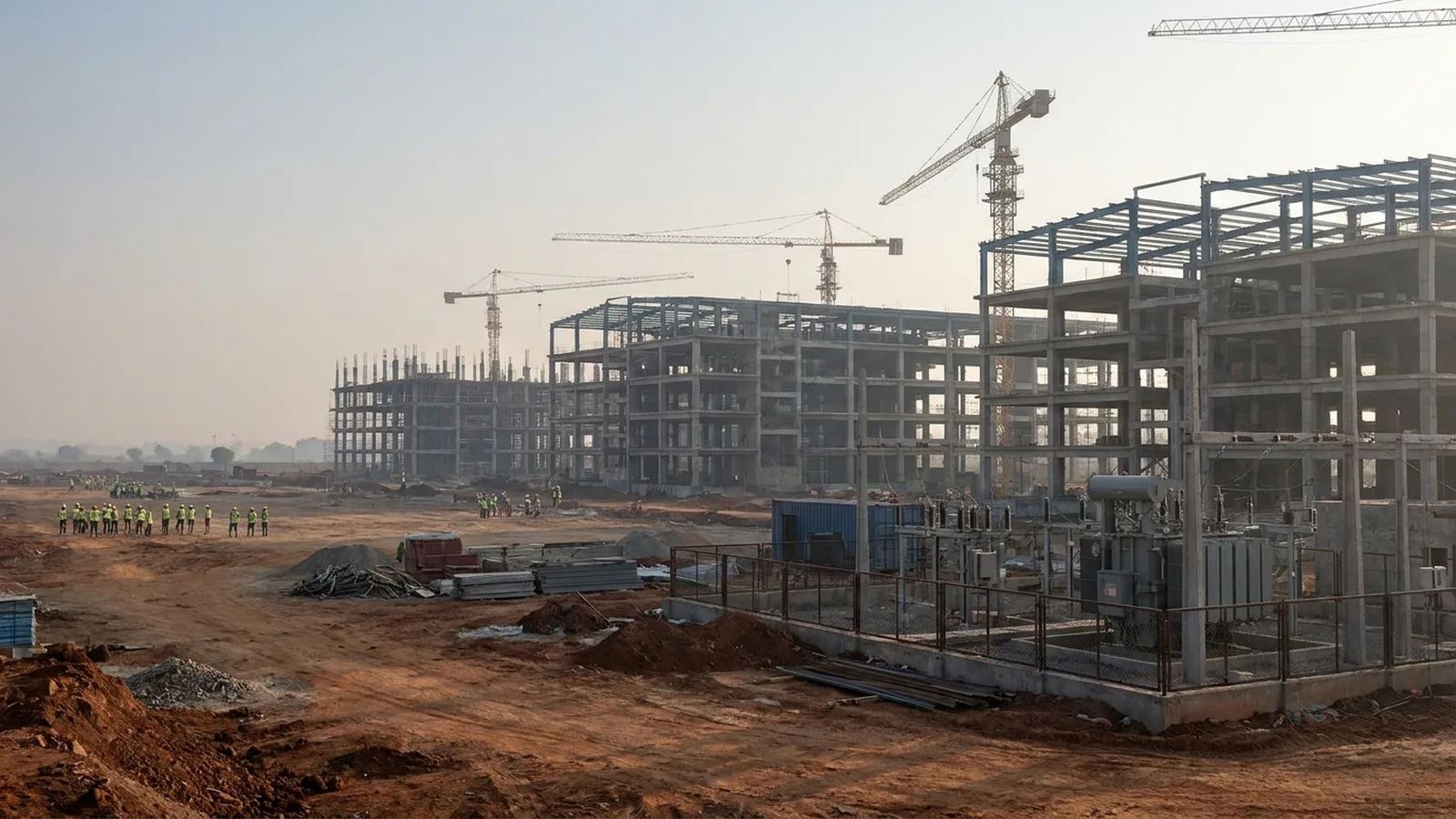
Setting up a data centre in India takes nine steps, from sizing the load to taking Consent to Operate, and the step to get right first is a dated power connection, confirmed before you buy land. Khaitan & Co notes that 100% foreign investment is permitted under the automatic route for an Indian company doing only data centre business. Then pick a state whose policy is still open, secure land, design to the National Building Code and IS 1893, collect the pre-construction approvals, and pass fire and electrical inspection. Data centres of 5 MW IT load or more in a dedicated building have infrastructure status, which Anarock says has improved access to long-tenor financing.
Before you start
- Power before land: get the voltage, MW and date in writing for each candidate site; in Navi Mumbai, Structure Research reports the grid capacity allocated to data centres is close to fully committed.
- Foreign investors: 100% under the automatic route according to Khaitan & Co, except investors from land-border countries, who need government approval under Press Note 3 (2020).
- Data centres in a dedicated building with 5 MW of IT load or more are infrastructure (Harmonised Master List, 11 October 2022).
- Environmental clearance is needed before construction if built-up area is 20,000 sq m or more; the fire NOC, electrical inspection and Consent to Operate come after construction.
- State policy: Tamil Nadu’s 2021 policy covered data centres incorporated up to 31 March 2026, and Uttar Pradesh notified a new policy on 9 July 2026, so check which incentives are open when you apply.
The nine steps to set up a data centre in India
| Step | What happens |
|---|---|
| 1. Size the load and the tier | Fix the IT load in MW, the phasing, the target tier and the rack density. Anarock puts an Nvidia H100 GPU cluster at 30 to 60 kW per rack against 8 to 10 kW traditionally, which changes power, cooling and land. |
| 2. Set up the Indian entity | Khaitan & Co notes that 100% foreign investment is permitted under the automatic route in an Indian company engaged only in the data centre business. Investors from countries that share a land border with India, or whose beneficial owner is in one, need government approval under Press Note 3 (2020). |
| 3. Shortlist states and check which policies are open | Compare the state policies in force on the date you will apply. Tamil Nadu’s 2021 policy covered data centres incorporated up to 31 March 2026; Uttar Pradesh replaced its 2021 policy in July 2026. |
| 4. Confirm the power path before buying land | Get the serving discom or transmission utility, the voltage, the MW and the date in writing for each candidate site. In Navi Mumbai, Structure Research reports that the grid capacity allocated to data centres is close to fully committed. |
| 5. Secure land and run site due diligence | Take an allotment from a state development authority or buy private land, then check title, land use, flood and seismic exposure, groundwater status and airport height limits. |
| 6. Design to Indian codes | National Building Code 2016 Part 4 (occupancy E-3), IS 1893 (Part 1):2016 for seismic design, BEE’s ECBC 2017 or ECSBC 2024, and the BIS adoptions of ISO/IEC 22237 and 30134 where you want a recognised standard. |
| 7. Get the pre-construction approvals | Building plan, environmental clearance if built-up area is 20,000 sq m or more, Consent to Establish, groundwater NOC, airport height clearance and the diesel storage licence. |
| 8. Build, inspect and get the operating consents | Fire NOC, electrical inspector approval before energisation and Consent to Operate from the state pollution control board. |
| 9. Energise, claim incentives and start operating compliance | Register for state incentives through the single window, and set up CERT-In reporting and log retention, battery and e-waste handling, and energy and water reporting. |
Indian entity, foreign investment and finance
Khaitan & Co notes that 100% FDI is permitted under the automatic route in Indian companies engaged only in the data centre business, and that if the company also owns fibre assets, the conditions for that sector apply. Under Press Note 3 (2020), an entity of a country that shares a land border with India, or whose beneficial owner is situated in or is a citizen of such a country, can invest only under the government route; Bar & Bench notes that Press Note 2 (2026) kept that requirement.Khaitan & CoPIB, Ministry of Commerce and IndustryBar & Bench
Data centres housed in a dedicated building with at least 5 MW of IT load were added to the Harmonised Master List of Infrastructure on 11 October 2022. Anarock reports long-tenor debt for data centres at about 9.5 to 10.5% for up to 12 years, helped by that status.Ministry of Finance, Department of Economic AffairsAnarock
Choosing a state and its data centre policy
Indian state data centre policies decide capital subsidy, stamp duty, electricity duty and power terms, and two of them changed in 2026: Uttar Pradesh notified a new policy on 9 July 2026 that repeals the 2021 one, and Tamil Nadu’s 2021 policy applied to data centres incorporated from 1 April 2021 to 31 March 2026. Read the notified text and its validity date, not a summary.Government of Uttar PradeshGovernment of Tamil Nadu (via National Single Window System)
Power and land, in that order
A large data centre in India needs a dedicated connection from the discom or the state transmission utility. Structure Research reports that the roughly 6 GW of grid capacity MSEDCL allocated to Navi Mumbai data centres is close to fully committed, which is why new campuses there are moving to sites where new substations can be built. NITI Aayog has asked states to verify power and water capacity before clearing projects.Structure ResearchThePrint
Allotment from a state development authority usually comes with defined use and building norms. Uttar Pradesh’s 2026 policy, for example, gives data centres FAR 3.0 free plus 1.0 chargeable, ground coverage of up to 60% or as per byelaws, and a 100% stamp duty exemption on land bought or leased from a government authority.Government of Uttar Pradesh
Design codes and standards for data centres in India
The National Building Code 2016 puts electronic data processing centres in occupancy E-3. For seismic design, BIS lists IS 1893 (Part 1):2016 among its published standards and the 2025 edition of Part 1 as withdrawn. BIS has adopted the ISO/IEC 22237 facility series and the ISO/IEC 30134 metrics (including PUE, WUE and CUE), and Business Standard reports that these standards are voluntary.Bureau of Indian Standards (copy hosted by Nagpur Municipal Corporation)Bureau of Indian StandardsIndia BriefingBusiness Standard
Uttar Pradesh’s 2026 policy offers a one-time reimbursement of 25% of Tier III and 50% of Tier IV certification charges by Uptime, TIA or an equivalent approved agency.Government of Uttar Pradesh
Compliance after energisation
A data centre’s operating obligations in India start on day one. CERT-In’s 2022 directions require incident reports within 6 hours, 180 days of logs kept in India and 5 years of subscriber records from data centres. Producers carry extended producer responsibility for UPS batteries under the Battery Waste Management Rules 2022, so confirm the hand-over route for waste batteries.CERT-InCentral Pollution Control Board
How Invariant helps
Invariant works on the steps that decide whether a site is real: it checks how the site gets power and the evidence behind the MW, screens seismic, flood, groundwater and airport height risk, and maps the central and state approvals with the authority behind each one. Send the state, the MW and the date you need power.
More on data centres in India
Questions that come up.
How do I set up a data centre in India?
Follow nine steps, and confirm a dated power connection before buying land. In order: size the load and tier, form an Indian company, choose a state whose policy is open, confirm a dated power connection, secure and diligence the land, design to the National Building Code and IS 1893, get the pre-construction approvals, pass fire and electrical inspection, then take Consent to Operate and energise.Bureau of Indian Standards (copy hosted by Nagpur Municipal Corporation)Bureau of Indian StandardsMinistry of Environment and ForestsCentral Electricity Authority
Can a foreign company set up a data centre in India?
Yes. Khaitan & Co notes that 100% FDI is permitted under the automatic route for an Indian company engaged only in the data centre business. Investors from countries sharing a land border with India, or whose beneficial owner is in one, need government approval under Press Note 3 (2020).Khaitan & CoPIB, Ministry of Commerce and Industry
How do I start a data center business in India?
You can build and lease capacity (colocation or build-to-suit for hyperscalers) or buy capacity from an operator. Either way the first questions are power, land and the state policy; the approvals list follows from the site and the size.
Do data centres get infrastructure status in India?
Yes, data centres in a dedicated building with at least 5 MW of IT load were added to the Harmonised Master List of Infrastructure on 11 October 2022. Anarock says the status has improved access to long-tenor financing at about 9.5 to 10.5% for up to 12 years.Ministry of Finance, Department of Economic AffairsAnarock
What standards should an Indian data centre be designed to?
The National Building Code 2016 (occupancy E-3), IS 1893 (Part 1):2016 for seismic design, BEE’s ECBC 2017 or ECSBC 2024, and voluntarily the BIS adoptions of ISO/IEC 22237 and ISO/IEC 30134.Bureau of Indian Standards (copy hosted by Nagpur Municipal Corporation)Bureau of Indian StandardsPIBIndia BriefingBusiness Standard
Sources and references.
Primary sources checked for this guide on . The location, equipment, and operating plan determine which requirements apply to a project.
- AnarockData Centre: The Blueprint of the Digital Fortress in India (2026) ↗
- Khaitan & CoData centres in India: a legal outlook for an emerging asset ↗
- PIB, Ministry of Commerce and IndustryReview of FDI policy for curbing opportunistic takeovers of Indian companies (Press Note 3, 2020) ↗
- Government of Tamil Nadu (via National Single Window System)Tamil Nadu Data Centre Policy 2021 ↗
- Government of Uttar PradeshUttar Pradesh Data Center Policy 2026 (G.O. dated 9 July 2026) ↗
- Structure ResearchMumbai and Pune data centre report 2026 ↗
- Bureau of Indian Standards (copy hosted by Nagpur Municipal Corporation)National Building Code 2016, Part 4: Fire and Life Safety ↗
- Bureau of Indian StandardsProgramme of work, CED 39 Earthquake Engineering: published and withdrawn standards ↗
- PIBData centres in India (explainer, 14 September 2026) ↗
- India BriefingIndia’s BIS standards for data centres ↗
- Ministry of Environment and ForestsEIA Notification 2006 ↗
- Central Electricity AuthorityCEA (Measures relating to Safety and Electric Supply) Regulations 2023 (gazette text, copy hosted by KSEB) ↗
- Bar & BenchBeyond Press Note 3: analysing Press Note 2 (2026) and the new FDI framework for land-bordering countries ↗
- Ministry of Finance, Department of Economic AffairsHarmonised Master List of Infrastructure Sub-sectors, notification of 11 October 2022 ↗
- ThePrintNITI Aayog asks states to verify power, water capacity before clearing data centre projects ↗
- Business StandardBIS standards for data centres, cloud and AI to bring uniformity ↗
- CERT-InDirections under section 70B(6) of the IT Act (28 April 2022) ↗
- Central Pollution Control BoardEPR portal, Battery Waste Management Rules 2022 ↗