

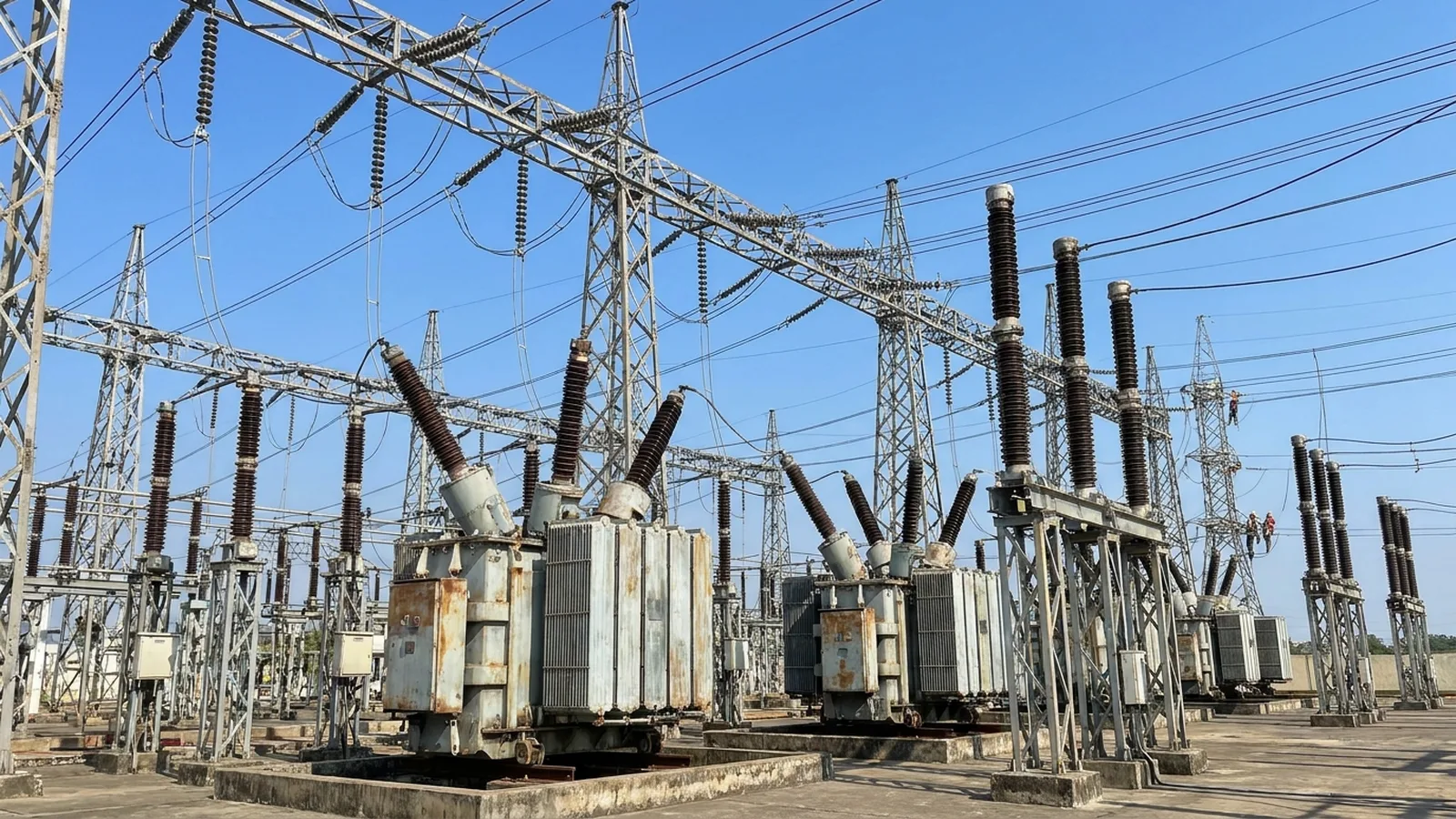
A data centre in India connects through the state discom at the voltage its supply code sets for contract demand: in Tamil Nadu, 110 kV from 10 to 50 MVA and 230 kV above 50 MVA, while Uttar Pradesh moves to 132 or 220 kV above 10 MVA. In the codes we checked, the consumer pays for dedicated lines, take-off bays and a second source. Loads of 50 MW or more can apply to connect directly to the inter-state grid, and a CERC draft of 16 June 2026 would let data centres hold both connections for the same load. The codes do not time-bound the substation and line work that sets the date.
Before you start
- Above roughly 10 MVA, supply moves from 33 kV to 110, 132 or 220 kV from a transmission substation; the exact threshold is in each state’s supply code.
- Telangana’s code makes the consumer pay the full cost of a dedicated feeder, including the take-off arrangement at the substation; Maharashtra’s charges the extra cost of a second source to the consumer.
- Maharashtra’s supply code allows one year where a new distribution substation is needed; we found no state code that sets a timeline for a new 132 kV or 220 kV bay or line.
- Bulk consumers of 50 MW and above may connect directly to the inter-state grid under CERC’s 2022 GNA regulations.
- CERC’s draft of 16 June 2026 on dual connectivity names data centres; CTUIL supported it, Grid-India and CEA opposed it. It is still a draft.
Connection voltage by contract demand, state by state
In Maharashtra, the MERC Supply Code 2021 sets the contract demand each voltage can serve, with higher limits in metropolitan areas and on express feeders:Maharashtra Electricity Regulatory Commission
| Voltage | Contract demand (general) | Metropolitan area or express feeder |
|---|---|---|
| 11 kV | Up to 3,000 kVA | Up to 5,000 kVA |
| 22 kV | Up to 7,500 kVA | Up to 10,000 kVA |
| 33 kV | Up to 10,000 kVA | Up to 20,000 kVA |
| Extra high voltage | Above the 22 and 33 kV limits | Above the 22 and 33 kV limits |
In Tamil Nadu, the supply code categories set 11 or 22 kV up to 3 or 5 MVA depending on the area network, 33 kV up to 10 MVA, 110 kV from 10 to 50 MVA, and 230 kV above 50 MVA.TNPDCL
In Telangana, the commission’s amendment to the general terms and conditions of supply sets the voltage by contracted demand and feeder type:Telangana Electricity Regulatory Commission
| Contracted demand | Telangana, common feeder | Telangana, dedicated feeder |
|---|---|---|
| 5,001 to 10,000 kVA | 33 kV or 132 kV and above | 33 kV |
| 10,001 to 20,000 kVA | 132 kV or above | 33 kV or 132 kV and above |
| Above 20,000 kVA | 132 kV or above | 132 kV or above |
In Uttar Pradesh, the Supply Code 2005 as amended sets 33 kV from 3,000 to 10,000 kVA and 132 or 220 kV above 10,000 kVA. For developers and colonisers above 10,000 kVA, the code calls for a 132 kV feeder from the nearest 132 or 220 kV substation; a 220 kV feeder from the nearest 220 or 400 kV substation is allowed on request if the licensee considers it essential, with clearances from the transmission licensee where necessary.Dakshinanchal Vidyut Vitran Nigam
Who pays for the line, the bay and a second source
In the state supply codes we checked, the consumer pays for a dedicated line, the take-off bay and any second source.Telangana Electricity Regulatory CommissionMaharashtra Electricity Regulatory CommissionDakshinanchal Vidyut Vitran Nigam
- Telangana: supply at 132 kV or above is through a dedicated feeder or a loop-in loop-out arrangement decided by the transmission company, and for a dedicated feeder the consumer pays the full cost of the service line, including take-off arrangements at the substation.
- Maharashtra: the licensee may provide multiple sources of supply if the consumer asks and it is technically feasible, but the additional cost is borne by the consumer, who may also face additional fixed charges set by the Commission.
- Uttar Pradesh: an independent feeder can be given on request if the consumer bears all applicable charges, subject to technical feasibility and availability of a bay and corridor at the substation.
State data centre policies have offered to carry part of this. Tamil Nadu’s 2021 policy promised dual power from the grid for sanctioned loads of 50 MW or more and an additional feeder above 100 MW, for projects incorporated up to 31 March 2026. Uttar Pradesh’s 2021 policy gave dual-grid supply to its first three parks, and its 2026 policy subsidises dual-grid supply for parks. Gujarat’s 2026-29 policy facilitates dual feeders.Government of Tamil Nadu, via National Single Window SystemInvest UPInvest UPCyril Amarchand Mangaldas
How long a data centre grid connection takes
Maharashtra’s supply code sets connection timelines: supply from the existing network within 7 to 30 days, three months where mains must be extended or augmented, and one year where a new distribution substation is needed. We found no state code that sets a timeline for a new 132 kV or 220 kV bay or line; in practice that depends on the transmission utility approving and building the scheme.Maharashtra Electricity Regulatory Commission
Maharashtra’s State Grid Code shows the planning tests a new load is checked against: the intra-state system must withstand the outage of a 132 kV or 220 kV double-circuit line, a 400 kV single-circuit line or a single interconnecting transformer without curtailing load, and a single 220 kV substation should not normally exceed 500 MVA, or a 400 kV substation 2,000 MVA.Maharashtra Electricity Regulatory Commission
Direct connection to the inter-state grid and the 2026 draft
CERC’s GNA Regulations 2022 let a bulk consumer seeking to connect directly to the inter-state transmission system, with a load of 50 MW and above, apply for General Network Access. A 2023 amendment lets such a consumer share that access with subsidiaries connected at the same point.Central Electricity Regulatory CommissionCentral Electricity Regulatory Commission
On 16 June 2026 CERC published a draft fourth amendment that would let an entity already connected to a state network also connect directly to the inter-state system for the same drawal capacity, with the state transmission utility’s consent. CERC wrote that data centres, green hydrogen plants and smelters may require dual connectivity with round-the-clock, economical power. The nodal agency would grant access only after technical studies. CTUIL supported the proposal; Grid-India opposed it over control-area and scheduling issues, and CEA opposed it as leading to a sub-optimal transmission system. As of 21 November 2026 we had not seen a final notification.Central Electricity Regulatory Commission
The same memorandum quotes CTUIL saying it has difficulty finalising transmission for about 33 GW of renewable connectivity partly because of uncertainty in bulk loads like green hydrogen and data centres. For a developer, that is the planning gap: transmission for a load gets built when the load is credible on paper.Central Electricity Regulatory Commission
Data centre parks with their own distribution
Maharashtra’s industries department notified 25 areas in Kurla, Chandivali, Marol, Thane, Navi Mumbai and Panvel as data centre parks and units with deemed distribution licences, and an October 2025 energy department order lets notified parks and units set up captive renewable generation and distribution, as reported by Construction World. Structure Research links the shift to Panvel, Taloja and Rasayani to the near-full 6 GW allocation for Navi Mumbai.Construction WorldStructure Research
Electrical inspection before energisation
The CEA (Measures relating to Safety and Electric Supply) Regulations 2023 govern a data centre’s electrical installation before it is energised. Each state notifies the voltage up to which owners may self-certify. Andhra Pradesh set 33 kV in March 2026: installations above 33 kV are inspected by the Electrical Inspector, and generating units above 10 kW need inspection before commissioning. A draft CEA connectivity standard issued in July 2026 would also bring bulk consumers connected at 33 kV and above under common technical standards, as reported by Indian Infrastructure.Central Electricity AuthorityGovernment of Andhra PradeshIndian Infrastructure
How Invariant helps
For a site or shortlist in India, Invariant checks how the site gets power: the discom or transmission connection, the voltage the load falls under, the nearest substations, the open access or captive route and the document behind the MW. We also screen seismic zone, flood history, groundwater status and airport height limits, and map the central and state approvals with the authority behind each. Send the state, the MW and the date you need power.
More on data centres in India
Questions that come up.
At what voltage does a data centre connect in India?
Above about 10 MVA, usually at 110 kV to 230 kV, with the threshold set by each state’s supply code and the contract demand. In Tamil Nadu, 110 kV from 10 to 50 MVA and 230 kV above 50 MVA; in Uttar Pradesh, 132 or 220 kV above 10 MVA; in Telangana, 132 kV or above beyond 10 MVA on a common feeder or 20 MVA on a dedicated one; in Maharashtra, extra high voltage above 10 MVA (20 MVA in metro areas).TNPDCLDakshinanchal Vidyut Vitran NigamTelangana Electricity Regulatory CommissionMaharashtra Electricity Regulatory Commission
Who pays for a dedicated 132 kV or 220 kV line to a data centre?
The consumer, in the codes we checked. Telangana’s code makes the consumer pay the full cost of a dedicated feeder including take-off at the substation, and Uttar Pradesh gives independent feeders if the consumer bears the charges and a bay is available.Telangana Electricity Regulatory CommissionDakshinanchal Vidyut Vitran Nigam
Can a data centre in India connect directly to the inter-state transmission system?
Yes, if its load is 50 MW or more: CERC’s GNA Regulations 2022 let bulk consumers apply for direct connection to the inter-state system. A June 2026 CERC draft would also allow dual state and inter-state connection for data centres; it is not final.Central Electricity Regulatory CommissionCentral Electricity Regulatory Commission
What is dual grid supply for a data centre?
Supply from two independent sources so one outage does not drop the site. Maharashtra allows it on request with the extra cost borne by the consumer; Tamil Nadu’s 2021 and Uttar Pradesh’s data centre policies offered it to large loads and parks.Maharashtra Electricity Regulatory CommissionGovernment of Tamil Nadu, via National Single Window SystemInvest UP
How long does it take to get a power connection for a data center in India?
Maharashtra’s code sets one year where a new distribution substation is needed. No state code we found sets a timeline for a new 132 kV or 220 kV bay or line, which depends on the transmission utility building the scheme.Maharashtra Electricity Regulatory Commission
Sources and references.
Primary sources checked for this guide on . The location, equipment, and operating plan determine which requirements apply to a project.
- Maharashtra Electricity Regulatory CommissionMERC Electricity Supply Code and Standards of Performance Regulations 2021 ↗
- TNPDCLCategories of supply (Tamil Nadu Electricity Supply Code) ↗
- Telangana Electricity Regulatory CommissionGTCS amendment on supply voltage by contracted demand (19 October 2022) ↗
- Dakshinanchal Vidyut Vitran NigamUP Electricity Supply Code 2005, salient features ↗
- Government of Tamil Nadu, via National Single Window SystemTamil Nadu Data Centre Policy 2021 ↗
- Invest UPUP Data Centre Policy 2021 ↗
- Invest UPUttar Pradesh Data Centre Policy 2026 ↗
- Cyril Amarchand MangaldasGujarat Data Center Policy 2026-2029 ↗
- Maharashtra Electricity Regulatory CommissionMERC State Grid Code Regulations 2020 ↗
- Central Electricity Regulatory CommissionCERC (Connectivity and General Network Access to the inter-State Transmission System) Regulations 2022 ↗
- Central Electricity Regulatory CommissionGNA Regulations, First Amendment (1 April 2023) ↗
- Central Electricity Regulatory CommissionDraft GNA Fourth Amendment, explanatory memorandum (16 June 2026) ↗
- Construction WorldMaharashtra allows data centres to generate green power ↗
- Structure ResearchMumbai and Pune data centre report 2026 ↗
- Central Electricity AuthorityCEA (Measures relating to Safety and Electric Supply) Regulations 2023 ↗
- Government of Andhra PradeshG.O.Ms.No.17 (Energy), implementation of the CEA safety regulations 2023 (11 March 2026) ↗
- Indian InfrastructureCEA issues draft Technical Standards for Connectivity to the Grid Regulations 2026 ↗